/ / News

The Guardian’s just published my latest column, “Developers still finding that it pays to get in the game,” about the increasingly prevalent online game practice of selling items to players, and the parallels this has to the download wars:

Official, game-sponsored exchanges for real-money trades (RMTs) are more than places where players can swap goods for money. Fundamentally, these exchanges act as an honest broker between two extremely different types of player: cash-rich/time-poor players (people with jobs, for the most part) and time-rich/cash-poor players (retirees and young people). Seen through this lens, a “game” is just a bunch of applied psychology that makes kids work long hours to earn virtual gewgaws that adults are trained to desire. In this “Free to play, pay for stuff” world, kids are alienated from the product of their leisure by a marketplace where the game-company skims a piece off of every transaction.

The psychology of this is fascinating, since it all only works to the extent that the game remains “fun”. One key element is that skilled players (eg kids) must not feel like the rich players are able to buy their way into positions of power. Game devs are advised to sell defensive items – shields, armour, dodging spells, but not offensive ones. A skilled player will still be able to clobber a heavily armoured rich player, given enough time (and skilled players have nothing but time, by definition), but may quit in disgust at the thought that some rich wanker is able to equip himself with a mega-powerful sword or blaster that gives him ultimate killing power. No one wants to play in a game where one player has an “I win” button.

For me, the most fascinating thing about this is how it can be seen as the application of the business model that downloaders have been advocating since Napster: “Don’t sue the kids who download your music or movies, rather, see them as the marketing that sells the same media to cash-rich adults who lack the time to use P2P software.”

Developers still finding that it pays to get in the game

/ / Futuristic Tales Of The Here And Now, News

Last year, IDW published a collection of six comics adapted from my short stories called Cory Doctorow’s Futuristic Tales of the Here and Now, all of these stories also licensed under Creative Commons.

Now, Robot Comics, a firm that provides comics for Android mobile phones, has begun to make the comics available free under the same CC license for mobile phones, beginning with my story Anda’s Game (which was also included in my short story collection Overclocked, and podcasted as a reading by Alice Taylor of Wonderland. The adaptation is by the excellent Dara Naraghi, illustrated by Esteve Polls.

The story is a riff on the way that property-rights are coming to games, and on the bizarre spectacle of sweat-shops in which children are paid to play the game all day in order to generate eBay-able game-wealth. When I was a kid, there were arcade kings who would play up Gauntlet characters to maximum health and weapons and then sell their games to nearby players for a dollar or two — netting them about $0.02 an hour — but this is a very different proposition indeed.

Cory Doctorow’s Anda’s Game

Previously:

/ / News

The Serbian City Magazine just published the first-ever interview with me in Serbo-Croatian!

Gomila mojih prijatelja je napisala knjige za mlade i odlično su se zabavljali. Moja prijateljica Kathe Koja je bila poznata horor spisateljica koja je pisala veoma živopisan horor, kada je, za svaki slučaj, odlučila da piše te skoro hemingvejske romane za mlade(ž). Iskustva koja mi je opisala su bila tako cool, pisati za decu koja ne čitaju samo iz zabave nego iz potrebe da prokljuve kako svet funkcioniše.

Povratna informacija koju je dobila je bila tako otvorena i iskrena i ona je bila tako jako, jako, jako uzbuđena da je promenila žanr.

Druga stvar koju sam želeo je bila da napišem roman u kom tehnologija zbilja funkcioniše, gde je tehnologija – prava tehnologija. Mislio sam da je young adult pravi žanr za to. U fikciji prozi za mlade postoji časna tradicija pisanja o tome kako tehnologija radi – prave lekcije – i stvarno mi se sviđao taj način rada. [Robert Anson] Heinlein je bio veliki zagovornik toga. Kada sam bio dete dosta sam saznao o finansijama i politici u knjigama kao što je Have Space Suit—Will Travel. Moja knjiga (Little Brother) je neka vrsta radikalne, političke Have Space Suit—Will Travel. Tako da se literatura za mlade nametnula kao pravi žanr za taj posao.

Intervju: Cory Doctorow

(Thanks, Zoran!)

/ / News, Someone Comes to Town, Someone Leaves Town


Web Webster writes, “Enjoying the podcast of Someone Comes To Town Someone Leaves Town. Excellent hearing it read by the author and I’m amazed at how much I didn’t pick up the first time I read it. Wanted to share a link to a Flickr set I shot this weekend. We went to Smithville, Tennessee to The Joe C. Evins Center for Craft and its annual Celebration. In wandering through the Ceramics building I ran across a set of pieces that immediately recalled the Golems from Someone.”

The Golems and pieces of Davey

/ / News, Podcast

Roy Trumbull has just posted his latest installment in his podcast readings of science fiction stories, and for this one he’s chosen my story “To Market, To Market: The Branding of Billy Bailey,” which was published in my first short story collection A Place So Foreign and Eight More. Roy really nailed the reading — this is one of my more comic stories, about elementary school kids who worry endlessly about their personal brands and sponsorship opportunities.

Billy and Principal Andrew Alty went all the way back to kindergarten, when Billy had convinced Mitchell McCoy that the green fingerpaint was Shamrock Shake, and watched with glee as the little babyface had scarfed it all down. Billy knew that Andrew Alty knew his style: refined, controlled, and above all, personal. Billy never would’ve dropped a dozen M-80s down the girls’ toilet. His stuff was always one-on-one, and possessed of a degree of charm and subtlety.

But nevertheless, here was Billy, along with the sixth-grade bumper-crop of nasty-come-latelies, called on the carpet in front of Andrew Alty’s massive desk. Andrew Alty was an athletic forty, a babyface true-and-through, and a charismatic thought-leader in his demographic.

To Market, To Market: The Branding of Billy Bailey by Cory Doctorow

MP3 Link

/ / A Place So Foreign and Eight More, News

Roy Trumbull has just posted his latest installment in his podcast readings of science fiction stories, and for this one he’s chosen my story “To Market, To Market: The Branding of Billy Bailey,” which was published in my first short story collection A Place So Foreign and Eight More. Roy really nailed the reading — this is one of my more comic stories, about elementary school kids who worry endlessly about their personal brands and sponsorship opportunities.

Billy and Principal Andrew Alty went all the way back to kindergarten, when Billy had convinced Mitchell McCoy that the green fingerpaint was Shamrock Shake, and watched with glee as the little babyface had scarfed it all down. Billy knew that Andrew Alty knew his style: refined, controlled, and above all, personal. Billy never would’ve dropped a dozen M-80s down the girls’ toilet. His stuff was always one-on-one, and possessed of a degree of charm and subtlety.

But nevertheless, here was Billy, along with the sixth-grade bumper-crop of nasty-come-latelies, called on the carpet in front of Andrew Alty’s massive desk. Andrew Alty was an athletic forty, a babyface true-and-through, and a charismatic thought-leader in his demographic.

To Market, To Market: The Branding of Billy Bailey by Cory Doctorow

Previously:

/ / News

My latest Guardian column, “Authors have lost the plot in Kindle battle,” argues that the Authors’ Guild is nuts to focus on the text-to-speech feature, and should really be paying attention to the fact that it’s apparently possible to remotely disable features in the ebook reader.

Maybe I’m right and maybe I’m wrong, but the important thing is, we don’t need new theories about copyright law to test the proposition. The existing, totally non-controversial aspect of copyright law that says, “Amazon can’t publish and sell my book without my permission” covers the territory nicely.

But while we were all running our mouths about the plausibility of the singularity emerging from Amazon’s text-to-speech R&D, a much juicier issue was escaping our notice: it is technically possible for Amazon to switch off the text-to-speech feature for some or all books.

That’s a hell of a thing, isn’t it? Now that Amazon has agreed with the Authors Guild that text-to-speech will only be switched on for authors who sign a contract permitting it, we should all be goggling in amazement at the idea that this can be accomplished.

Authors have lost the plot in Kindle battle

French fan-translation (Eric Moreau)

/ / News

Charlie Stross and I are doing a benefit talk for the Open Rights Group on May 1 in London, entitled “Resisting the all-seeing eye.” Hope to see you there — Stross is a ball, and ORG is a damned worthy cause, especially in this era of ubiquitous surveillance.


From technologies like PGP and Tor to the arguments that will convince people – friends and family as well as media and politicians – to watch out for their digital rights, this event is your anti-surveillance 101.

Cory Doctorow – science fiction novelist, blogger and technology activist – and Charlie Stross – science fiction writer and former programmer and pharmacist – will share how and why to control your data. The event will be moderated by Ian Brown – academic, activist and Blogzilla.

The entry price is either joining Open Rights Group – by handing door staff a completed form (link to PDF) – or making a one-off £10 donation on the door. Please register for tickets here. Drinks will be available, as is The Three Kings – a local pub – to continue the debate.

What: Doctorow and Stross: Resisting the all-seeing eye
When: 1830, Friday 1 May 2009
Where: Crypt on the Green, St James Church, Clerkenwell, Clerkenwell Close, London, EC1R 0EA – Map

Event – Doctorow and Stross: Resisting the all-seeing eye

/ / Little Brother, News

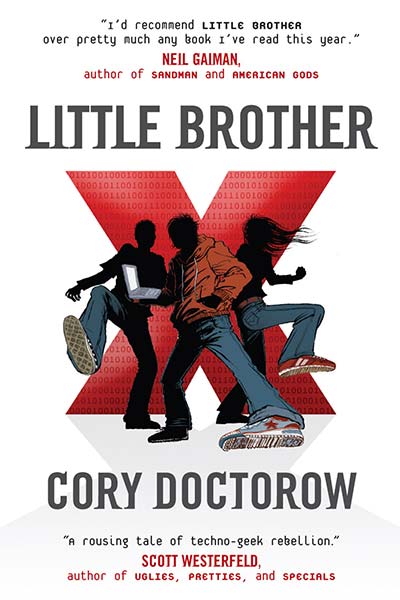
The Libertarian Futurist Society has released its slate of nominees for this year’s Prometheus Awards, the award for the best “pro-freedom” science fiction of the year. I’m proud to say that my novel Little Brother made the cut, as did five other standout books, including a couple personal favorites: Half a Crown by Jo Walton and Saturn’s Children by Charlie Stross.

* Matter, by Iain Banks (Orbit Books) – Part of Banks’ series of far-future space operas about the Culture, a utopia which reflects Banks’ interest in anarchism through its avoidance of the use of force except when necessary for protection and defense. The novel focuses on an agent in Special Circumstances, the Culture’s special forces unit, who returns to her home planet, a “shellworld” with multiple layers of habitation, after her father has been killed in a coup.

* Little Brother, by Cory Doctorow (TOR Books) – A cautionary tale about a high-school student and his friends who are rounded up in the hysteria following a terrorist attack, the novel focuses on how people find the courage to respond to oppression.

* The January Dancer, by Michael Flynn (TOR Books) -The classic space opera, set in an interstellar civilization created by a wide-ranging human diaspora, revolves around how discovery of a an alien relic sends agents of a multisystem federation on a quest that exposes them to political and economic institutions of many different cultures and requires them to deal with threats to freedom, from piracy to political corruption.

* Saturn’s Children, by Charles Stross (Ace Books) -A robot’s adventures after all the humans in a society have died raises complex issues of ethics, duty, family and struggle in this Heinlenesque novel.

* Opening Atlantis, by Harry Turtledove (Penguin/Roc Books) – Set in a world where medieval Europeans discover an island continent in the Atlantic Ocean, this first novel in a new atternate-history series explores the politics of colonization and the struggle for self-determination while offering parallels and contrasts with development of the Americas.

* Half a Crown, by Jo Walton (TOR Books) -The sequel to Walton’s Prometheus Award-winning Ha’penny concludes her alternative-history trilogy, set two decades after Britain reached accommodation with Hitler’s Germany in the 1940s, with a chilling portrait of people all too willing to trade freedom for security.

2009 PROMETHEUS AWARDS FINALISTS ANNOUNCED