/ / Little Brother, News, Remixes

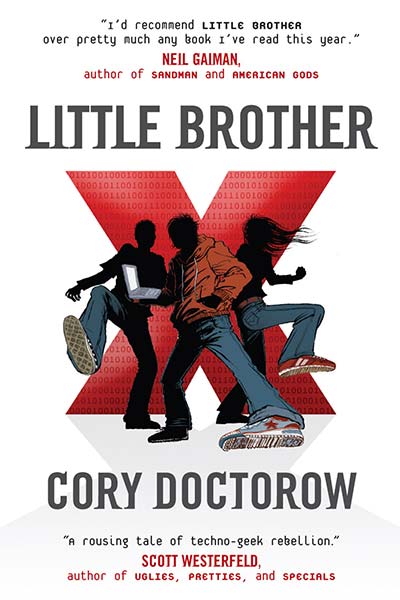
Bruce M Campbell created a lovely alternative PDF of Little Brother:

I took the HTML version, ran some type-cleaning things on it, and restyled it using, of all things, Apple’s Pages 8. I thought about using Adobe InDesign, but as my intention was to produce this as a PDF, thought that ID would be over-kill.

I’ve styled it as I thought it appropriate to the subject matter and the fonts I have on my system.

I’ve used Rockwell for the the Chapter titles and heads as I think the sardonicness of the “All-American” feel covers the “on-message” hypocrisy of the overall government policy here, and Minion Pro for the body, because I think it’s a very readable font, and the innate typography, especially with the punctuation characters, makes it disappear for the reader. For novelty, I’ve used Orator for the IM texts, and ITC AMerican Typewriter for the literary extracts.

/ / Little Brother, News

Today I found myself surrounded by hundreds and hundreds of enthusiastic, high-school age readers from the Ontario school system, and was honoured to receive a popular award for best Canadian young adult novel of 2008. The award was the White Pine, part of the Ontario Library Association’s “Forest of Reading” program — librarians nominate ten books in each of several age-divided categories and students from across the province are encouraged to read all ten on the roster and vote for their favourite.

All in all, 250,000 students participate in Forest of Reading, and over 8,000 were in attendance today for the awards ceremony at Harbourfront in Toronto. I was mobbed by group after group of vibrant, intelligent, engaged students, passionate readers who wanted to talk about my book and the other books they’d enjoyed (the other nine nominees were all very good, and the authors were fascinating people).

To top it all off, I was delighted to discover that Little Brother won the White Pine award, making it the popular choice for best YA book among Ontario’s high-school students. I could not be more delighted!

/ / News

Today I found myself surrounded by hundreds and hundreds of enthusiastic, high-school age readers from the Ontario school system, and was honoured to receive a popular award for best Canadian young adult novel of 2008. The award was the White Pine, part of the Ontario Library Association’s “Forest of Reading” program — librarians nominate ten books in each of several age-divided categories and students from across the province are encouraged to read all ten on the roster and vote for their favourite.

All in all, 250,000 students participate in Forest of Reading, and over 8,000 were in attendance today for the awards ceremony at Harbourfront in Toronto. I was mobbed by group after group of vibrant, intelligent, engaged students, passionate readers who wanted to talk about my book and the other books they’d enjoyed (the other nine nominees were all very good, and the authors were fascinating people).

To top it all off, I was delighted to discover that Little Brother won the White Pine award, making it the popular choice for best YA book among Ontario’s high-school students. I could not be more delighted!

/ / News

In my latest Guardian column, “When love is harder to show than hate,” I look at the fact that copyright protects critics who want to talk trash about creative works, but gives no real protection to people who want to say nice things about them.

The damage here is twofold: first, this privileges creativity that knocks things down over things that build things up. The privilege is real: in the 21st century, we all rely on many intermediaries for the publication of our works, whether it’s YouTube, a university web server, or a traditional publisher or film company. When faced with legal threats arising from our work, these entities know that they’ve got a much stronger case if the work in question is critical than if it is celebratory. In the digital era, our creations have a much better chance of surviving the internet’s normal background radiation of legal threats if you leave the adulation out and focus on the criticism. This is a selective force in the internet’s media ecology: if you want to start a company that lets users remix TV shows, you’ll find it easier to raise capital if the focus is on taking the piss rather than glorifying the programmes.

Second, this perverse system acts as a censor of genuine upwellings of creativity that are worthy in their own right, merely because they are inspired by another work. It’s in the nature of beloved works that they become ingrained in our thinking, become part of our creative shorthand, and become part of our visual vocabulary. It’s no surprise, then, that audiences are moved to animate the characters that have taken up residence in their heads after reading our books and seeing our movies. The celebrated American science-fiction writer Steven Brust produced a fantastic, full-length novel, My Own Kind of Freedom, inspired by the television show Firefly. Brust didn’t – and probably can’t – receive any money for this work, but he wrote it anyway, because, he says, “I couldn’t help myself”.

When love is harder to show than hate

/ / News

In my latest Internet Evolution column, “Digital Licensing: Do It Yourself,” I propose a new kind of self-serve, lightweight “commercial commons” that would allow makers to do small-scale commercial manufacturing of goods that remix copyrights and trademarks, with no upfront payments, and a fixed royalty rate that lets the makerverse operate as a giant, well-compensated R&D lab for products you should be selling:

From edge to edge, the Net is filled with creators of every imaginable tchotchke – and quite a lot of them are for sale.

And quite a lot of that is illegal.

That’s because culture isn’t always non-commercial. All around the physical world, you can find markets where craftspeople turn familiar items from one realm of commerce into handicrafts sold in another realm.

I have a carved wooden Coke bottle from Uganda, a Mickey Mouse kite from Chile, a set of hand-painted KISS matrioshkes from Russia. This, too, is a legitimate form of commerce, and the fact that the villager who carved my Coke bottle was impedance-mismatched with Coke and didn’t send a lawyer to Atlanta to get a license before he started carving isn’t a problem for him, because Coke can’t and won’t enforce against carvers in small stalls in marketplaces in war-torn African nations.

If only this were true for crafters on the Net. Though they deploy the same cultural vocabulary as their developing-world counterparts for much the same reason (it’s the same reason Warhol used Campbell’s soup cans), they don’t have obscurity on their side. They live by the double-edged sword of the search-engine: The same tool that enables their customers to find them also enables rights-holders to discover them and shut them down.

It doesn’t have to be this way.

Digital Licensing: Do It Yourself

/ / News

My latest Guardian column, “Transparency means nothing without justice,” is up. I wrote this before the G20 debacle (it was delayed due to an administrative problem at the Guardian), but all the points are just as relevant to the G20’s climate camp as they are to last summer’s version of it.

And here’s where transparency breaks down. We’ve known about all this since last August – seven months and more. It was on national news. It was on the web. Anyone who cared about the issue knew everything they needed to know about it. And everyone had the opportunity to find out about it: remember, it was included in national news broadcasts, covered in the major papers – it was everywhere.

And yet … nothing much has happened in the intervening eight months. Simply knowing that the police misbehaved does nothing to bring them to account.

Transparency means nothing unless it is accompanied by the rule of law. It means nothing unless it is set in a system of good and responsible government, of oversight of authority that expeditiously and effectively handles citizen complaints. Transparency means nothing without justice.

Transparency means nothing without justice

/ / News

The Locus Award shortlist has been posted — this is the list of the best science fiction books and stories of the year, as chosen by the general public. I’m immensely gratified to say that I’m on the list three times, for my young adult novel Little Brother, my collaborative novella True Names (with Ben Rosenbaum), and my novelette The Things that Make Me Weak and Strange Get Engineered Away.

The whole list is a great jumping-off point for exploring the best written sf and fantasy of 2008!

2009 Locus Award Finalists

/ / Little Brother, News

The Locus Award shortlist has been posted — this is the list of the best science fiction books and stories of the year, as chosen by the general public. I’m immensely gratified to say that I’m on the list three times, for my young adult novel Little Brother, my collaborative novella True Names (with Ben Rosenbaum), and my novelette The Things that Make Me Weak and Strange Get Engineered Away.

The whole list is a great jumping-off point for exploring the best written sf and fantasy of 2008!

2009 Locus Award Finalists

/ / Little Brother, News

Cam writes in with just about the perfect parable about why DRM just sucks:

I thought you’d be amused to hear the circumstances which caused me to pick up and read Little Brother.

Being a pretty big nerd (I’m a tech director at Electronic Arts by day), I was excited to pick up a Sony ebook reader. I got the last one in the shop, which was actually a return – but the sales guy assured me that they’d “reconditioned it”.

After taking it home and installing Sony’s terrible, terrible ebook software I was only moderately surprised to find that I couldn’t “authorise” my new reader to read their DRM-laden ebooks. It gave me the always helpful error code of “3-013”. Googling this code told me that (of course) the reader was already authorised (presumably to the person who bought it the first time).

I contacted Sony’s only means of support, which was a web form on their site. Hours later, I received a response telling me that I needed to call their support line, which was open until 6PM. Naturally this email arrived at 5:58PM, and the support line kindly informed me that I should call back the next day. I think their time calculation function must suffer from some floating point inaccuracy.

Cursing my now apparently totally useless $300 device, I decided to read a free ebook to tide me over until I could call Sony the next day. I’m a regular boing boing reader and remembered your posts on Little Brother, so I downloaded it and started reading.

Needless to say, not only did I really enjoy reading it (and yes I know it’s nominally a book for kids!) but I’ve yet to make that call to authorise my device, and I’ve been reading more Creative Commons-licensed books.

So long story short, DRM turned me onto Little Brother and onto other CC-licensed works. I thought you might find that amusing.

Regards,
Cam Dunn

PS Nice work making Little Brother technically accurate in so many ways (ignoring the “near future” technologies). I get the impression that you’d lose your tech-savvy kid readers these days if you didn’t get that stuff so right.

/ / News

Cam writes in with just about the perfect parable about why DRM just sucks:

I thought you’d be amused to hear the circumstances which caused me to pick up and read Little Brother.

Being a pretty big nerd (I’m a tech director at Electronic Arts by day), I was excited to pick up a Sony ebook reader. I got the last one in the shop, which was actually a return – but the sales guy assured me that they’d “reconditioned it”.

After taking it home and installing Sony’s terrible, terrible ebook software I was only moderately surprised to find that I couldn’t “authorise” my new reader to read their DRM-laden ebooks. It gave me the always helpful error code of “3-013”. Googling this code told me that (of course) the reader was already authorised (presumably to the person who bought it the first time).

I contacted Sony’s only means of support, which was a web form on their site. Hours later, I received a response telling me that I needed to call their support line, which was open until 6PM. Naturally this email arrived at 5:58PM, and the support line kindly informed me that I should call back the next day. I think their time calculation function must suffer from some floating point inaccuracy.

Cursing my now apparently totally useless $300 device, I decided to read a free ebook to tide me over until I could call Sony the next day. I’m a regular boing boing reader and remembered your posts on Little Brother, so I downloaded it and started reading.

Needless to say, not only did I really enjoy reading it (and yes I know it’s nominally a book for kids!) but I’ve yet to make that call to authorise my device, and I’ve been reading more Creative Commons-licensed books.

So long story short, DRM turned me onto Little Brother and onto other CC-licensed works. I thought you might find that amusing.

Regards,
Cam Dunn

PS Nice work making Little Brother technically accurate in so many ways (ignoring the “near future” technologies). I get the impression that you’d lose your tech-savvy kid readers these days if you didn’t get that stuff so right.