Here’s the audio of my talk at UC Irvine this week on copyright and trade policy — a variation on the video I posted of me speaking at Google a couple weeks back.
All About:
Podcast
My Podcast is a regular feed in which I read from one of my stories for a few minutes at least once a week, from whatever friend’s house, airport, hotel, conference, treaty negotiation or what-have-you that I’m currently at. Here’s the podcast feed.
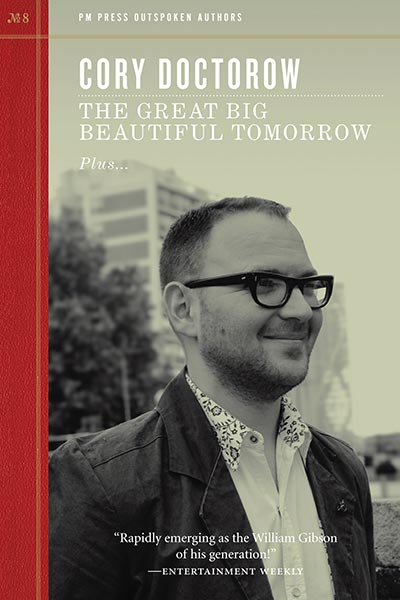
Here’s part five of my podcast of my novella-in-progress called “There’s a Great Big Beautiful Tomorrow/Now is the Best Time of Your Life.”
Here’s part four of my podcast of my novella-in-progress called “There’s a Great Big Beautiful Tomorrow/Now is the Best Time of Your Life.”
On April 28, I did a panel at the LA Times Festival of Books with Kage Baker, John Scalzi and Harry Turtledove, called “Science Fiction: The Road From Here to There.” The LA Times just provided us with the audio for this panel on CD and I’ve secured the permission of my co-panelists to rip the disc and put the audio up on the Internet Archive as an MP3, licensed Creative Commons Attribution-NonCommercial-ShareAlike. Enjoy!
Here’s part three of my podcast of my novella-in-progress called “There’s a Great Big Beautiful Tomorrow/Now is the Best Time of Your Life.”
A couple months back, I did an interview with Sun’s VP of Engineering, Hal Stern. Hal’s an amazing guy, a really smart advocate for open standards and open systems. We had a great conversation:
HS As we start to look at the issues of identity and security and privacy, we also come up with trust. What is the purpose of actually keeping a secret? It’s so you can either control the flow of information where there is no trust or validate information where there’s imperfect trust or less-than-ideal secrecy or less-than-ideal security. You start to build up a model of what particular threats you’re worried about and how those threats represent themselves, and then you can ask, “Well, where is it that I need to go and enforce protection?” Is it keeping things on my laptop that are unencrypted, or is it that if I just keep everything in a network file storage mechanism somewhere, that’s as safe as keeping my money at the bank and just using the ATM for cash and cache, in both homophonic interpretations of the word.
I worry about accidentally divorcing people from their content. In the short-term there are things like theft, or losing your laptop with your book on it. But over longer periods of time, we have to worry about the encoding of the data. Do we actually know how to interpret that five, 10, 50 years from now? I don’t think we have that much experience with it. I think my mom probably asks me at least every six months when she can throw away the paper tape that’s in my old bedroom. It’s a very retro technology placeholder of 25 years ago, but that was the preferred storage and transfer mechanism, lacking anything else, and my Radio Shack TRS-80 with the cassette tape backup was a big improvement over that. It’s hard data, but where are you going to find a KSR 33 Teletype with a paper-tape reader on it? In some museum somewhere…
Update: Here’s the MP3 as well!

Last night, Rudy Rucker and I gave a reading and a fun panel in San Francisco, as part of the SF in SF series hosted by Terry Bisson. Terry and Rudy are two of my favorite writers, and they were absolutely great. Rudy read a wild story about Alan Turing’s efforts to avoid the MI5’s post-war morality squad as he pursues a gay dalliance with a handsome Greek. I read a part of my forthcoming hackers-versus-the-DHS novel Little Brother. Afterwards we talked publishing. Al Billings brought his podcasting rig and recorded the whole thing and he’s already got it online.
(Thanks, Al!)
Here’s part two of my podcast of my novella-in-progress called “There’s a Great Big Beautiful Tomorrow/Now is the Best Time of Your Life.”
I recently did an interview with Oort Cloud, a killer copy-friendly science fiction writing site. We talked a lot about creative process, writing (and, of course, copyright).
I’ve just started podcasting a new story, a novella-in-progress called “There’s a Great Big Beautiful Tomorrow/Now is the Best Time of Your Life.” It’s a long, weird adventure story about the failure of futurism and the difference between “progress” and “change,” all about immortal children stalking the bones of ruined cities in lethal mechas. Disney fans will recognize the title as coming from the amazing, weird, awful and wonderful Carousel of Progress ride that Disney built for GE at the 1964 World’s Fair in NYC, and subsequently moved to Disneyland, then Walt Disney World.
I’m presently about 18,000 words into this — final length is probably somewhere north of 30,000 words — and I’m planning on reading about 30 minutes’ worth of audio every week.
I piloted the mecha through the streets of Detroit, hunting wumpuses. The mecha was a relic of the Mecha Wars, when the nation tore itself to shreds with lethal robots, and it had the weird, swirling lines of all evolutionary tech, channelled and chopped and counterweighted like some freak dinosaur or a racecar.
I loved the mecha. It wasn’t fast, but it had a fantastic ride, a kind of wobbly strut that was surprisingly comfortable and let me keep the big fore and aft guns on any target I chose, the sights gliding along on a perfect level even as the neck rocked from side to side.
The pack loved the mecha too. All six of them, three aerial bots shaped like bats, two ground-cover streaks that nipped around my heels, and a flea that bounded over buildings, bouncing off the walls and leaping from monorail track to rusting hover-bus to balcony and back. The pack’s brains were back in dad’s house, in the old Comerica Park site. When I found them, they’d been a pack of sick dogs, dragging themselves through the ruined city, poisoned by some old materiel. I had done them the mercy of extracting their brains and connecting them up to the house network. Now they were immortal, just like me, and they knew that I was their alpha dog. They loved to go for walks with me.