/ / News, Overclocked

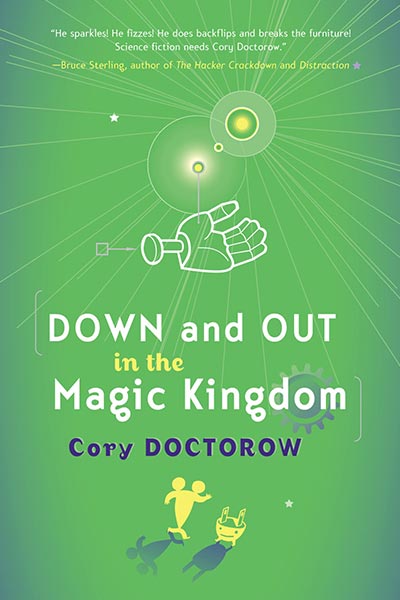
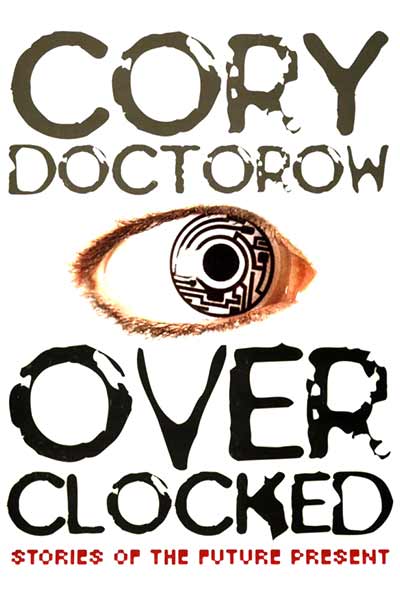
This is the site for my new short story collection, “Overclocked: Stories of the Future Present,” published by Avalon Books in January 2007, exactly four years after my first novel, Down and Out in the Magic Kingdom was published. And just as with Down and Out, this collection is released under a liberal Creative Commons license.

That means you can buy it in a store, or you can download it for free. Or both.

Why would I do this? Because I’m a science fiction writer. That means I have to be attuned to the future, or at least the present. Most people seem to live in the distant past, pausing occasionally to look around, do a spit-take, and say, “Holy hells, when did all this happen?”

I try to live in the present. In my present, bits are easy to copy and they will never get harder to copy. Bits love to be copied. It’s probably in their Buddha nature or something.

In my present, electronic books sell the everlasting crap out of print books. Electronic books are naturally social beasts. They want you to paste them into your email signature, or pass them on to a friend. They want you to talk about them. They want you to search them. They want you to print out favorite chunks and pass them around the office. They want you to beam them from your PDA to a friend’s phone.

In my present, readers who love my work are the most important thing in the world. Readers have told me that they want electronic text and that they want paper text. That each adds value to the other.

So, living in the present, I have wrapped these six stories — intense, personal things that I sweated bullets over, good friends all — in Creative Commons licenses that encourage you to:

* Share them

* Improve on them

* Make new things from them

You’re free to do all this stuff, provided that you:

* Don’t charge money for your new works or copies

* Pass the same freedoms on when you distribute my stories or their offspring

* Don’t put any anti-copying technology (“DRM” “Technological Protection Measures” “Copy-protection”) on my work

I’m doing this because I’m convinced that ebooks sell print books. And because I’m convinced — in the immortal words of Tim O’Reilly — that my biggest problem is obscurity, not piracy.

So make me well known. Adapt my works in ways that make them suitable to your conversation. Tweak the format. Tweak the writing. Make videos. Make art. Make crap! There’s no such thing as a creator who creates alone, from the whole cloth. We all stand on the shoulders of giants. I’m no giant, but my shoulders are available anytime.

Mail me with your hacks, please and thanks! I’d love to hear what you make!

Now, some FAQs:

1. I want to send you money. Where should I send it?

Keep it! If you like the ebooks and you want to reward me, buy the print books. If you don’t want the print books, give them to a library or shelter. If you don’t like libraries or shelters, you should be ashamed of yourself there are other ways to reward me:

* Post a review of the book to your blog, MySpace, LiveJournal or other personal site — and paste it up at BN.com, Powells.com and Amazon.com. Personal endorsements from real readers are the best thing a writer like me can have.

* Attach the stories to an email and send it to five friends telling them why you liked it.

* Remix the stories in some cool way and put them back online.

And if none of that strikes your fancy, don’t sweat it. It’s on me.

2. You are a communist. Writers deserve to get paid.

First of all, that’s not a question.

Secondly, I’m more of a techno-agnostic social-democrat libertarian.

Lastly, I think the idea that writers deserve to get paid sounds great, but the truth is that most writers — nearly all writers — have not been paid through history. The Internet doesn’t change that. But it does make it possible for writers to earn their living in new and exciting ways. That’s what I’m doing here. If you have a scheme to provide full employment to writers, I’d love to hear it, but I think you’re going to have some problems getting it rolling.

Giving writers more copyright doesn’t make them more money. You could give me ten million years of copyright and the right to personally impale anyone who makes an unauthorized copy of my work and it wouldn’t change the word-rate at Asimov’s Science Fiction Magazine.

More copyright just means that working writers have to go through more permissions-clearance hell when they want to create new things from old. More copyright means that dead writers’ works vanish from the historical record because their idiot descendants turn into lunatic saber-rattlers, or because no one can figure out who the right idiot descendant is. More copyright means that the public is denied the benefit of the 98 percent of works in copyright that have no visible owner, and that are out of print.

3. I want to do something commercial with your work. Is that possible?

Hell yeah! Just talk to my agent, Russell Galen, of Scovil Chicak Galen. For film inquiries, talk to my film agent, Justin Manask, of the IP Group.

4. Will you come and speak at my school/company/conference/whatever?

It’s possible. Email me.

/ / News, Overclocked

Interested in getting a personalized, signed copy of Overclocked shipped right to your door? Two booksellers, one in Toronto, the other in Los Angeles, are taking orders for customized copies of Overclocked.

Canada:
Bakka Books, Toronto – Place orders before Feb 1, 2007
Bakka is the world’s oldest science fiction bookstore (I used to work there!). They’re hosting a launch for me on Feb 1 and I’ll sign any special orders then.

Canadian shipping is CDN$10, plus the CDN$19.95 cover price. Inquire for overseas rates.

Bakka Books 697 Queen Street West, Toronto, ONT M6J 1E6, ph 416 963 9993.

USA:
Secret Headquarters, Los Angeles
Secret HQ is my local comics emporium — they’re terrific. I stop by at least once a week to sign special orders.

US shipping is $5, plus the $15.95 cover price. Inquire for overseas rates.

Secret Headquarters: 3817 W Sunset Blvd Los Angeles, CA 90026, 323-666-2228

/ / News

SFRevu magazine has just published a wide-ranging interview with me and a great review of my forthcoming short story collection Overclocked: Stories of the Future Present.


SFRevu: Will ebooks ever get traction? Do you read electronically? How does that experience differ from reading on a full size display and print?

Cory: People already read “ebooks” — that is to say, the majority of readers presently spend the majority of their reading time reading on screens. They don’t read longer form works that way (by and large) and it’s likely they never will. The computer screen has its own affordances that will drive new forms of creativity.

This isn’t just about resolution or form-factor. The point of a computer is that it is multi-purpose, networked, and social. It does lots of things, and it wants your attention to wander around its infinite depths. Long linear narratives just don’t work well in that medium.

I’ll channel a little Eric Flint here. Reading novels has always been a minority pass-time, and the people who read novels fetishize the form factor the way that, say, a classic car hobbyist loves his tailfins. I recently wrote an op-ed for Forbes where I described these people as “pervy for paper” (I count myself among them). For us, the paper codex has value that has nothing to do with its technical merit.

Link to interview,

Link to review

/ / News

My story, “When Sysadmins Ruled the Earth” has been published in the magazine The Rake, including the online edition. You may remember the earlier podcast of the story, which tells the tale of gangs of sysadmins stuck in the world’s data-centers as a string of nuclear, biological and conventional attacks herald the end of the Earth. The story will also appear in my forthcoming short story collection Overclocked, which will be published later this month.

“Main routers not responding. BGP not responding.” The mechanical voice of the systems monitor didn’t care if he cursed at it, so he did, and it made him feel a little better.

“Maybe I can fix it from here,” he said. He could log in to the UPS for the cage and reboot the routers. The UPS was in a different netblock, with its own independent routers on their own uninterruptible power supplies.

Kelly was sitting up in bed now, an indistinct shape against the headboard. “In five years of marriage, you have never once been able to fix anything from here.” This time she was wrong—he fixed stuff from home all the time, but he did it discreetly and didn’t make a fuss, so she didn’t remember it. And she was right, too—he had logs that showed that after 1:00 a.m., nothing could ever be fixed without driving out to the cage. Law of Infinite Universal Perversity—aka Felix’s Law.

Link

Podcast: Part 1,
Part 2,
Part 3,
Part 4,
Part 5,
Part 6

/ / News

I’m heading out for a couple weeks’ holidays now — back on January 2. Taking a cue from danah boyd, I’m discarding all the mail that comes in between now and then; that way I won’t come back from hols with a million emails shouting for my attention and harshing my mellow. It’s a good way of managing holiday away-time, keeping work from creeping into downtime — I’m seeing it more and more.

Of course, the rest of the gang will still be here. If you want to submit a Boing Boing suggestion, use the form. I just delete Boing Boing suggestions I get by email, anyway, so this is always the right thing to do, no exceptions, ever, period.

If you want to talk to someone about doing business with Boing Boing, visit FM Publishing.

If you’re looking to talk to someone about licensing some of my stories or novels, or commissioning a speech, article or whatnot, contact my agent, Russell Galen.

Have a great holiday, everyone! See you in 07!

Cory

/ / News

Last week I did an interview with Tom from the Command Line podcast, and I was immediately struck by how knowledgeable and quick Tom was on the subjects that I care about — technology, civil liberties, and social change. Curious, I downloaded some of the previous episodes of his podcast and found them to be even better than I’d hoped — thoughtful, informative, and deep, a real plunge into the geeky end of the news-pool. There’s great analysis and rumination, as well as detailed explanations of important security issues with common OSes and so on. Tom’s just posted the episode with my interview, but don’t stop there — I’ve added this one to my subscription list.

Link, Podcast feed link, iTunes “enhanced” podcast feed link

/ / News

Lirevite is a new, free/open speed-reading program for mobile devices that displays a long text one word at a time, quickly. The three initial test books for the system were my novels Down and Out in the Magic Kingdom, Eastern Standard Tribe, and Someone Comes to Town, Someone Leaves Town.

/ / News

Alexandre Hervaud from Fragil, a French website, did a short interview with me last month in Nantes at the Utopiales convention and he’s just posted it:

Le copyright est justement l’objet de sa venue aux Utopiales où il donne une conférence à ce sujet. Activiste, il est convaincu de l’absurdité d’un copyright excessif.

« Le copyright, c’est un monopole qui a tendance à entraîner des concentrations. Désormais, dans le domaine artistique, on a 3 ou 4 compagnies qui contrôlent la musique, et autant pour le cinéma et l’édition… D’une certaine manière, c’est comme un retour au mécénat, l’ancêtre du copyright, lorsqu’un artiste ne pouvait exercer son talent qu’avec l’appui des puissants, et pas autrement. Le pape ou le PDG d’Universal, c’est du pareil au même. »

Son baladeur mp3 à portée d’oreilles, il voit le Web comme une chance pour l’Art. « Avec des coûts de distribution très bas, Internet permet à un plus grand nombre de personnes de participer aux pratiques artistiques. L’offre s’en trouve considérablement augmentée, ce qui permet de satisfaire différents publics. »

Link