I’ve got a old-fashioned link-blog, Pluralistic, where I post a daily list of links with commentary and analysis. If you’d prefer to get it as a newsletter, you can subscribe to the Plura-list. Both are free from surveillance and advertising.

This week on my podcast, I read “By all means, tread on those people,” a recent column from my Pluralistic newsletter; about the way that the American descent in fascism is connected to its abandonment of the rule of law more broadly:
Just as Martin Niemöller’s “First They Came” has become our framework for understanding the rise of fascism in Nazi Germany, so, too is Wilhoit’s Law the best way to understand America’s decline into fascism:
In case you’re not familiar with Frank Wilhoit’s amazing law, here it is:
Conservatism consists of exactly one proposition, to wit: There must be in-groups whom the law protects but does not bind, alongside out-groups whom the law binds but does not protect.
The thing that makes Wilhoit’s Law so apt to this moment – and to our understanding of the recent history that produced this moment – is how it connects the petty with the terrifying, the trivial with the radical, the micro with the macro. It’s a way to join the dots between fascists’ business dealings, their interpersonal relationships, and their political views. It describes a continuum that ranges from minor commercial grifts to martial law, and shows how tolerance for the former creates the conditions for the latter.

It’s the 500th edition of my podcast, and to celebrate, I’m bringing you an hour-long excerpt from the audiobook of my forthcoming book Enshittification: Why Everything Suddenly Got Worse and What To Do About It (Farrar, Straus and Giroux US/Canada; Verso UK/Commonwealth).
Because Amazon won’t carry my audiobooks (or any DRM-free audiobooks), I have to produce my own books and pre-sell them on Kickstarter campaigns. The Kickstarter for this one is underway and going great.
I hope that listening to this long sample will convince you to pre-order your copy! I don’t ask for Patreon donations, I don’t put ads on my work – these Kickstarters are a big part of why I’m able to pursue my open access, enshittification-free publishing program, and I really thank you for your support.

This week on my podcast, I conclude my reading of my 2003 Asimov’s Science Fiction Magazine story, Nimby and the D-Hoppers” (here’s the first half). The story has been widely reprinted (it was first published online in The Infinite Matrix in 2008), and was translated (by Elisabeth Vonarburg) into French for Solaris Magazine, as well as into Chinese, Russian, Hebrew, and Italian. The story was adapted for my IDW comic book series Cory Doctorow’s Futuristic Tales of the Here and Now by Ben Templesmith. I read this into my podcast 20 years ago, but I found myself wanting to revisit it.
Don’t get me wrong — I like unspoiled wilderness. I like my sky clear and blue and my city free of the thunder of cars and jackhammers. I’m no technocrat. But goddamit, who wouldn’t want a fully automatic, laser-guided, armor-piercing, self-replenishing personal sidearm?
Nice turn of phrase, huh? I finally memorized it one night, from one of the hoppers, as he stood in my bedroom, pointing his hand-cannon at another hopper, enumerating its many charms: “This is a laser-guided blah blah blah. Throw down your arms and lace your fingers behind your head, blah blah blah.” I’d heard the same dialog nearly every day that month, whenever the dimension-hoppers catapaulted into my home, shot it up, smashed my window, dived into the street, and chased one another through my poor little shtetl, wreaking havoc, maiming bystanders, and then gateing out to another poor dimension to carry on there.
Assholes.
It was all I could do to keep my house well-fed on sand to replace the windows. Much more hopper invasion and I was going to have to extrude its legs and babayaga to the beach. Why the hell was it always my house, anyway?
This week on my podcast, I once again read my 2003 Asimov’s Science Fiction Magazine story, Nimby and the D-Hoppers” The story has been widely reprinted (it was first published online in The Infinite Matrix in 2008), and was translated (by Elisabeth Vonarburg) into French for Solaris Magazine, as well as into Chinese, Russian, Hebrew, and Italian. The story was adapted for my IDW comic book series Cory Doctorow’s Futuristic Tales of the Here and Now by Ben Templesmith. I read this into my podcast 20 years ago, but I found myself wanting to revisit it.
Don’t get me wrong — I like unspoiled wilderness. I like my sky clear and blue and my city free of the thunder of cars and jackhammers. I’m no technocrat. But goddamit, who wouldn’t want a fully automatic, laser-guided, armor-piercing, self-replenishing personal sidearm?
Nice turn of phrase, huh? I finally memorized it one night, from one of the hoppers, as he stood in my bedroom, pointing his hand-cannon at another hopper, enumerating its many charms: “This is a laser-guided blah blah blah. Throw down your arms and lace your fingers behind your head, blah blah blah.” I’d heard the same dialog nearly every day that month, whenever the dimension-hoppers catapaulted into my home, shot it up, smashed my window, dived into the street, and chased one another through my poor little shtetl, wreaking havoc, maiming bystanders, and then gateing out to another poor dimension to carry on there.
Assholes.
It was all I could do to keep my house well-fed on sand to replace the windows. Much more hopper invasion and I was going to have to extrude its legs and babayaga to the beach. Why the hell was it always my house, anyway?

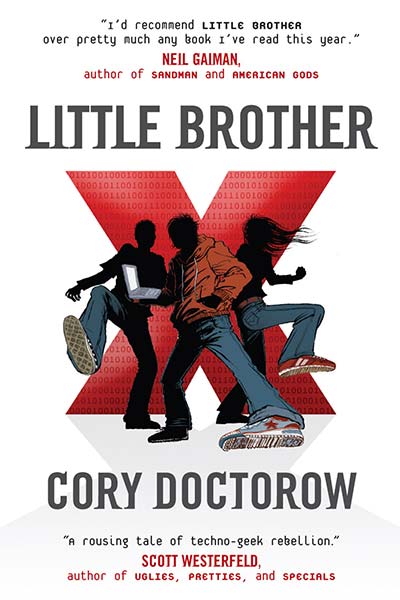
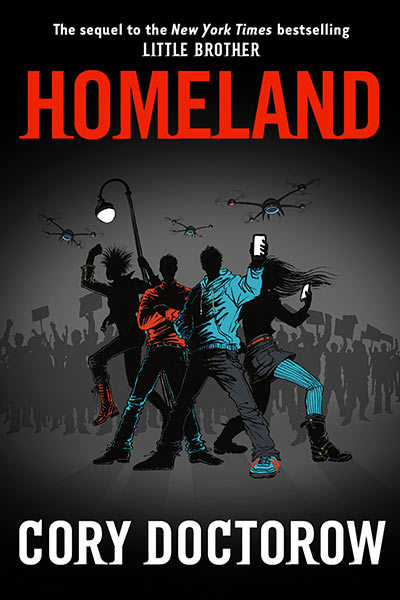
This week on my podcast, I read part four of “Spill“, a new Little Brother story commissioned by Clay F Carlson and published on Reactor, the online publication of Tor Books. Also available in DRM-free ebook form as a Tor Original.
I didn’t plan to go to Oklahoma, but I went to Oklahoma.
My day job is providing phone tech support to people in offices who use my boss’s customer-relationship management software. In theory, I can do that job from anywhere I can sit quietly on a good Internet connection for a few hours a day while I’m on shift. It’s a good job for an organizer, because it means I can go out in the field and still pay my rent, so long as I can park a rental car outside of a Starbucks, camp on their WiFi, and put on a noise-canceling headset. It’s also good organizer training because most of the people who call me are angry and confused and need to have something difficult and technical explained to them.
My comrades started leaving for Oklahoma the day the Water Protector camp got set up. A lot of them—especially my Indigenous friends—were veterans of the Line 3 Pipeline, the Dakota Access Pipeline, and other pipeline fights, and they were plugged right into that network.
The worse things got, the more people I knew in OK. My weekly affinity group meeting normally had twenty people at it. One week there were only ten of us. The next week, three. The next week, we did it on Zoom (ugh) and most of the people on the line were in OK, up on “Facebook Hill,” the one place in the camp with reliable cellular data signals.
This week on my podcast, I read part three of “Spill“, a new Little Brother story commissioned by Clay F Carlson and published on Reactor, the online publication of Tor Books. Also available in DRM-free ebook form as a Tor Original.
I didn’t plan to go to Oklahoma, but I went to Oklahoma.
My day job is providing phone tech support to people in offices who use my boss’s customer-relationship management software. In theory, I can do that job from anywhere I can sit quietly on a good Internet connection for a few hours a day while I’m on shift. It’s a good job for an organizer, because it means I can go out in the field and still pay my rent, so long as I can park a rental car outside of a Starbucks, camp on their WiFi, and put on a noise-canceling headset. It’s also good organizer training because most of the people who call me are angry and confused and need to have something difficult and technical explained to them.
My comrades started leaving for Oklahoma the day the Water Protector camp got set up. A lot of them—especially my Indigenous friends—were veterans of the Line 3 Pipeline, the Dakota Access Pipeline, and other pipeline fights, and they were plugged right into that network.
The worse things got, the more people I knew in OK. My weekly affinity group meeting normally had twenty people at it. One week there were only ten of us. The next week, three. The next week, we did it on Zoom (ugh) and most of the people on the line were in OK, up on “Facebook Hill,” the one place in the camp with reliable cellular data signals.
This week on my podcast, I read part two of “Spill“, a new Little Brother story commissioned by Clay F Carlson and published on Reactor, the online publication of Tor Books. Also available in DRM-free ebook form as a Tor Original.
I didn’t plan to go to Oklahoma, but I went to Oklahoma.
My day job is providing phone tech support to people in offices who use my boss’s customer-relationship management software. In theory, I can do that job from anywhere I can sit quietly on a good Internet connection for a few hours a day while I’m on shift. It’s a good job for an organizer, because it means I can go out in the field and still pay my rent, so long as I can park a rental car outside of a Starbucks, camp on their WiFi, and put on a noise-canceling headset. It’s also good organizer training because most of the people who call me are angry and confused and need to have something difficult and technical explained to them.
My comrades started leaving for Oklahoma the day the Water Protector camp got set up. A lot of them—especially my Indigenous friends—were veterans of the Line 3 Pipeline, the Dakota Access Pipeline, and other pipeline fights, and they were plugged right into that network.
The worse things got, the more people I knew in OK. My weekly affinity group meeting normally had twenty people at it. One week there were only ten of us. The next week, three. The next week, we did it on Zoom (ugh) and most of the people on the line were in OK, up on “Facebook Hill,” the one place in the camp with reliable cellular data signals.
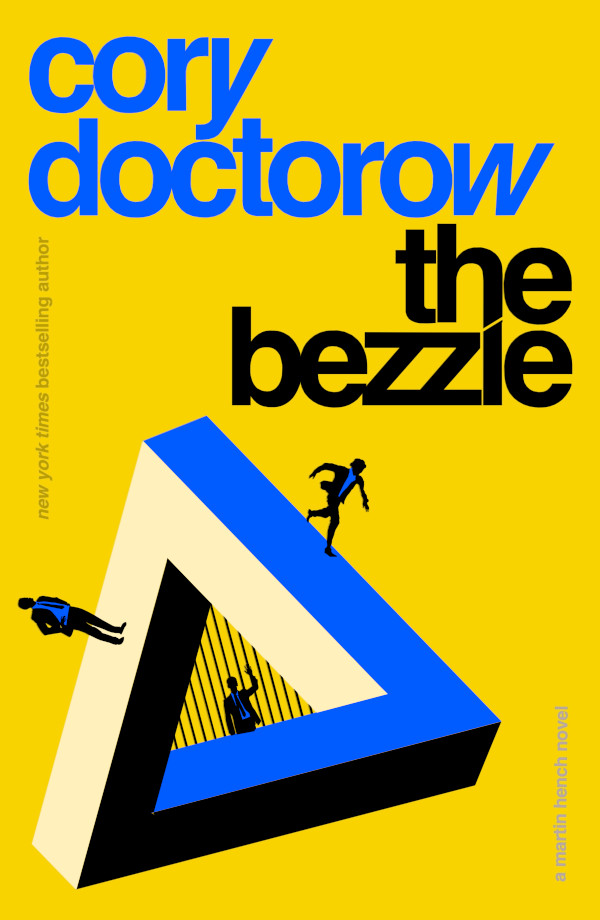
I’m about to hit the road again for a series of back-to-back public appearances as I travel with my new, nationally bestselling novel The Bezzle. I’ll be in Los Angeles, Boston, Providence, Chicago, Turin, Marin, Winnipeg, Calgary, Vancouver, and Tartu, Estonia!
- Los Angeles: UCLA Institute for Law, Technology and Policy, April 10, 1215PM
https://pages.e2ma.net/pages/1972582/47480 - Boston: Harvard Pound Hall, with Randall “XKCD” Munroe, April 11, 6PM (note: we’ve moved this to a bigger hall – a new block of free tickets were just released!)
https://cyber.harvard.edu/events/enshittification - Providence, RI: RISD Debates in AI, April 12
https://involved.risd.edu/event/9777963 - Chicago: Anderson’s Books (Napierville), April 17, 7PM
https://www.andersonsbookshop.com/event/cory-doctorow-1 - Turin, Italy: Torino Biennale Tecnologia, April 21, 6:30PM
https://www.biennaletecnologia.it/evento/come-sfuggire-al-merdocene-e-costruire-un-internet-migliore/ - Marin: Book Passage Corte Madera, April 27, 1PM
https://www.bookpassage.com/event/cory-doctorow-bezzle-martin-hench-novel-corte-madera-store - Winnipeg: Canadian Centre for Policy Alternatives, May 2, 7PM
https://www.eventbrite.ca/e/cory-doctorow-tickets-798820071337 - Calgary: Wordfest, May 3, 7PM
https://wordfest.com/2024/event/wordfest-presents-cory-doctorow-2/ - Vancouver: Massy Arts, May 4, 6PM
https://www.eventbrite.ca/e/solo-reading-cory-doctorow-the-bezzle-tickets-876989167207 - Tartu, Estonia: Prima Vista Literary Festival, May 5-11
https://tartu2024.ee/en/kirjandusfestival/
I hope to see you! Bring friends!

My next novel is The Bezzle, a high-tech ice-cold revenge thriller starring Marty Hench, a two-fisted forensic accountant, as he takes on the sleaziest scams of the first two decades of the 2000s, from hamburger-themed Ponzis to the unbelievably sleazy and evil prison-tech industry:
https://us.macmillan.com/books/9781250865878/thebezzle
I’m taking Marty on the road! I’ll be visiting eighteen cities between now and June, and I hope you’ll come out and say hello, visit a beloved local bookseller, and maybe get a book (or two)!
21 Feb: Weller Bookworks, Salt Lake City, 1830h:
https://www.wellerbookworks.com/event/store-cory-doctorow-feb-21-630-pm
22 Feb: Mysterious Galaxy, San Diego, 19h:
https://www.mystgalaxy.com/22224Doctorow
24 Feb: Vroman’s, Pasadena, 17h, with Adam Conover (!!)
https://www.vromansbookstore.com/Cory-Doctorow-discusses-The-Bezzle
26 Feb: Third Place Books, Seattle, 19h, with Neal Stephenson (!!!)
https://www.thirdplacebooks.com/event/cory-doctorow
27 Feb: Powell’s, Portland, 19h:
https://www.powells.com/book/the-bezzle-martin-hench-2-9781250865878/1-2
29 Feb: Changing Hands, Phoenix, 1830h:
https://www.changinghands.com/event/february2024/cory-doctorow
9-10 Mar: Tucson Festival of the Book:
https://tucsonfestivalofbooks.org/?action=display_author&id=15669
13 Mar: San Francisco Public Library (with Robin Sloan):
https://sfpl.org/events/2024/03/13/author-cory-doctrow-bezzle
22 Mar: Wendy Michener Memorial Lecture (Toronto):
https://events.yorku.ca/events/wendy-michener-memorial-lecture2024/
24 Mar: Word Books Brooklyn (with Laura Poitras) (NYC):
https://shop.wordbookstores.com/event/word-presents-cory-doctorow
29-31 Mar: Wondercon Anaheim:
https://www.comic-con.org/wc/
10 Apr: UCLA Institute for Law, Technology and Policy, 1215PM (Los Angeles):
https://pages.e2ma.net/pages/1972582/47480
11 Apr: Harvard Berkman-Klein Center, with Randall Munroe
https://cyber.harvard.edu/events/enshittification
12 Apr: RISD Debates in AI, Providence
17 Apr: Anderson’s Books, Chicago, 19h:
https://www.andersonsbookshop.com/event/cory-doctorow-1
21 Apr: Torino Biennale Tecnologia
https://www.biennaletecnologia.it/evento/come-sfuggire-al-merdocene-e-costruire-un-internet-migliore/
27 Apr: Book Passage Corte Madera, 1PM (Marin County)
https://www.bookpassage.com/event/cory-doctorow-bezzle-martin-hench-novel-corte-madera-store
2 May, Canadian Centre for Policy Alternatives, Winnipeg
https://www.eventbrite.ca/e/cory-doctorow-tickets-798820071337
3 May, Wordfest, 7PM (Calgary):
https://wordfest.com/2024/event/wordfest-presents-cory-doctorow-2/
4 May, Massy Arts, 6PM (Vancouver)
https://www.eventbrite.ca/e/solo-reading-cory-doctorow-the-bezzle-tickets-876989167207
5-11 May: Tartu Prima Vista Literary Festival
https://tartu2024.ee/en/kirjandusfestival/
6-9 Jun: Media Ecology Association keynote, Amherst, NY
https://media-ecology.org/convention

This week on my podcast, I read my Locus Magazine column “Don’t Be Evil,” about the microeconomics and moral injury of enshittification.
It’s tempting to think of the Great Enshittening – in which all the internet services we enjoyed and came to rely upon became suddenly and irreversibly terrible – as the result of moral decay. That is, it’s tempting to think that the people who gave us the old, good internet did so because they were good people, and the people who enshittified it did so because they are shitty people.
But the services that defined the old, good internet weren’t designed or maintained by individuals; they were created by institutions – mostly for-profit companies, but also non-profits, government and military agencies and academic and research facilities. Institutions are made up of individuals, of course, but the thing that makes an institution institutional is that no one person can direct it. The actions of an institution are the result of its many individual constituent parts, both acting in concert, and acting against one another.
In other words: institutional action is the result of its individuals resolving their conflicts. Institutional action is the net results of wheedling, horse-trading, solidarity, skullduggery, power-moves, trickery, coercion, rational argument, love, spite, ferocity, and indifference among the institution’s members.