/ / Podcast, Stories

The cover for the MIT Press edition of 'Communications Breakdown.'

This week on my podcast, I read my short story “Moral Hazard,” published last month in MIT Press’s Communications Breakdown, a science fiction anthology edited by Jonathan Strahan. “Moral Hazard” is a story about inequality, fintech, and the problems of “solutionism.”

I know exactly where I was the day I decided to give every homeless person in America their own LLC. I was in the southeast corner of the sprawling homeless camp that had once been Seattle’s Discovery Park on a rare, dry February afternoon. The sun was weak but so welcome. After weeks of sheltering in our tents and squelching through the mud and getting drenched waiting for the portas, we were finally able to break out the folding chairs and enjoy each other’s company.

Mike the Bike had coffee. He always did. Mike knew more ways to make coffee than any fancy barista. He had a master’s in chemical engineering and a bachelor’s in mechanical engineering and when he was high he spent every second of the buzz thinking of new ways to combine heat and water and solids to produce a perfect brew.

I brought trail mix, which I mixed up myself with food-bank supplies and spices I bought from the bulk place for pennies. My secret is cardamom and a little chili powder. I learned that from my Mom.

“Trish,” Mike the Bike said, “I wish I was a corporation.”

MP3

/ / Podcast

A 2022 selfie of me with my daughter Poesy at Disneyland's Adventureland.

When my daughter Poesy was four, her nursery school let us know that they were shutting down a day before my wife’s office closed for the holidays, leaving us with a childcare problem. Since I worked for myself, I took the day off and brought her to my office, where we recorded a short podcast, singing Rudolph the Red-Nosed Reindeer (a frankly amazing rendition!).

We’ve done it every year since, except for 2016 when I had mic problems. Now she’s 14, and we’ve just recorded our tenth installment, and as always, it was a highlight of my holiday season. This year, our Christmas carol is back, along with a brief interview about her interests and hobbies, and a summary of a seriously creepy short story she’s writing.

Here’s this year’s recording, and here are the years gone by:

MP3

/ / Articles, Podcast

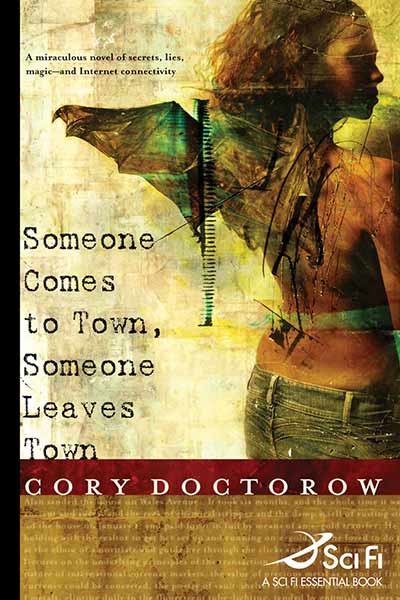
Here’s part thirty of my new reading of my novel Someone Comes to Town, Someone Leaves Town (you can follow all the installments, as well as the reading I did in 2008/9, here).

This is easily the weirdest novel I ever wrote. Gene Wolfe (RIP) gave me an amazing quote for it: “Someone Comes to Town, Someone Leaves Town is a glorious book, but there are hundreds of those. It is more. It is a glorious book unlike any book you’ve ever read.”

Here’s how my publisher described it when it came out:


Alan is a middle-aged entrepeneur who moves to a bohemian neighborhood of Toronto. Living next door is a young woman who reveals to him that she has wings—which grow back after each attempt to cut them off.

Alan understands. He himself has a secret or two. His father is a mountain, his mother is a washing machine, and among his brothers are sets of Russian nesting dolls.

Now two of the three dolls are on his doorstep, starving, because their innermost member has vanished. It appears that Davey, another brother who Alan and his siblings killed years ago, may have returned, bent on revenge.

Under the circumstances it seems only reasonable for Alan to join a scheme to blanket Toronto with free wireless Internet, spearheaded by a brilliant technopunk who builds miracles from scavenged parts. But Alan’s past won’t leave him alone—and Davey isn’t the only one gunning for him and his friends.

Whipsawing between the preposterous, the amazing, and the deeply felt, Cory Doctorow’s Someone Comes to Town, Someone Leaves Town is unlike any novel you have ever read.

MP3

/ / Attack Surface, Little Brother

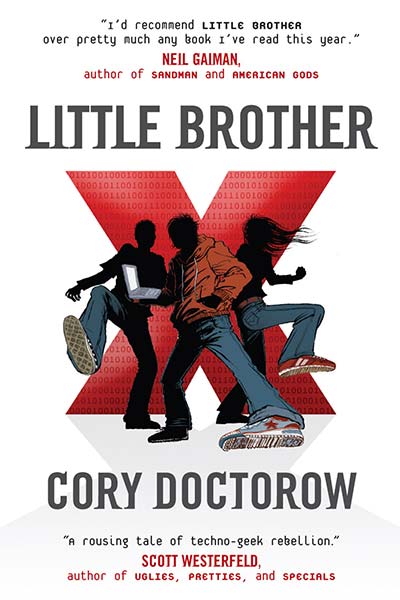
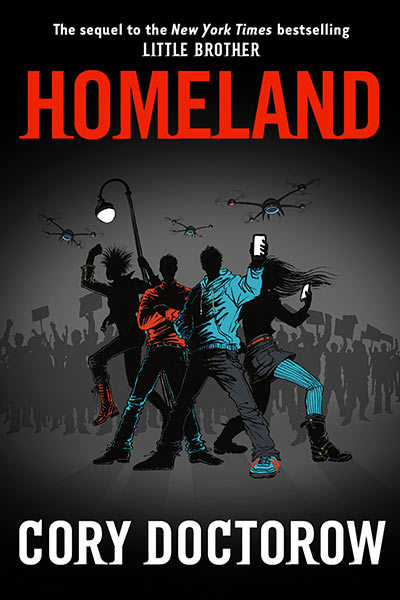
In an interview in the LA Review of Books, Technology and Politics Are Inseparable: An Interview with Cory Doctorow, Eliot Peper digs into the backstory and ethos of the Little Brother books in general and Attack Surface in particular:

Attack Surface explores how technology is not the solution to social problems, but a morally neutral accelerant to political action, and that ultimately only politics can solve social problems. How did you learn this lesson? How did it change your worldview? What does it mean for someone who wants to contribute to building a better future?

I started in politics — my parents are activists who started taking me to protests when I was in a stroller. But in 1977, when I was six, we got our first computer (a teletype terminal and acoustic coupler that let me connect to a DEC minicomputer at the university my dad was studying at). I never thought that computers on their own could solve our political problems — but I always thought that computers would play an important role in social and political struggles.

Technology and politics are inseparable. There’s a kind of nerd determinism that denies politics (“Our superior technology makes your inferior laws irrelevant”). But just as pernicious is the inverse, the politicos who insist that technology is irrelevant to struggle, sneering about “clicktivism” and “solutionism.” I have logged innumerable hours wheatpasting posters for demonstrations to telephone poles. I can’t believe that anyone who claims networked computers don’t change how politics work has ever wheatpasted a single handbill.

Cryptography cannot create a stable demimonde that is impregnable to oppressive, illegitimate states — over time, you and your co-dissidents will make a mistake, and the protection of math will vanish. But the fact that it’s not impregnable doesn’t disqualify cryptography from being significant to political struggle. Nothing is impregnable. Crypto is a tool — not a tool for obviating politics, but a tool for doing politics.

Moreover, the existence of crypto — the fact that everyday people can have secrets that can’t be read without their consent — changes the equilibrium in oppressive states. The privilege of the powerful — secrecy — has spread to the general public, which means that leaders who are tempted to take oppressive action have to take account of the possibility that the people they oppress will be able to plan their downfall in ways that they will struggle to detect.

/ / Attack Surface, Little Brother

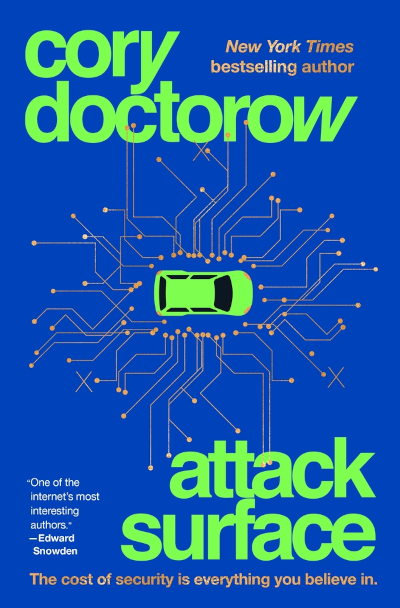
Well this is pretty terrific: Pavel Anni was so taken with my 2020 novel ATTACK SURFACE (the third Little Brother novel) that he’s created “Mashapedia,” a chapter-by-chapter breakdown of the real world technologies in the tale.

https://pavelanni.github.io/attack-surface-tech/attack-surface-tech.html

Pavel is both comprehensive and comprehensible, with short definitions and links for the mundane (MIT Media Lab, EL wire, PGP) to the exotic (binary transparency, reverse shells, adversarial preturbation).

When I was an adolescent, my friend group traded secret knowledge as a kind of social currency – tricks for getting free payphone calls, or doubling the capacity of a floppy disc, or calling the White House switchboard.

I doted on books that promised more of the same: Paladin Press and Amok Catalog titles, Steal This Book, the Anarchist Cookbook, the Whole Earth Review and the Whole Earth Catalog.

But when I sat down in 2006 to write the first Little Brother book, I realized that facts were now cheap – anything could be discovered with a single search. The thing in short supply now was search terms – knowing what to search for.

As John Ciardi wrote,

The old crow is getting slow;
the young crow is not.
Of what the young crow does not know,
the old crow knows a lot.

The young crow flies above, below,
and rings around the slow old crow.
What does the fast young crow not know?
WHERE TO GO.

So I set out to write a book of realistic scenarios, dramatizing what tech COULD do, on the assumption that readers would glean those all-important search-terms from the tale, and that this could launch them on a voyage of discovery.

That’s the ethic I’ve stuck with through all three novels and the short stories in the series. It seems to have worked. Anni’s Mashapedia is the apotheosis of that plan: a comprehensive set of search terms masquerading as a glossary.

Anni’s hosted Mashapedia on Github, and you can amend, extend or contest his definitions by opening an issue in the repo. What a delight!