/ / Novels

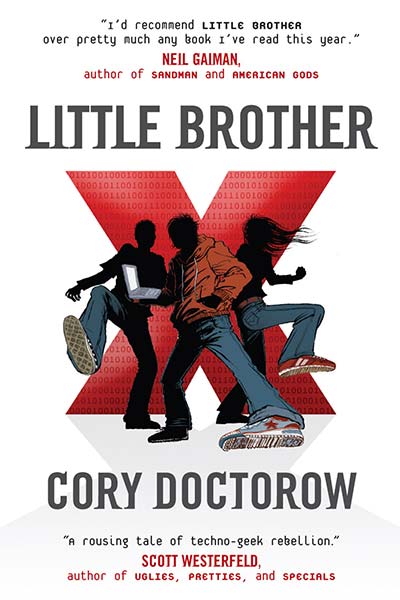
Little Brother is my first young adult novel, a story about hacker kids in San Francisco who use technology to reclaim democracy from the Department of Homeland Security after a terrorist attack and the concomitant crackdown. It was published by Tor Books on April 29, 2008.

/ / News

I’ve just put up my site for Little Brother, my young adult novel about hacker kids who use technology to reclaim the Bill of Rights from the DHS after a terrorist attack on San Francisco. Included on the site are:

Still to come: the tour schedule, more Instructables HOWTOs, and lots of other news.

Link

/ / Little Brother, News

Borderlands Books, San Francisco’s wonderful science fiction bookstore, has offered to free US shipping for signed, inscribed copies of Little Brother. Just order before my in-store appearance on May 22, and they’ll take care of having me sign and personalize your copy. People outside of the US can order, too — but there’s a small charge for shipping, depending on where you live.

Borderlands Books 866 Valencia Ave, San Francisco CA USA 94110 +1 888 893 4008

/ / Little Brother, News

Instructables has just posted the latest installment in its ongoing series of HOWTOs inspired by my young adult novel Little Brother, which tells the story of a teen underground that uses technology to fight back against surveillance and control.

This week’s HOWTO is “Avoiding Camera Noise Signatures” — AKA, anonymizing your photos before you post them online:


If you take enough images with your digital camera, they can all be compared together and a unique signature can be determined. This means that even when you think that you are posting a photo anonymously to the internet, you are actually providing clues for the government to better tell who you are. The larger the sample size of images they have, the easier it is them to track down images coming from the same camera. Once they know all the images are coming from the same camera, all they then have to do is find that camera and take a picture to confirm it beyond a reasonable doubt.

It is important to remove this noise signature so that you cannot be tracked down. I cannot guarantee any of these methods will work beyond the shadow of a doubt because the woman doing research for the government on how to find the signature is very good. I can only promise that this will make their work more difficult.

Link, Link to feed of Little Brother Instructables

/ / News

Instructables has just posted the latest installment in its ongoing series of HOWTOs inspired by my young adult novel Little Brother, which tells the story of a teen underground that uses technology to fight back against surveillance and control.

This week’s HOWTO is “Avoiding Camera Noise Signatures” — AKA, anonymizing your photos before you post them online:


If you take enough images with your digital camera, they can all be compared together and a unique signature can be determined. This means that even when you think that you are posting a photo anonymously to the internet, you are actually providing clues for the government to better tell who you are. The larger the sample size of images they have, the easier it is them to track down images coming from the same camera. Once they know all the images are coming from the same camera, all they then have to do is find that camera and take a picture to confirm it beyond a reasonable doubt.

It is important to remove this noise signature so that you cannot be tracked down. I cannot guarantee any of these methods will work beyond the shadow of a doubt because the woman doing research for the government on how to find the signature is very good. I can only promise that this will make their work more difficult.

Link, Link to feed of Little Brother Instructables

/ / News

In my latest Guardian column, I disclose my five email power-tips — the system I use to manage hundreds of emails every single day:

Sort your inbox by subject

This is my favorite one by far. If something big is going on in the world, chances are lots of people are going to be emailing you about it, and they’ll generally use pretty similar subject lines.

When my daughter was born, the majority of congratulatory emails began with the word “Congratulations.” When I’d asked my friends to help me find an office, most of the tips I got began with “office.”

Best of all, if some spammer manages to get a few hundred copies of a message through my filter and into my inbox, they’ll all have the same subject line, making them easy to bulk-select and delete.

Foreign-alphabet spam is also a doddle, since non-Roman characters will all alphabetise at the bottom or top of your inbox; if you don’t read Cyrillic, Korean, Hebrew or Simplified Kanji, you can just delete them all with a couple of key presses.

Link