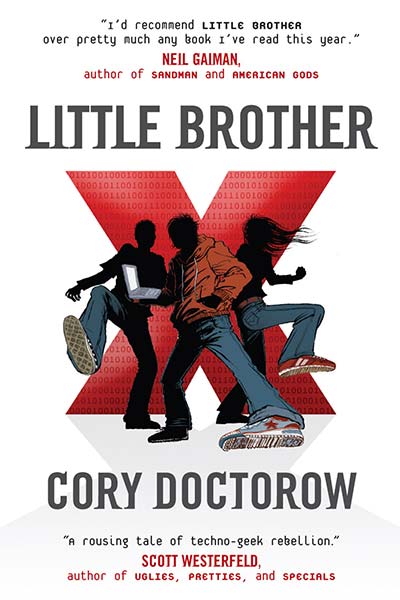
A high-school in Phoenix, Arizona is mounting a production of the theatrical adaptation of my novel Little Brother (this is the same script that was mounted for the 2008 performances in Chicago, written by Bill Massolia). They’re doing a three-night run, starting tomorrow — tickets are still available.
All About:
News
A high-school in Phoenix, Arizona is mounting a production of the theatrical adaptation of my novel Little Brother (this is the same script that was mounted for the 2008 performances in Chicago, written by Bill Massolia). They’re doing a three-night run, starting tomorrow — tickets are still available.
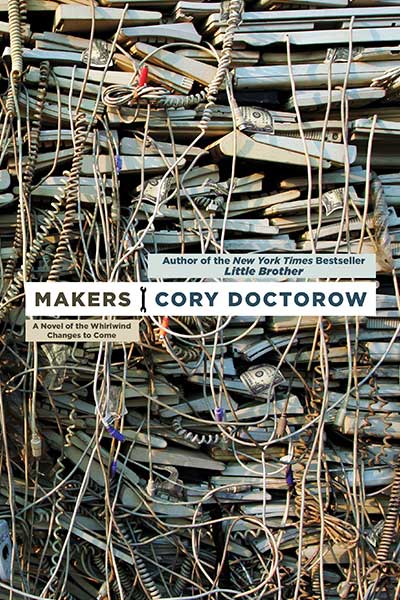
I recently spoke to the CBC’s Shelagh Rogers on The Next Chapter about my novel Makers. The interview just aired, and they’ve put up streaming audio of it as well.
Corrinne Hite is a fifteen-year-old singer/songwriter who has just finished an album of songs based on the novels she loves. She’s done me the honor of writing a song based on my novel Little Brother: stream it here.
Corrine’s band, CORY & THE TIGERMEN, is in the SchoolJamsUSA finals (northeast region). US residents can vote for her — she’d have my vote if I was eligible!
Corrinne Hite is a fifteen-year-old singer/songwriter who has just finished an album of songs based on the novels she loves. She’s done me the honor of writing a song based on my novel Little Brother: stream it here.
Corrine’s band, CORY & THE TIGERMEN, is in the SchoolJamsUSA finals (northeast region). US residents can vote for her — she’d have my vote if I was eligible!
I recently spoke to the CBC’s Shelagh Rogers on The Next Chapter about my novel Makers. The interview just aired, and they’ve put up streaming audio of it as well.
I’ll be on CBC’s The Next Chapter with Sheelagh Rogers this Monday at 1PM Eastern, discussing my novel Makers (it’ll also be streamable after it airs).
Uta Bayer translated my essay Metacrap to Belorussian: Metacrap: Увод паходня да сямі саламяныя людзі мета-ўтопіі — thanks, Uta!
My latest Locus column, “A Cosmopolitan Literature for the Cosmopolitan Web,” is up: it’s a piece on the way that science fiction’s insistence that all laws are local prefigures the web’s weird and wonderful diversity:
One of science fiction’s greatest tricks is playing ‘‘vast, cool intelligence’’ and peering through a Martian telescope aimed Earthwards and noticing just how weird and irrational we all are. At its best, science fiction is a literature that can use the safe distance of an alien world or a distant future as a buffer-zone in which all mores can be called into question – think, for example, of Theodore Sturgeon’s story of the planet of enthusiastic incest-practitioners, ‘‘If All Men Were Brothers, Would You Let One Marry Your Sister?’’ published in Dangerous Visions in 1967.
Behind every torturer’s mask, behind every terrible crusade, behind every book-burning and war-drum is someone who has forgotten (or never learned) that all laws are local. Forgetting that all laws are local is the ultimate in hubris, and it is the province of yokels and bumpkins who assume that just because they do something in a particular way, all right-thinking people always have and always will. For a mild contemporary example, consider the TV executive who blithely asserts that her industry is safe, because no matter what happens in the future, the majority of us will want to come home, flop down on the sofa, and turn on the goggle-box – despite the fact that TV has existed for less than a century, a flashing eyeblink in the long history of hominids, most of whom have gotten by just fine without anesthetizing themselves with a sitcom at the end of a long day.
Which is not to say that cosmopolitans don’t believe in anything. To be cosmopolitan is to know that all laws are local, and to use that intellectual liberty to decide for yourself what moral code you’ll subscribe to. It is the freedom to invent your own ethics from the ground up, knowing that the larger social code you’re rejecting is no more or less right than your own – at least from the point of view of a Martian peering through a notional telescope at us piddling Earthlings.
Cory Doctorow: A Cosmopolitan Literature for the Cosmopolitan Web