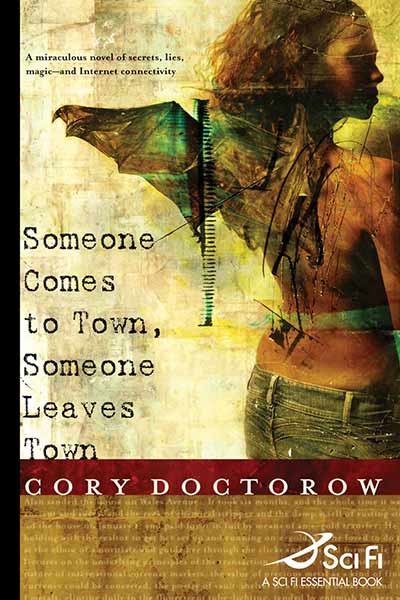
Here’s part four of my new reading of my novel Someone Comes to Town, Someone Leaves Town (you can follow all the installments, as well as the reading I did in 2008/9, here).
In this installment, we meet Kurt, the crustypunk high-tech dumpster-diver. Kurt is loosely based on my old friend Darren Atkinson, who pulled down a six-figure income by recovering, repairing and reselling high-tech waste from Toronto’s industrial suburbs. Darren was the subject of the first feature I ever sold to Wired, Dumpster Diving, which was published in the September, 1997 issue.
This is easily the weirdest novel I ever wrote. Gene Wolfe (RIP) gave me an amazing quote for it: “Someone Comes to Town, Someone Leaves Town is a glorious book, but there are hundreds of those. It is more. It is a glorious book unlike any book you’ve ever read.”
Here’s how my publisher described it when it came out:
Alan is a middle-aged entrepeneur who moves to a bohemian neighborhood of Toronto. Living next door is a young woman who reveals to him that she has wings—which grow back after each attempt to cut them off.
Alan understands. He himself has a secret or two. His father is a mountain, his mother is a washing machine, and among his brothers are sets of Russian nesting dolls.
Now two of the three dolls are on his doorstep, starving, because their innermost member has vanished. It appears that Davey, another brother who Alan and his siblings killed years ago, may have returned, bent on revenge.
Under the circumstances it seems only reasonable for Alan to join a scheme to blanket Toronto with free wireless Internet, spearheaded by a brilliant technopunk who builds miracles from scavenged parts. But Alan’s past won’t leave him alone—and Davey isn’t the only one gunning for him and his friends.
Whipsawing between the preposterous, the amazing, and the deeply felt, Cory Doctorow’s Someone Comes to Town, Someone Leaves Town is unlike any novel you have ever read.