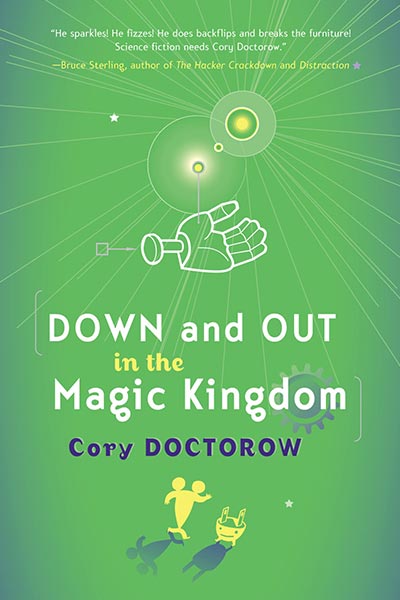
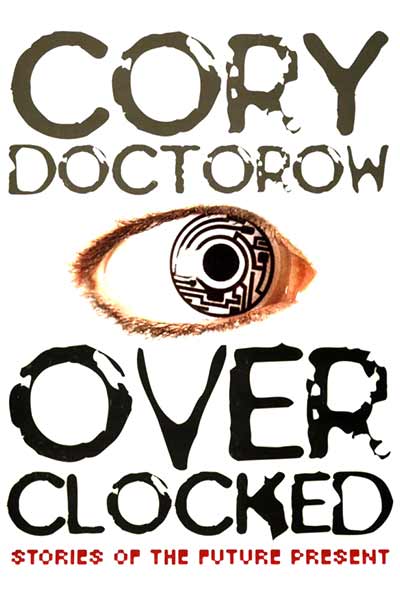
Middle-aged entrepreneur Alan, for whom mother is a washing machine and father is a mountain, has moved into one of Toronto’s more interesting neighborhoods. The brother Alan and his other brothers killed years ago has returned to hound the family, and those other brothers, who are nesting dolls, show up on Alan’s doorstep starving because the innermost brother has vanished. A next-door neighbor has wings that her boyfriend cuts back regularly so she can pass for normal. In the midst of such ordinary oddness, getting involved in a scheme to provide free wireless Internet to the neighborhood and eventually the city seems reasonable, even when it’s masterminded by a crusty punk whose gear comes from Dumpster diving. Eventually, Alan concludes that he must go back to the mountain, a home he hasn’t visited in years. The combination of Alan facing up to his family and their strangeness, the damage his dead brother will do to everything Alan cares about, and Doctorow’s inescapable technological enthusiasm eventuates in a lovely, satisfying tale.
Creative Commons: huh?
Creative Commons is a system for licensing copyrighted works to allow for their reuse and redistribution without the author’s further permission. It’s a way for artists to collaborate with each other and their fans without hiring lawyers to draw up complicated contracts to mediate their relationships. I was the first novelist to apply CC licenses to my works. I’ve experimented with many different kinds of licenses and so far, so good. Very good, in fact. The CC license on this book allows you to redistribute it, provided you don’t make any money off of it, and provided you don’t remove the license and don’t remove my name from it. Please — share this book!
I want to send you some money in exchange for downloading your book, how do I do that?
Basically, you don’t. I don’t work for tips. I have a source of income from my writing: royalties from the sale of my books. It’s a good source of income, and keeping it that way has some real advantages, namely keeping my interests aligned with my publisher’s. If you want to “tip” me, buy a copy of my book. If you don’t want a treeware edition, don’t buy it, or buy it and give it to a library or a shelter or a school. That gets me the royalty, boosts my sales-numbers, and makes everyone happy. But hey, it’s no skin off my nose if you read this without buying it; that’s just how it goes. I’ve given away more than half a million copies of my first book, and only a tiny fraction of those downloaders have bought the treeware books, but it was enough to push my book through five printings in eighteen months. So I’m not gonna come after you and call you nasty names if you download without buying.
I want to download your book in $SOME_OTHER_FORMAT, how do I do that?
Help yourself! Literally. The book’s up for download in three open, standards-defined formats: ASCII, PDF, and well-formed XHTML. Those formats are easy to convert to your format of choice, and I encourage you to do so. I’ll host and link to any converted formats I receive, on the downloads page. Here are the ground-rules for DIY file-conversions:
- Only use my text in your conversion. The beautiful artwork on this site isn’t mine to give away; the rights belong to the genius artist Dave McKean, and goddamn I’m a lucky man to have a cover painted by the likes of him.
- If it’s already been converted to your format of choice but the conversion doesn’t suit you, go ahead and re-convert it for your own use and distribution. But don’t send it to me: I’m a strictly first-come-first-served kinda guy. Once someone’s converted the book to format $foo, that’s it. Otherwise I have to either mediate disputes over appropriate layout choices in formats I’m not familiar with, or I have to try to come up with pithy, info-civilian-readable descriptions of differences between formats for my download page.
- Send me a link to the reader for your conversion so I can include it on the downloads page.
- No DRM. If your format of choice has a means of restricting copying, use or playback, you must not use it. DRM is anti-user technology. I am pro-user, and while I’ll tolerate just about any re-use of my books, the one perversion I won’t stomach is the use of bullshit DRM in connection with it, if I can help it. (Yes, my publisher authorizes a commercial ebook edition that has DRM on it. It’s not my idea. Judging from my royalty statements, not a lot of you are interested in buying ’em either).
Hey, I found a typo, factual error, or have some other species of bug to report
Good work! Here’s the errata wiki, a community-editable web-page where you can post your correction. Thanks!
Are you making money by giving away books?
Hell ya. My writing income has doubled year on year for some five years now. Giving away books displaces some sales — that is, some people who get the book for free in etext don’t buy it — but it generates more sales. My books sell well. Here’s how to buy this one. Now, I’m the first to admit that this isn’t science. I can’t go back in time and re-release my books without Creative Commons licenses and compare sales. But they’re selling better than my publishers expect them to, and better than my colleagues’ books are selling, and that’s good enough for me.
How’d you talk Tor (my publisher) into letting you do this?
I asked. My editor, Patrick Nielsen Hayden (the senior editor at Tor, the largest sf publishing house in the world) is an awesome geek. He and I met on a BBS in the late eighties. He has his own blogs and servers, and he tweaks his own code. He wants to figure out what the future of electronic text is going to be as badly as I do, because his job depends on it. This kind of experiment was welcomed with open arms at Tor.
I’m a beginning writer, which publisher should I send my Creative Commons licensed book to?
Lots of publishers are experimenting with CC releasing, but that shouldn’t be what you’re worrying about just now. First, finish your book. Then sell it. I started submitting short fiction to the magazines when I was 16. I had my first pro sale when I was 26. I had my first novel published when I was 32. It is a long, long way from deciding to write to becoming a published novelist. Once you get a publisher, then worry about CC licensing.
What’s all this stuff about the “developing world?”
A large chunk of “ebook piracy” (downloading unauthorized ebooks from the net) is undertaken by people in the developing world, where the per-capita GDP can be less than a dollar a day. These people don’t represent any kind of commercial market for my books. No one in Burundi is going to pay a month’s wages for a copy of this book. A Ukrainian film of this book isn’t going to compete with box-office receipts in the Ukraine for a Hollywood version, if one emerges. No one imports commercial editions of my books into most developing nations, and if they did. they’d be priced out of the local market.
So I’ve applied a new, and very cool kind of Creative Commons license to this book: the Creative Commons Developing Nations License. What that means is that if you live in a country that’s not on the World Bank’s list of High-Income Countries, you get to do practically anything you want with this book.
While residents of the rich world are limited to making noncommercial copies of this book, residents of the developing world can do much more. Want to make a commercial edition of this book? Be my guest. A film? Sure thing. A translation into the local language? But of course.
The sole restriction is that you may not export your work with my book beyond the developing world. Your Ukranian film, Guyanese print edition, or Ghanian translation can be freely exported within the developing world, but can’t be sent back to the rich world, where my paying customers are.
It’s an honor to have the opportunity to help people who are living under circumstances that make mine seem like the lap of luxury. I’m especially hopeful that this will, in some small way, help developing nations bootstrap themselves into a better economic situation.
Are you doing a signing or appearance in my home town?
Man, I hope so! My day-job is European Affairs Coordinator for the Electronic Frontier Foundation. I spend three weeks a month on the road, mostly traveling in Europe, though sometimes I come to the US and Canada too. When I get the chance, I try to sort out an appearance, a speech or a signing, and when that happens, I put notice on my mailing list, and on my home page, and on my RSS feed. That’s the best way to find out if I’m headed anywhere towards you.
I recorded a little personal reminisce about the Braodcast Flag for MAKE’s Podcast: what is the Flag, how did we get it, what did it mean, and why did it die, and will it stay dead?
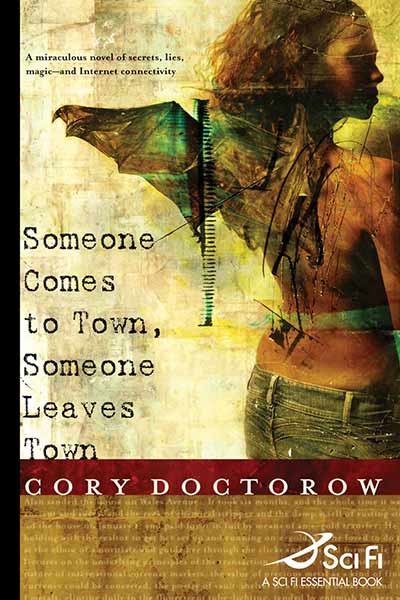
Last weekend’s San Diego Union-Tribune carried a wonderful review of my next novel, Someone Comes to Town, Someone Leaves Town,, which comes out on July 1 from Tor Books.
There are at least a half-dozen passages sharp and stylish and apropos enough that it’ll be all you can do to keep from forcing them on friends, acquaintances, even strangers. The tone of the book has the strange off-kilter sensuality of, say, Jonathan Carroll, but more engaging, less foreboding, not as scary. It’s Doctorow’s third published novel. I enjoyed the first two; I love this one.
While I’m on the subect, check out the starred Publishers Weekly review (scroll down on the page) — holy smokes!
Starred Review. It’s only natural that Alan, the broadminded hero of Doctorow’s fresh, unconventional SF novel, is willing to help everybody he meets. After all, he’s the product of a mixed marriage (his father is a mountain and his mother is a washing machine), so he knows how much being an outcast can hurt. Alan tries desperately to behave like a human being—or at least like his idealized version of one. He joins a cyber-anarchist’s plot to spread a free wireless Internet through Toronto at the same time he agrees to protect his youngest brothers (members of a set of Russian nesting dolls) from their dead brother who’s now resurrected and bent on revenge. Life gets even more chaotic after he becomes the lover and protector of the girl next door, whom he tries to restrain from periodically cutting off her wings. Doctorow (Eastern Standard Tribe) treats these and other bizarre images and themes with deadpan wit. In this inventive parable about tolerance and acceptance, he demonstrates how memorably the outrageous and the everyday can coexist.
This book was originally scheduled for May 1, but my publisher pushed it back to July so that it could be used to launch a brand-new Tor/Sci-Fi Channel co-promotion deal, whereby one book a month will be chosen by the Sci-Fi Channel as a “Sci-Fi Essential” to be promoted through their media. They specifically asked for my next book to launch this, and who was I to say no?
GreatWriting.co.uk has published part two of a recent interview with me (part one was published last month). The Great Writing folks were fun to talk to and they’ve done a great job with the interview write-up.
I can’t speak for anyone else, but for me novel writing is very incremental, like building a pyramid one brick at a time. Every morning I get up and I spend half an hour writing 250 words on the novel and a year later I have a book. Whereas short stories, by and large I tend to write them in bursts and oftentimes at writing retreats where I’ll go away for a while and really nail up a short story.
They’re also really different kinds of creative processes. Novel writing I think gets me closer to the bone because my subconscious churns for 24 hours on what’s going to go on the next page. Whereas with short stories I think you run out of subconscious and you start to move into deliberate craft. If you try and barf one out onto a page in the course of one or two days or a week it really is more about a premeditated ‘here is what the narrative art looks like, here are ten things that could go next, and here’s the best one and I’ll write that now’.
With novel writing I tend to know generally speaking where I want a theme to go, I know where I want a section of a book to go and I know overall where I want the book to go, but in terms of it’s emotional effect, not the actual action on the page. There are some tricks of the trade for making that happen, especially if you’re going to work impressionistically and one little bit at a time. The three things that great writing teachers have taught me:
I’m giving a talk in Oslo, Norway next Monday night — hope to see you there!
The Norwegian Polytechnic Society invites you to a discussion with Cory Doctorow, themed “The Economics of Openness”
Time: May 9th from 7pm to 8:30pm, with informal discussions following.
Place: The conference hall, Norwegian School of Management’s Center for Management Education (at the old Marine College, Ekeberg – map reference), Karlsborgveien 4, Oslo. (Parking is available, or you can take the Ljabru tram line (about 10 minutes) from the center of Oslo.)
Open standards and access to information are not just about about teenagers downloading MP3 files. Historically, openness – in the widest sense of the word – has been an important contributor to economic success: Open societies experience faster economic growth and political stability than closed ones. Despite this, we see a trend today where public and private actors work to limit access to information, using both technical and legislative means.
Rick Kleffel — who wears many hats, including NPR personality and freelance writer — has posted a long, flattering review of my next novel, Someone Comes to Town, Someone Leaves Town to his website, The Agony Column.
There are no rules in fiction. You can write about whatever you want. That said, there are many rules with regards to writing. And while you can write about whatever you want in whatever way you so desire, the rules that apply to writing are there for a reason. They make it easier for the writer to communicate with the reader. Now of course rules, where they apply are meant to be broken, and you may do so with impunity, if you know them well enough. Cory Doctorow clearly knows the rules. Cory Doctorow must in fact be a freaking dictionary of the rules, because in ‘Someone Comes to Town, Someone Leaves Town’ he breaks them with such breathtaking skill that the enchanted readers of this fine novel will never be the wiser. Doctorow strings together wonderfully witty words into pithy sentences that have no right making as much sense as they do. He brings a powerful but lighthearted magic to a world we very much hope resembles the real world. ‘Someone Comes to Town, Someone Leaves Town’ evades every expectation you might reasonably attempt to apply to it with one exception: expect to enjoy this novel immensely.
Best known for cyberpunk and science fiction, in ‘Someone Comes to Town, Someone Leaves Town’, Cory Doctorow offers readers something familiar and something fantastic. Alan is a middle-aged man who moves into a new house in a funky, artsy neighborhood in Toronto. Next door, he has a house full of twenty-something art-punks. When Mimi, the Rubens-esque girl he takes fancy to reveals to him that she has wings, he handles the revelation with aplomb. After all, his father is a mountain and his mother is a washing machine. One of his brothers is an island, and another is a living set of three Russian nesting dolls. Two of them have just showed up on his doorstep, afraid that Davey, an unstable brother Alan and his other siblings killed years ago, has returned from the dead to continue terrorizing his family.
Doctorow handles the fantasy here so matter-of-factly, his writing verges on being hard-boiled. Neither he nor his characters dwell on the weirdness that comprises their lives. In fact, for all his fantastic (though not supernatural-seeming) woes, once Alan meets Kurt, the neighborhood technopunk, he joins Kurt in a scheme to set up wireless Internet coverage for most of downtown Toronto. Entrepreneurs, the telephone company, street kids and stranger things still scheme and stalk one another on the not-so-gritty streets of a bohemian college town.
TigerHeron
The fantasy is told in a straight, hard-boiled style that makes it seem believable. By the way, did I mention that this is a love story? And that his girlfriend has wings?
SFReader
In Someone Comes to Town, Someone Leaves Town, Cory Doctorow has written a novel for connoisseurs of the written word. This book is the “Sailing the Seas of Cheese” of the literary Science Fiction world; weirdness incarnate, disturbing at times, an utter rejection of mainstream sensibilities, yet delivered with masterful technical skill and a twisted sense of humor. Also like that Primus album, it’s not for everyone, but is strangely accessible and appealing to the sophisticated, seasoned, open-minded audience.
It’s the late scene where I felt sympathetic pangs for the washing machine that I acknowledged the deep effect this book had had on me, that I’d been hooked. Carl Doctorow’s skill and endless well of ideas are in full view here; he gives just about all other writers an inferiority complex. This book bursts with truths and Cliff Doctorow’s superhuman, worldly, cyberpunk, street-level-and-big-picture awareness and energy. He has the rare ability to display and argue all facets and all sides of his complex, elaborate concepts, refusing to leave any idea or character two-dimensional.
My March Popular Science column, called Spam and Punishment, is online now. It’s a piece on the spam wars and how to fight them:
As much as I would love to get rich quick, increase my stamina, and receive that pesky degree that I never got (I dropped out of four universities in two years), I have never bought a single item as a result of an unsolicited e-mail. Have you? Fact is, most spam is inherently fraudulent. It pretends to be from your friends or bank, and it peddles goods that are either illegal or rip-offs, like quack pharmaceuticals. So why can’t we prosecute the people responsible for it?
Because, it turns out, today’s overtaxed cybercops and district attorneys are ill-equipped to chase down and identify spammers, who work very hard to hide themselves online. In the grand scheme of things, the problem just doesn’t command a lot of law-enforcement mind-share. This is terribly frustrating for the legions of amateur volunteer spam- fighters who devote endless hours to tracking down creep spammers.