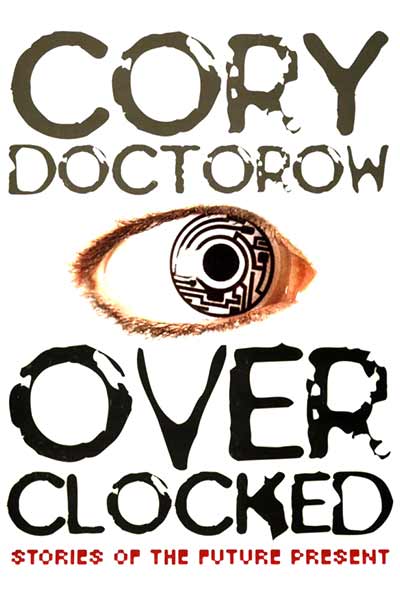
My new short story collection, Overclocked: Stories of the Future Present is out this week, and I’ve just launched the website that goes with it. Overclocked collects six of my most recent stories: Printcrime, When Sysadmins Ruled the Earth, Anda’s Game, I, Robot, I Row-Boat, and After the Siege. Between them, these stories have been reprinted in five languages, won a Locus Award, been a Hugo finalist, and been selected for every one of the Best of the Year anthology series in the field, along with Michael Chabon’s tony Best American Short Stories collection.
All of these stories are available for download under a Creative Commons By-Noncommercial-Sharealike license. Take ’em, send them around, convert them to new formats, make new and cool things out of them — but don’t charge money for them without talking to me first — and no adding DRM to them, ever!
I’ve got a bunch of launch-events planned for the next couple months, in Toronto, San Francisco, LA, Vancouver, San Diego and Chapel Hill, NC (basically, places that I’m going to for work). I might be able to line up NYC too — but it’s too soon to tell. Details for all of them will be here, or you can sign up for my mailing list.
Additionally, you can get signed, personally inscribed copies of the book shipped right to your door. Canadians, contact Bakka Books in Toronto before Feb 1 with your order, Americans and others get in touch with Secret Headquarters in LA.
The first two launches are in Toronto at Bakka Books on Feb 1 at 7PM, and in San Francisco at Borderlands Books, along with Rudy Rucker, on Feb 8 at 7PM.
Each short story is an idea bomb with a candy coating of human drama, wrapped in shiny tech tropes and ready to blow your mind. Overclocked is SF info-warfare ammunition of the highest caliber, so load up, move out, and take no prisoners…let Asimov sort em out. Overclocked, which you probably recognize as a computer term for running a processor faster than the clock rate it’s rated for, generally courting some sort of meltdown, is a fantastic collection of stories about people living with technology for better or worse and you should feel free to stop reading here and just go buy the book. At least if there’s a drop of geekazoid blood anywhere in your veins, which there is or you wouldn’t be here… The hard part of all this is that every one of these stories deserves consideration for a Hugo and I’d hate to see him split his own vote as a result. Not that it matters. What matters is that this is a collection really worth reading, sharing, downloading and generally infecting others with. Overclocked is SF info-warfare ammunition of the highest caliber. Load up, move out, and remember, take no prisoners…let Asimov sort em out. – SFRevu


 I’ve found a half-brick that was being used to hold down the tar paper around an exhaust-chimney. I should’ve used that to hold the door open, but it’s way the hell the other side of the roof, and I’d been really pleased with my little pebbly doorstop. Besides, I’m starting to suspect that the doorjamb didn’t fail, that it was sabotaged by some malevolently playful goon from the sanatorium. An object lesson or something.
 The coppers smashed my father’s printer when I was eight. I remember the hot, cling-film-in-a-microwave smell of it, and Da’s look of ferocious concentration as he filled it with fresh goop, and the warm, fresh-baked feel of the objects that came out of it.