/ / News

Back in August, I got a surprise in the mail: a long Braille computer printout and a letter. The letter was from Patti Smith, who teaches visually impaired middle-schoolers in Detroit’s public school system. She explained that almost all the Braille kids’ books she had access to were for really little kids — kindergartners, basically — and how discouraging this was for her kids.

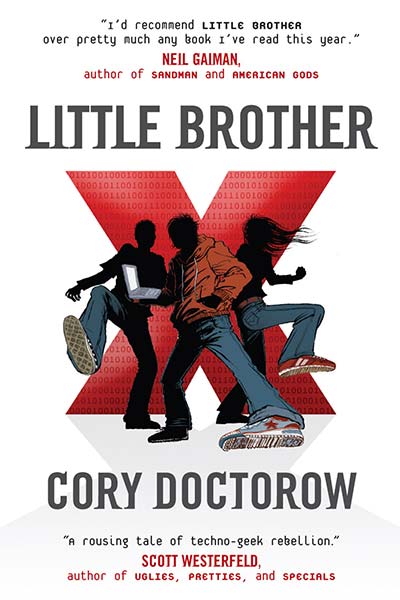
The reason she was writing to me was to thank me for releasing my young adult novel Little Brother under a Creative Commons license, which meant that she could download the ebook version and run it through her school’s Braille embosser (US copyright law makes it legal to convert any book to Braille or audiobook for blind people, but it is technically challenging and expensive to do this without the electronic text).

I wrote about this on my personal blog, and it inspired my colleague, the sf/f writer Paula Johansen, to write to Patti to offer up her own YA titles as ebooks for Patti’s students.

Well, this got me thinking that there might be lots of YA writers who’d be glad to see their books get into the hands of visually impaired, literature-hungry students, so I worked with Patti to put together the pitch below. Please pass it along to all the YA writers you know. I would love to see Patti’s class start the school year with a magnificent library of hundreds and hundreds of fantastic YA books to choose from, so that they can start a lifelong love-affair with literature.

Thanks!


I am Patti Smith and I teach at OW Holmes, which is an elementary-middle
school in Detroit Public Schools in Detroit, Michigan. My students are
visually impaired, ranging in age from 2nd grade to 8th grade. Five of
my students are Braille writers and two are learning Braille. I would
love books for young adults in electronic format (Word or RTF) so that I can plug the
file into my computer program and emboss the book in Braille so my kids
can have something to read. I have found it very difficult to find books for young adults; most seem to be written for very young readers. My Braille readers are all age 11+ and it is a challenge to find relevant books for them to read. Thank you so much!!

Patti’s email is TeacherPattiS@gmail.com

/ / News


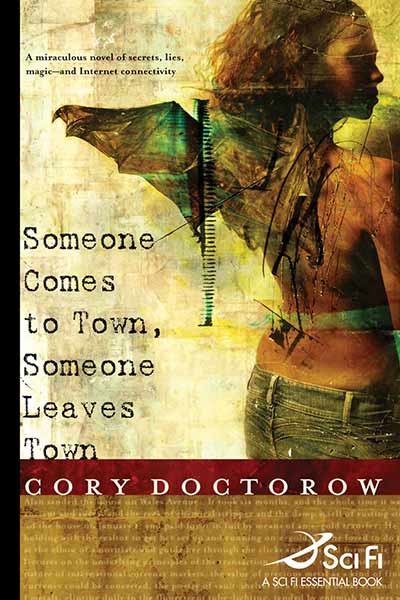
36 weeks ago — give or take — I set out to read my 2005 novel Someone Comes to Town, Someone Leaves Town aloud, in installments, in my podcast. And now I am done.

Someone Comes to Town is my weirdest book by far, a fantasy novel about a man whose father is a mountain and whose mother is a washing machine, who moves from small-town Ontario to Toronto to help build a citywide meshing wireless network with a crustypunk dumpster-diver.

Reading the book aloud was enormously satisfying. I hadn’t read it through since I finished the final draft in 2004, and in many ways it was like coming back to it for the first time.

But even more satisfying was the participation from my readers. First there was John Taylor Williams, of DC’s Wryneck Studios, who volunteered to master the audio for me, adding bed-music, editing out the gonks, and making it sound really good — he started this around week 27, and it seriously improved the final 9 episodes.

Then Glenn Jones, a reader in the UK, decided to create a dedicated podcast feed for the book, with all 36 episodes, to make it easy to fetch and play in one gulp.

Im not sure what I’ll podcast next — I have a little more than a week to think about it — but I’m really looking forward to it.

Podcast feed for Someone Comes to Town, Someone Leaves Town

My podcast feed

Someone Comes to Town, Someone Leaves Town


/ / News, Someone Comes to Town, Someone Leaves Town


36 weeks ago — give or take — I set out to read my 2005 novel Someone Comes to Town, Someone Leaves Town aloud, in installments, in my podcast. And now I am done.

Someone Comes to Town is my weirdest book by far, a fantasy novel about a man whose father is a mountain and whose mother is a washing machine, who moves from small-town Ontario to Toronto to help build a citywide meshing wireless network with a crustypunk dumpster-diver.

Reading the book aloud was enormously satisfying. I hadn’t read it through since I finished the final draft in 2004, and in many ways it was like coming back to it for the first time.

But even more satisfying was the participation from my readers. First there was John Taylor Williams, of DC’s Wryneck Studios, who volunteered to master the audio for me, adding bed-music, editing out the gonks, and making it sound really good — he started this around week 27, and it seriously improved the final 9 episodes.

Then Glenn Jones, a reader in the UK, decided to create a dedicated podcast feed for the book, with all 36 episodes, to make it easy to fetch and play in one gulp.

Im not sure what I’ll podcast next — I have a little more than a week to think about it — but I’m really looking forward to it.

Podcast feed for Someone Comes to Town, Someone Leaves Town

My podcast feed

Someone Comes to Town, Someone Leaves Town


/ / News

I’m speaking at the odd and cool-sounding Longplayer “Long Conversation” event this Saturday in London. The “Long Conversation” is a twelve-hour continuous on-stage conversation in which the participants rotate on and off the stage every 36 minutes. One of the organisers is a friend and he waxed so rhapsodic about previous events that I jumped at the chance. Tix are £15 (£12 concessions) and you can get a third off that by using the promo code 144 here.

10:00-10:36 Jeanette Winterson with Susie Orbach
10:36-11:12 Susie Orbach with Daniel Glaser
11:12-11:48 Daniel Glaser with Sophie Fiennes
11:48-12:24 Sophie Fiennes with Mark Miodownik
12:24-13:00 Mark Miodownik with Cory Doctorow
13:00-13:36 Cory Doctorow with Ruth Padel
13:36-14:12 Ruth Padel with Lewis Wolpert
14:12-14:48 Lewis Wolpert with Charles Arsene-Henry
14:48-15:24 Charles Arsene-Henry with Mark Lythgoe
15:24-16:00 Mark Lythgoe with Bonnie Greer
16:00-16:36 Bonnie Greer with Marcus du Sautoy
16:36-17:12 Marcus du Sautoy with Robert Peston
17:12-17:48 Robert Peston with Steven Rose
17:48-18:24 Steven Rose with Lisa Jardine
18:24-19:00 Lisa Jardine with Andrew Kotting
19:00-19:36 Andrew Kotting with David Toop
19:36-20:12 David Toop with Mark Haddon
20:12-20:48 Mark Haddon with Rachel Armstrong
20:48-21:24 Rachel Armstrong with Vincent Walsh
21:24-22:00 Vincent Walsh with Jeanette Winterson

Longplayer

/ / Little Brother, News

Ross sez, “Recently, I stumbled upon a website called wordle.net, which creates images out of text files. The image is calculated in a histogram style, with words that appear more appearing larger than words that don’t appear as often. I decided to hack the algorithm by pasting ‘Little Brother Cory Doctorow’ about a thousand times (don’t worry- it wasn’t labor intensive- I used gvim and the handy keyboard shortcuts) before the text of your novel to allow your name and the title to appear more prominently in the image, for those that are into that sort of thing. The wordles have a Creative Commons Attribution 3.0 license, so I’m pretty sure they could be redistributed instead of your licensed cover art on freely downloadable versions, if you felt like it. The only caveat is that you need to attribute the image to wordle.net. The images I have attached are free for you to use. I’m not related to this website at all. I just thought it was cool.”

/ / News

Ross sez, “Recently, I stumbled upon a website called wordle.net, which creates images out of text files. The image is calculated in a histogram style, with words that appear more appearing larger than words that don’t appear as often. I decided to hack the algorithm by pasting ‘Little Brother Cory Doctorow’ about a thousand times (don’t worry- it wasn’t labor intensive- I used gvim and the handy keyboard shortcuts) before the text of your novel to allow your name and the title to appear more prominently in the image, for those that are into that sort of thing. The wordles have a Creative Commons Attribution 3.0 license, so I’m pretty sure they could be redistributed instead of your licensed cover art on freely downloadable versions, if you felt like it. The only caveat is that you need to attribute the image to wordle.net. The images I have attached are free for you to use. I’m not related to this website at all. I just thought it was cool.”

/ / News

Tomorrow (Thursday) night, I’m appearing on stage in London with my fellow sf writers Gwyneth Jones, Ian Watsonand Matthew de Abaitua for an odd live event called “The BAD IDEA Butcher’s Shop: FUTURE HUMAN.” Here’s the pitch:


The Butcher’s Shop is a unique writers’ workshop and theatrical experience. Hosted by BAD IDEA’s editors at the Old Operating Theatre Museum in London, short stories submitted by guests are dissected, chopped up, and improved through an intensive process of live editing and debate.

It’s £12 to attend, and attendees are given free gin (!), and it runs 7pm – 9pm at the Old Operating Theatre Museum and Herb Garret, 9a St. Thomas’s St., London SE1 9RY.

Hope to see you!

The BAD IDEA Butcher’s Shop: FUTURE HUMAN

/ / News

My latest Locus column, “Special Pleading,” talks about the damned-if-you-do/ damned-if-you-don’t nature of free ebook scepticism. When I started out giving away my print novels as free ebooks, critics charged that it only worked because I was so obscure that I needed the exposure. Now that I’ve had a book on the NYT bestseller list, a new gang of critics claim my strategy only works so well because I’m established and can afford to lose sales to free ebooks. The arguing tactic is called “special pleading,” and it’s a dirty rhetorical trick indeed!

The Down and Out in the Magic Kingdom experiment really pissed people off. It was denounced as a breaking of ranks with authors as a class, and as a stunt that I could only afford because I had so little to lose, being such a nobody in the field with my handful of short story sales and my tiny print run — at least when compared to the big guys. Free samples were good news if no one had heard of you, but for successful writers, free downloads were poison.

To “prove” this, critics often pointed to Stephen King’s experiment in online publishing, “The Plant,” which King gave up as a bad job after earning a mere hundreds of thousands of dollars in voluntary payments, and which he never returned to. A genuinely successful writer like King had nothing to gain from the publicity value of free downloads, they said (ironically, this appears to be the story that Charles referred to in the July Locus, citing it as proof of the success of free downloads).

Special Pleading

/ / News

Here’s my submission to the Canadian Copyright Consultation. You’ve still got time to get yours in, too.

Some industry representatives have advocated for a US-style anti-circumvention regime for Technical Protection Measured (TPMs, also called Digital Rights Management systems or DRMs). They argue that these will preserve creators’ rights. The 1998 US Digital Millennium Copyright Act and the various EUCD implementations in Europe have failed to deliver on this promise. Rather, they have tipped the balance in favour of TPM vendors at the expense of rightsholders and creators.

This is because anti-circumvention regimes that prohibit all circumvention — regardless of whether it is for a lawful purpose — give tremendous lock-in power to DRM vendors. For example, songs sold through the iTunes Store with Apple’s DRM on it could not be played on devices created by Apple’s rivals, even if the record-labels authorised listeners and device vendors to do this, because while the labels controlled the copyright in the works, this did not give them the right to unlock the DRM Apple had put on their music.

Record labels have long been concerned over the amount of control exerted by big-box retailers such as WalMart. But imagine if, in addition to having control over what inventory they carry, the big box stores also carried their books in such a way that they could only be shelved on WalMart shelves, they could only be read in WalMart lamps, running WalMart light bulbs. Imagine the lock-in to your customers and the lack of control over your destiny that you have signed up with if this is the path you pursue. Well, this is in fact what you get when you sell DRM’d eBooks or DRM’d music — in order to play back that DRM format, in order carry, manipulate or convert that DRM format, you have to license the DRM. The company that controls licensing for the DRM controls your business.

/ / News

My latest Guardian column, “Not every cloud has a silver lining,” is about the dirty secret of cloud computing: most of it is about making a buck off of you by supplying something you can do cheaply and easily for yourself.

Here’s something you won’t see mentioned, though: the main attraction of the cloud to investors and entrepreneurs is the idea of making money from you, on a recurring, perpetual basis, for something you currently get for a flat rate or for free without having to give up the money or privacy that cloud companies hope to leverage into fortunes…

Now, this makes sense for some limited applications. If you’re supplying a service to the public, having a cloud’s worth of on-demand storage and hosting is great news. Many companies, such as Twitter, have found that it’s more cost-effective to buy barrel-loads of storage, bandwidth and computation from distant hosting companies than it would be to buy their own servers and racks at a data-centre. And if you’re doing supercomputing applications, then tapping into the high-performance computing grid run by the world’s physics centres is a good trick.

But for the average punter, cloud computing is – to say the least – oversold. Network access remains slower, more expensive, and less reliable than hard drives and CPUs. Your access to the net grows more and more fraught each day, as entertainment companies, spyware creeps, botnet crooks, snooping coppers and shameless bosses arrogate to themselves the right to spy on, tamper with or terminate your access to the net.

Not every cloud has a silver lining