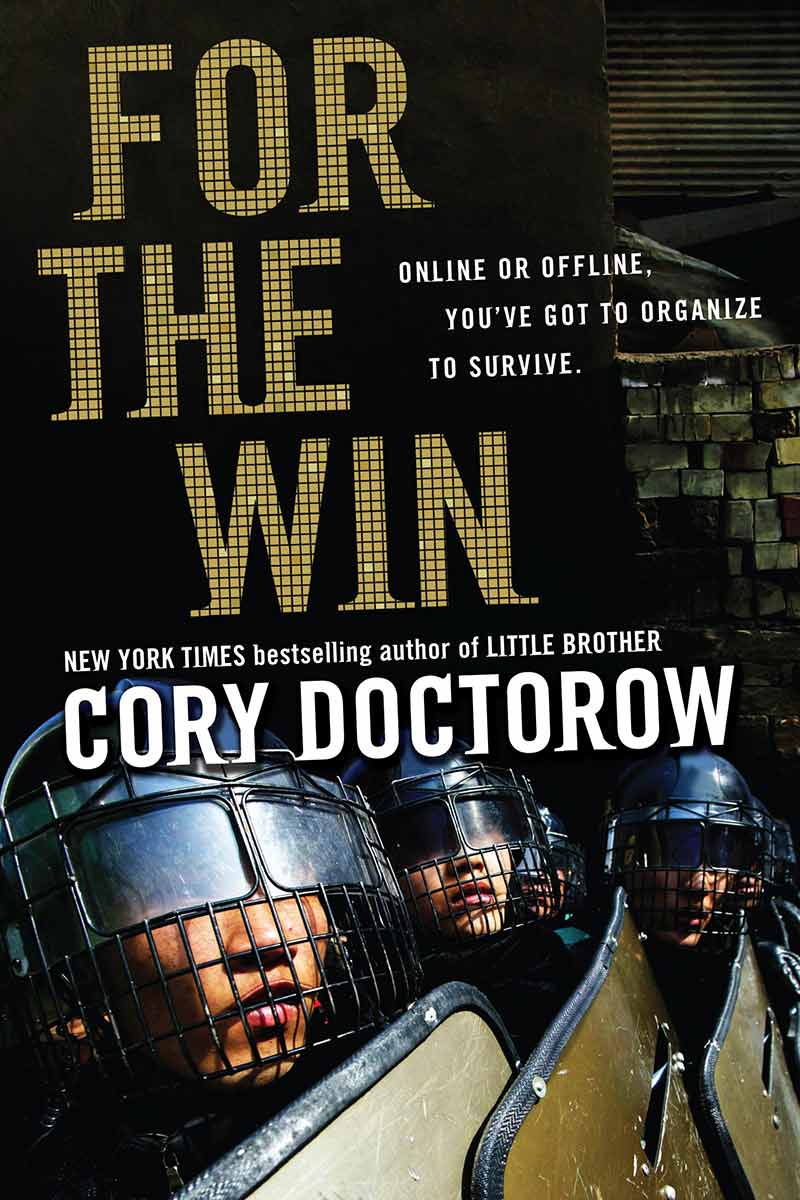
Tor Books, the US/Canada publisher, has two hundred advance copies of my next young adult novel, For the Win, available for free to young (19 or younger) gamers who are interested in reviewing the book on their blog or school paper. The book is about gamer kids all over the world who use multiplayer games to organize and fight back against abusive employers:

In the virtual future, you must organize to survive
At any hour of the day or night, millions of people around the globe are engrossed in multiplayer online games, questing and battling to win virtual “gold,” jewels, and precious artifacts. Meanwhile, others seek to exploit this vast shadow economy, running electronic sweatshops in the world’s poorest countries, where countless “gold farmers,” bound to their work by abusive contracts and physical threats, harvest virtual treasure for their employers to sell to First World gamers who are willing to spend real money to skip straight to higher-level gameplay.
Mala is a brilliant 15-year-old from rural India whose leadership skills in virtual combat have earned her the title of “General Robotwalla.” In Shenzen, heart of China’s industrial boom, Matthew is defying his former bosses to build his own successful gold-farming team. Leonard, who calls himself Wei-Dong, lives in Southern California, but spends his nights fighting virtual battles alongside his buddies in Asia, a world away. All of these young people, and more, will become entangled with the mysterious young woman called Big Sister Nor, who will use her experience, her knowledge of history, and her connections with real-world organizers to build them into a movement that can challenge the status quo.
The ruthless forces arrayed against them are willing to use any means to protect their power—including blackmail, extortion, infiltration, violence, and even murder. To survive, Big Sister’s people must out-think the system. This will lead them to devise a plan to crash the economy of every virtual world at once—a Ponzi scheme combined with a brilliant hack that ends up being the biggest, funnest game of all.
Imbued with the same lively, subversive spirit and thrilling storytelling that made LITTLE BROTHER an international sensation, FOR THE WIN is a prophetic and inspiring call-to-arms for a new generation
If you’re under 19 and want a free early look at the book for review on your blog/paper/whatever, send a note with your address to torpublicity@tor.com with “FTW” for the subject-line. Also include the name of your blog or school paper. For fun, also share a game you enjoyed recently and why.
We did this with Little Brother a couple years back, on the grounds that books for young people should be available for young reviewers to write about, rather than just adult reviewers who try to figure out whether young people will enjoy them. It was a real success and I’m happy to be repeating it.
This is being launched in honor of the American Library Association’s Teen Tech Week, and is open to Canadians and Americans. I’m working on a similar offer for the UK edition, for Britons, Aussies, South Africans and Kiwis, and will post about it as soon as I have details.