Here’s the first installment of my reading of my story Human Readable, originally published in 2005’s Future Washington anthology. It’s the tale of a world that’s been upended by hyper-efficient planning algorithms based on ant-colony optimizations, so that Los Angeles has the best traffic in the world. However, when these networks crash, they really crash — cars, surfboards, and many other common conveyances end up catastrophically failing, with concomitant loss of life.
All About:
News
I have a short-short story on the back page of this week’s Nature magazine, which just hit the stands today. The story’s called “Printcrime,” and it’s a little dystopian/utopian story about 3D printers and totalitarianism. Nature has generously granted me permission to reproduce the story in full.
The coppers smashed my father’s printer when I was eight. I remember the hot, cling-film-in-a-microwave smell of it, and Da’s look of ferocious concentration as he filled it with fresh goop, and the warm, fresh-baked feel of the objects that came out of it.
The coppers came through the door with truncheons swinging, one of them reciting the terms of the warrant through a bullhorn. One of Da’s customers had shopped him. The ipolice paid in high-grade pharmaceuticals — performance enhancers, memory supplements, metabolic boosters. The kind of things that cost a fortune over the counter; the kind of things you could print at home, if you didn’t mind the risk of having your kitchen filled with a sudden crush of big, beefy bodies, hard truncheons whistling through the air, smashing anyone and anything that got in the way.
They destroyed grandma’s trunk, the one she’d brought from the old country. They smashed our little refrigerator and the purifier unit over the window. My tweetybird escaped death by hiding in a corner of his cage as a big, booted foot crushed most of it into a sad tangle of printer-wire.

Today’s Doonesbury strip has a nice, EST-like riff on timezone tribalism.
(Thanks, Mike!)
I’ve just posted the third and final part of the podcast of Alice Taylor of the Wonderland games blog reading my story Anda’s Game. Subscribe to the podcast here (or via iTunes) or download the individual parts: Part 1, Part 2, Part 3
With the new year comes a new podcast. This time around, it’s a reading of Anda’s Game, my Nebula-Award-shortlisted story about in-game sweatshops, originally published on Salon.com and reprinted in Michael Chabon’s Best American Short Stories. However, this time around, it’s not me reading the story — it’s Alice Taylor, the founder of the Wonderland games blog and former competitive Quake player. She’s the perfect reader for this one — this story really does need to be read by a 1337 gamer-woman with a British accent to do it justice.
Alice has read the story in three parts, and I’ll be podcasting them over the next week or two. The story itself is under a Creative Commons license that allows you to redistribute the text freely — as is this podcast. Share it around, why don’t ya?
For the first time in my life, I am a full-time writer. Effective today, I’m no longer an employee — effective today, I’m a full-time, freelance word-maker. It’s something I’ve dreamt of since I was 12 years old, and now it’s a reality. Whew. Scary.
It’s an amazing feeling.
It was a hard decision to make. For the past four years, I’ve been in the employ of the Electronic Frontier Foundation, a nonprofit organization that has repeatedly kept the online world safe for you and me — that has preserved our fundamental liberties in the new digital world. Whether it’s fighting warrantless wiretaps, the criminalization of hundreds of millions of file-sharers, or greedy encroachments on the public domain, EFF is there, winning substantial and critical victories.
Working for EFF has been an education. Watching the sausage of law get ground up and stuffed into its casings is something that changes you — changes the way you think about the world and its secret workings.
So the hardest part of this decision wasn’t the worry about financial insecurity: it was the difficulty of saying goodbye to the most meaningful, rewarding and challenging job I’ve ever had. It was saying goodbye to the best, smartest, most committed and most effective activists I’ve ever had the privilege of knowing, in a lifetime of activism.
Luckily for me, I didn’t have to make a binary decision. I’m delighted to announce that EFF has named me a Fellow of the Electronic Frontier Foundation, an honor I share with attorney James Tyre. As a Fellow, I’m still within the scope of EFF’s attorney-client confidentiality and hence able to contribute on active cases.
EFF has a problem: we work on issues before anyone knows that they matter. In 2002, we were at the inaugural meeting on the Broadcast Flag, and we spent the next two years explaining to everyone we could find what this stuff was and why it mattered. We published on the risks of Trusted Computing before anyone had a clue that this isn’t just a security technology: it’s a system for gutting competition in the market and user choice and privacy by subjecting computers to control by remote parties. We’re at the Broadcast Treaty meetings at the UN, trying to get the big IT companies to understand that if its provisions come to pass, they’ll need permission from the entertainment companies to launch new services like Google Video and new devices like the Video iPod. We’ve been sounding the alarm over the Analog Hole, over paperless electronic voting machines, over DRM, since the earliest days.
EFF are canaries in the coal-mine, the first responders of cyberspace, building coalitions and briefing lawmakers, users and companies on the risks coming down the pipe. This is a critical job: if the resistance to these issues only mobilized once their risks had percolated out to the wide world, it would be too late. You need to start work on these issues as they are born, not when they are about to mature.
But the problem is that this makes EFF into an organization whose core issues are hard to explain to the mass audience, or even to the mass audience of geeks (witness the number of online posts that mangle our issues). Everyone wants to describe the Broadcast Flag as a system for stopping you from recording video, but that’s just not true, and if you go around saying it, lawmakers will think you’re full of it. The Broadcast Flag’s danger is much deeper and subtler: it puts the features of electronics and computers under the veto of entertainment companies, who intend to use this veto to block any features that disrupt their business models. That’s a lot scarier — but it’s also more abstract and wordier. Saying that the issue isn’t recording, but freedom to build better recorders is true, and it’s also hard to make understood.
I’ve been privileged to participate in a years-long effort on the part of EFF to make these issues more accessible without sacrificing accuracy. It’s working. Our membership rolls have swollen, our staff has too. Geeks and civilians around the world have opened their wallets and have contributed signatures, code, and advocacy. You can, too: donations to EFF are tax-deductible, and there are many other ways to contribute — see here
So what am I going to be doing now that I don’t have a day-job? Well for starters, I’m going to be getting a full night’s sleep every night. I’m going to stop travelling three weeks a month. I’m going to join the gym and get the hundred and a half household chores I’ve neglected while working three full-time jobs for the past two years done. I’m going to get a checkup and have my teeth x-rayed. All that overdue stuff I’ve put off and put off and put off.
Most importantly, though: I’m going to write. More blog posts, and longer ones. I have three novellas in the pipe. I’m tripling the pace of work on Themepunks, my fourth novel, and plan to have it in the can by early spring. I’m going to do a fix-up novel with Charlie Stross, completing our “Huw” stories (Jury Service and Appeals Court) and publishing them between covers. My podcast is going thrice weekly. I’ve got articles in production for a bunch of magazines and websites.
I’m not giving up on travel altogether. I’m still going to be speaking at various companies and conventions and seminars on technology, authorship and copyright, but a lot less of that. I’ll be spending most of April in Australia, New Zealand and Japan at various speaking gigs and conventions like ConJure, the national Aussie SF con in Brisbane; I’m a guest of honor at Boskone in Boston in February; I’ll be at the LIFT conference in Geneva in January and a Red Hat con in Nashville in June. But for all that, I’m going to be spending approximately 1000 percent more time sitting in one place, concentrating on one task. I can’t wait.
I’m also going to be working on numerous civil liberties causes. I’m proud to serve on the Boards of Directors for two great charities, the Participatory Culture Foundation, creators of the indie Internet TV platform DTV and the MetaBrainz Foundation, which oversees development of the MusicBrainz system for distributing free, rich metadata about music.
There’s also some big plans for a long, nonfiction DRM-book/research project lurking around here. With any luck I’ll be able to announce more about that in late January or early February.
This is the most exciting day of my life — the day I quit my day-job. Thanks to everyone who made this possible, all the readers and bloggers and friends and editors and agents. I’ll do my best not to screw it up!
I’m going on a much-needed offline holiday between now and January 1, 2006. Save your email until then, or send me a message to get some substitute addresses you can write to if you need an urgent reply. Remember that you should always send Boing Boing suggestions to the form here, and not to my email address.
Happy holidays! See you in 2006!
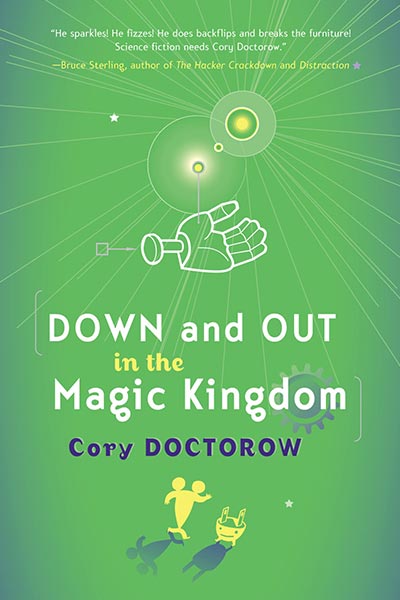
Mitch did a project for a San Francisco State University course in Design and Industry in which he created three alternative covers for Down and Out in the Magic Kingdom. He sez,
The cover titled “experimental” is a photo I shot of Tomorrowland with my Digital Rebel from the Monorail last year. I added vertical grain to it to give it a dissonant look. The type is terminal inspired.“conventional” is a drawing of a robot action figure that I did a little while back which turned out to work really well with this project. Reminiscent of the animatronics in the story. This is my favorite of the covers.
Not much to say about the typographic cover other than I like the way your name turned out with the bisecting line.

Mitch did a project for a San Francisco State University course in Design and Industry in which he created three alternative covers for Down and Out in the Magic Kingdom. He sez,
The cover titled “experimental” is a photo I shot of Tomorrowland with my Digital Rebel from the Monorail last year. I added vertical grain to it to give it a dissonant look. The type is terminal inspired.“conventional” is a drawing of a robot action figure that I did a little while back which turned out to work really well with this project. Reminiscent of the animatronics in the story. This is my favorite of the covers.
Not much to say about the typographic cover other than I like the way your name turned out with the bisecting line.
Last month at London’s Stanhope Centre, I gave a little reading from the next book of Themepunks, the novel in progress that Salon syndicated book one of last autumn. Paul Parkinson recorded it and put it on his podcast — here’s the MP3 of the reading and the Q&A that followed.