/ / News

The Guardian’s Michelle Pauli has written a stupendous profile of me and review of MAKERS for today’s edition:

In Makers, 3D printers are used to run off everything from homes for squatters to the fairground rides that cause the plot-twisting showdown with Disney. But, typically for a Doctorow novel, it’s not as far-fetched as it might sound: the 3D world is already here. He jumps up to show me a 3D museum object, part of a bear’s jaw, that was scanned and printed in six hours, and explains that he’s waiting for the post to bring one of the first 3D-printed objects he’s ordered online (“a beautiful big steel cross that looks like a nun’s cross except that the tips are screwdriver tips and it’s actually a multi-driver and it hangs around your neck from a leather thong!”) “We’ll have 3D printers which will make the world weird and they will beget something even weirder. 3D printers are just for starters!” he says, gleefully.

Despite his success in fiction – last year’s young adult novel Little Brother was a New York Times bestseller and he has previously won the Locus award and been nominated for Hugo and Nebula awards – Doctorow is better known in some quarters for his political activism around digital freedom and open rights. He’s the former European director of the Electronic Frontier Foundation, a civil liberties group that defends freedom in technology law, policy and standards; he co-founded the UK Open Rights Group; and he’s currently campaigning on the government’s draconian digital rights bill. Both sides of his work come together in his novels, not just in terms of subject matter but in the way they are distributed. Although published by mainstream presses, Doctorow also releases all his books for free download from his website under a creative commons licence, and talks enthusiastically about the uses people have made of these free online versions of his books, from foreign translations and student films to a teacher in a Detroit school for the blind who was able to run the download of Little Brother through the school’s Braille embosser for her students without having to painstakingly retype the whole book first.

/ / News

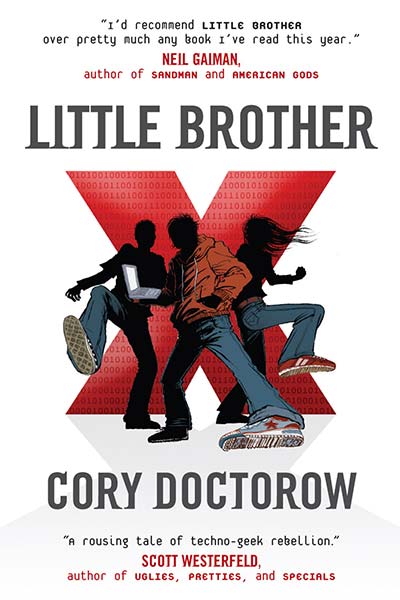
The Trans-Atlantic Fan Fund is a venerable institution that sends sf fans from North America to Europe and vice-versa, to bridge the world’s fandoms (there are other funds that bring together fans from other parts of the world). Frank Wu, Anne KG Murphy and Brian Gray are fundraising for this year’s fund, and they’ve solicited many writers — Charlie Stross, Nalo Hopkinson, David Brin, Elizabeth Bear, Julie Czerneda and Mary Robinette Kowal and me! — to donate “tuckerizations” in forthcoming works for a charity auction. Tuckerizing is the inclusion of a real person’s name in a fictional piece (previous tuckerizations from charity auctions in my novels include General Graeme Sutherland in Little Brother, Suzanne Church in Makers, and Connor Prikkel in the forthcoming For the Win; my god-daughter Ada has also been tuckerized in my story “I, Robot” and in Makers).

TAFF is also auctioning off a first edition of “Nineteen Eighty-Four” (!), and John Hersey’s “Hiroshima.”

It’s a great cause, and great prizes that make killer gifts (how cool would it be for a kid to grow up with her name on a character in a wonderful novel?)

TAFF updatery!

(Thanks, Frank!)

/ / News

Nice, short profile in today’s Wall St Journal about pursuing a career in the nonprofit sector:

For those who are interested in doing the same, he stresses the importance of volunteering for a cause first. “Your best bet is to join up with a cause pro bono or part time,” he says. “You have to be realistic and see the value of each experience.”

Among the various types of nonprofits, some of the most visible are community-based organizations that provide direct services such as Meals on Wheels, job-placement assistance and child care. Others are concerned with arts and culture, advocacy and social policy, scientific research or international outreach.

How do you go about targeting a nonprofit with which to work? Mr. Doctorow recommends approaching organizations as a donor would and looking carefully at their statistics. “Find out their ideology, how they pay their executives, how they administer their funds and how they handle crises,” he says.

If your hope is to procure a full-time job, your odds will be better if you select a larger nonprofit. Staff roles at these organizations include the executive director, the director of development (fund raising), the director of programming and the director of marketing.

/ / News

My latest Guardian column looks at Peter Mandelson’s new “Digital Economy Bill,” a sweeping piece of proposed British legislation that would give Mandelson broad powers to act as the Pirate-Finder General, with the implausible aim of reducing UK file-sharing by 70 percent in one year.

Mandelson argues that Britain’s Digital Economy will be based on the contrafactual premise of a steady decrease in computer speed, drive capacity, technical competence, network versatility and network ubiquity. Of course, the real digital economy is in those British companies that figure out how to thrive whether or not copying occurs – companies that use networks to reduce their costs, reach larger customer bases, and provide services whose demand and profitability grow with network use, companies such as Last.fm or Moo.com.

These companies’ businesses are inconceivable without the net, but they also risk being collateral damage in Mandelson’s war on the British internet. Just increasing the liability for copyright infringement (and creating a duty to police user-submitted files for infringement) could bankrupt either company overnight. How would Moo sell business cards with your personal photos on them if they could be sued into oblivion should those photos turn out to infringe copyright?

Mandelson is standing up for the Analogue Economy, the economy premised on the no-longer-technically-true idea that copying is hard. Companies based on the outdated notion of inherent difficulty of copying must change or they will die. Because copying isn’t hard. Copying isn’t going to get harder. This moment, right now, 2009, this is as hard as copying will be for the rest of recorded history. Next year, copying will be easier. And the year after that. And the year after that.

Why does Mandelson favour the Analogue Economy over the Digital?