I sat down with BookBaby‘s Brian Felsen last month at the London Book Fair for a long interview about business, publishing, authorship and copyright. Brian’s just posted the first installment of several that comprise the whole discussion.
All About:
News

While I’m in New York for Personal Democracy Forum, I’ll be participating in a group signing/launch for Welcome to Bordertown, the shared-world fantasy anthology of stories about Bordertown, where faerie and the human world meet and magic and technology are equally unreliable. In attendance will be Holly Black, Alaya Dawn Johnson, Annette Curtis Klause, Ellen Kushner and Delia Sherman. If you can’t make it, you can pre-order a signed copy for delivery or pickup.
Where: Books of Wonder, 18 West 18th Street, New York, NY 10011, (212) 989-3270
When: June 9, 6-8PM
Make has posted on of my columns from the print edition online; “Walled Gardens vs. Makers” is a look at the way that modern, Internet-era making is built on knowledge sharing and collaboration, and how walled gardens get in the way:
Because, of course, today I have millions of hacks and tips and tricks and ideas at my fingertips, thanks to the internet and the tools that run on top of it. When I invent or discover something, I immediately put it on the net. And when I find myself in a corner of the world that is not to my liking, I Google up some hack that someone else has put on the net and apply it or adapt it to my needs.
Making, in short, is not about making. Making is about sharing. The reason we can make so much today is because the basic knowledge, skills, and tools to make anything and do anything are already on the ground, forming a loam in which our inspiration can germinate.
My latest Guardian column, “Google’s YouTube policy for Android users is copyright extremism,” examines the theory of copyright behind Google’s announcement that it would bar people who unlocked their phones from using the new YouTube video store. This is the latest example of a new kind of copyright emerging in the 21st century, “configuration-right,” in which someone who makes a creative work gets a veto over how all the devices that can play or display that work must be configured. It’s a novel — and dangerous — proposition, akin to record companies telling which furniture you were allowed to move into the same room as your stereo, and to require that you close your window when the record was playing, lest your neighbors get some tunes for free.
Which brings us back to where we started: unless you’re running a very specific version of Google’s software on your phone or tablet, you can’t “rent” movies on YouTube. Google – the vendor – and the studios – the rights holders – are using copyright to control something much more profound than mere copying. In this version of copyright, making a movie gives you the right to specify what kind of device can play the movie back, and how that device must be configured.
This is as extreme as copyright gets, really. Book publishers have never told you which rooms you could read in, or what light bulbs you were allowed to use, or whether you could rebind the book or take it abroad with you. Broadcasters have never vetoed the design of radios.
The extension of copyright to “configuration right” is a profound shift in the history of technology and culture. There are lots of reasons to want to a non-stock OS on your Android phone; some versions allow you to assert fine-grained privacy controls, others add features useful to people with disabilities; others make it simpler to use cheap/free voice-over-IP for long-distance calls. There are at least as many reasons to want to redecorate and reconfigure your phone, your computer or your tablet as there are reasons to rearrange your kitchen or redecorate your bedroom.
Google’s YouTube policy for Android users is copyright extremism
Earlier this year, I interviewed IT Crowd creator Graham Linehan at The Story conference. Matt Locke, who put on the event, has just posted an MP3 of the chat.
Here’s a short video I recorded for The Guardian called “Every Pirate Wants to Be an Admiral,” in which I lay out the case for a less-restrictive copyright as better for culture.
Cory Doctorow on copyright and piracy: ‘Every pirate wants to be an admiral’

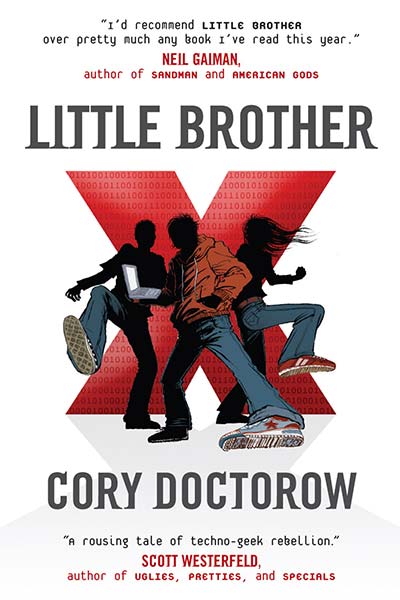
Eleventh graders at Oakland International High School read my novel Little Brother and produced a fantastic school reading kit with chapter summaries, student discussions, student-made comic strips, and further topics for classroom discussion. It’s a tremendous piece of work, and I’m grateful to the young people in Sailaja Suresh’s class.

Eleventh graders at Oakland International High School read my novel Little Brother and produced a fantastic school reading kit with chapter summaries, student discussions, student-made comic strips, and further topics for classroom discussion. It’s a tremendous piece of work, and I’m grateful to the young people in Sailaja Suresh’s class.
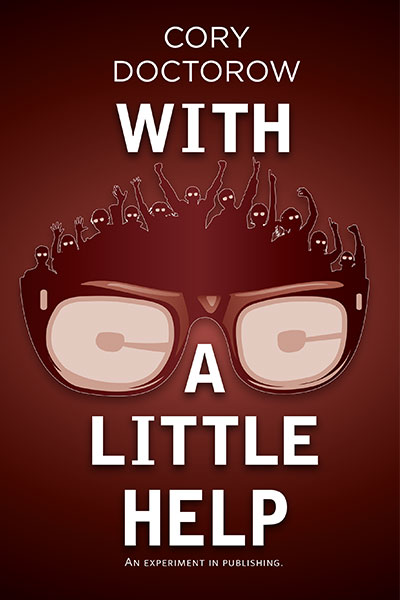
My new DIY short story collection With a Little Help has garnered a positive writeup and review in the Wall Street Journal, thanks to Tom Shippey:
So far so good, but “With a Little Help” shows that Mr. Doctorow isn’t starry-eyed about what will happen next. State bureaucracies can use technology as well as individuals, and a struggle has already started over who will control the Internet. The evil side of the IT revolution is that the state can check on everything, and its data-banks get bigger all the time. Who has not cracked a joke in an email, or made some electronic comment, that could be taken the wrong way? Once you’ve attracted attention, the story “Scroogled” points out, “scroogled” is exactly what you could be.Another Doctorow thought: Computer-guided traffic could be much more efficient, right? But would it be fair, or would the road clear magically for government apparatchiks and guys with the right microchip, while all the lights turn mysteriously red for those on some secret gray-list? The story “Human Readable” puts both sides of the argument.
Whatever the future, here and now Mr. Doctorow’s stories offer compelling images of the way it’s going to be. Venture capitalists? Forget them, says “Other People’s Money.” Big money is dumb money. Much easier, says one old-lady manufacturer to a smart young gigafund manager, for her to make and market her own product, and keep the money (just like Mr. Doctorow), than for him to find and fund a hundred products and take a rake-off. He only deals in six-figure multiples, and that’s no good: not nimble enough. And he has to get a return on all those billions, poor outdated soul.
My new DIY short story collection With a Little Help has garnered a positive writeup and review in the Wall Street Journal, thanks to Tom Shippey:
So far so good, but “With a Little Help” shows that Mr. Doctorow isn’t starry-eyed about what will happen next. State bureaucracies can use technology as well as individuals, and a struggle has already started over who will control the Internet. The evil side of the IT revolution is that the state can check on everything, and its data-banks get bigger all the time. Who has not cracked a joke in an email, or made some electronic comment, that could be taken the wrong way? Once you’ve attracted attention, the story “Scroogled” points out, “scroogled” is exactly what you could be.Another Doctorow thought: Computer-guided traffic could be much more efficient, right? But would it be fair, or would the road clear magically for government apparatchiks and guys with the right microchip, while all the lights turn mysteriously red for those on some secret gray-list? The story “Human Readable” puts both sides of the argument.
Whatever the future, here and now Mr. Doctorow’s stories offer compelling images of the way it’s going to be. Venture capitalists? Forget them, says “Other People’s Money.” Big money is dumb money. Much easier, says one old-lady manufacturer to a smart young gigafund manager, for her to make and market her own product, and keep the money (just like Mr. Doctorow), than for him to find and fund a hundred products and take a rake-off. He only deals in six-figure multiples, and that’s no good: not nimble enough. And he has to get a return on all those billions, poor outdated soul.