Metropolis, a German/French documentary series from Arte.tv, shot a short documentary with me about online freedom and surveillance, and science fiction. They’ve put the episode online as a free, remixable, Creative Commons licensed download.
Metropolis, a German/French documentary series from Arte.tv, shot a short documentary with me about online freedom and surveillance, and science fiction. They’ve put the episode online as a free, remixable, Creative Commons licensed download.
Posted to Boing Boing yesterday — but in the hustle and bustle, forgot to put i t here!

I am ecstatic to announce a new Happy Mutant on the scene:
Doctorow. Hatched at home, in a pool, this morning, in London, weighing 9 lbs and 6 oz. All bits correct and accounted for. Already stolen the hearts of all who see her.
Consider me on paternity leave until further notice.
Forbes magazine just published my latest article for them, a piece for a special on global pop culture about the “otaci” — Romanian manga enthusiasts who remix French, Japanese and American comic styles, language and stories:
The artwork in the individual panels veered from traditional Japanese manga to surreal, “adult” images seemingly lifted from the French classic magazine Métal Hurlant to stuff that could have come from the pages of the latest Marvel comic. The text, too, was a glorious linguistic salmagundi, mostly Romanian, but with English, French and Japanese phrases sprinkled liberally throughout.“What the hell is this thing?” I shouted at Stefan, over the din of the monstrous, grinding automated mojito machine that was attempting to crush lemons beside us.
“They choose different languages and styles based on the kind of stories they want to tell,” he said.
In my new Guardian column, “Copyright law should distinguish between commercial and cultural uses,” I argue for a new kind of copyright law, one that mirrors the “folk copyright” that individuals have lived by for decades — the alternative is to try to get kids and fans to participate in the “real” copyright, a system of industrial regulation so complex that it can barely be understood by full-time copyright attorneys.
This is a genuinely radical idea: individuals should hire lawyers to negotiate their personal use of cultural material, or at least refrain from sharing their cultural activities with others (except it’s not’s really culture if you’re not sharing it, is it?).
It’s also a dumb idea. People aren’t going to hire lawyers to bless the singalong or Timmy’s comic book. They’re also not going to stop doing culture.
We need to stop shoe-horning cultural use into the little carve-outs in copyright, such as fair dealing and fair use. Instead we need to establish a new copyright regime that reflects the age-old normative consensus about what’s fair and what isn’t at the small-scale, hand-to-hand end of copying, display, performance and adaptation.
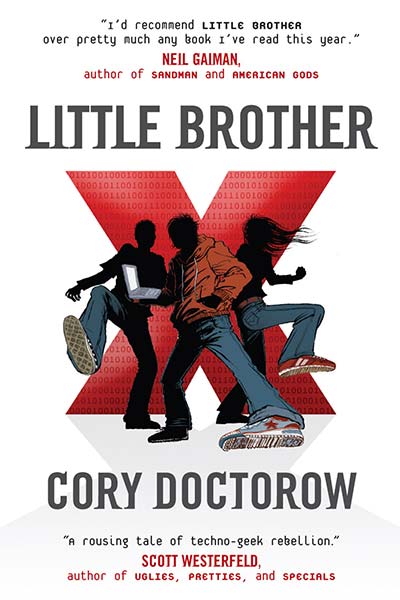
Publishers Weekly has published an amazing feature on my forthcoming novel Little Brother, and all the buzz it’s gotten so far:
Little Brother offers more in the way of circuit boards than gears, and could almost be read with a laptop in hand. Marcus frequently makes reference to hacks (ways to reprogram computers and other devices to suit one’s needs), Internet history (such as the protocols that make email work) and privacy-protection programs (like The Onion Router, which allows users to access Web sites that might otherwise be blocked by censorware), all of which beg to be looked up on Google or Wikipedia. In addition, Doctorow makes use of Internet slang known as “leetspeak” (Marcus describes a female friend as “totally h4wt,” and notes that some of his attempts to interfere with the DHS surveillance might be considered “a little aggro,”as well as acronyms for activities that range from “ARGing” to “LARPing” (participating in Alternate Reality Games or Live Action Role Play).“One thing I admire is that everything he talked about in the book, he explained—at least to the extent you could get an idea of it,” says Jordan Gower, a bookseller at Harry W. Schwartz Bookshops in Milwaukee, Wis. “But he didn’t do it in a way like he’s trying to teach a child. It was more like he was just spreading his information.” Nielsen Hayden believes that Doctorow “nailed” the book’s language (at least according to his nephews, he jokes), though he also admits that there’s always a danger of slang becoming outmoded. “The Internet speeds up the process by which kid language and slang evolve and change,” he says.
Here’s my latest column for CBC’s Search Engine — my Facebook Faceplant editorial.

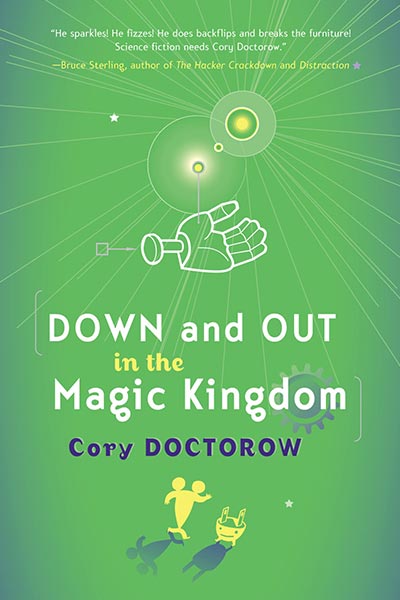
Matt sez, “The science fiction and software event Penguicon is converting its volunteer rewards system into Whuffie, the reputation economy from Cory Doctorow’s science fiction novel Down and Out in the Magic Kingdom. The attendance badges and currency will use a barcode system to track individual work throughout multiple years. It is described in this post to the Penguicon blog.”
Stupendous! I had a completely rockin’ time a Penguicon a couple years back — it’s the perfect mix of geek passions. Plus, Whuffie’s about as stable a currency as you’re likely to find these days as half a petabuck of toxic debt gets de-leveraged.
(Thanks, Matt!)
Matt sez, “The science fiction and software event Penguicon is converting its volunteer rewards system into Whuffie, the reputation economy from Cory Doctorow’s science fiction novel Down and Out in the Magic Kingdom. The attendance badges and currency will use a barcode system to track individual work throughout multiple years. It is described in this post to the Penguicon blog.”
Stupendous! I had a completely rockin’ time a Penguicon a couple years back — it’s the perfect mix of geek passions. Plus, Whuffie’s about as stable a currency as you’re likely to find these days as half a petabuck of toxic debt gets de-leveraged.
(Thanks, Matt!)
Wired’s Clive Thompson has a thought-provoking column about science fiction and philosophy in the latest ish, and he was kind enough to cite my story After the Siege as an example of what sf does well:
Technically, After the Siege is a work of science fiction. But as with so many sci-fi stories, it works on two levels, exploring real-world issues like the plight of African countries that can’t afford AIDS drugs. The upshot is that Doctorow’s fiction got me thinking — on a Lockean level — about the nature of international law, justice, and property.
Which brings me to my point. If you want to read books that tackle profound philosophical questions, then the best — and perhaps only — place to turn these days is sci-fi. Science fiction is the last great literature of ideas.
From where I sit, traditional “literary fiction” has dropped the ball. I studied literature in college, and throughout my twenties I voraciously read contemporary fiction. Then, eight or nine years ago, I found myself getting — well — bored.
One of the coolest things about using Creative Commons licenses on my work is how they allow readers to try stuff that I’d never be able to do on my own — like the fan-translations of my stories.
This week, I’ve got news of four more fan-translations of my Radar story Scroogled, which tries to paint a picture of what the world would be like on the day that Google turned evil. The story has been translated into sixteen languages now, including the latest additions:
Additionally, Pavol Hvizdos (who previously translated my novel Someone Comes to Town, Someone Leaves Town and my story Truncat into Slovak) has also translated my story 0wnz0red into Slovak, where he’s translated the title as 0v1adany.