Review:

SFWeekly

Doctorow aligns himself right from the get-go with an axis of serious jocularity, whose members are such folks as Rudy Rucker, Robert Sheckley, Matt Ruff, Jonathan Lethem and, at his loosest, Bruce Sterling. These authors spin off wild blue-sky ideas in rigorous profusion, as many as any recognizable hard SF author, but couch them in absurdist plots populated by eccentrics and oddballs. (It’s interesting, for instance, to compare Doctorow’s book with John Wright’s The Golden Age [2002]), which deals with many of the same issues of posthuman living, but ! in a sober, leaden tone.) Life is not to be taken too seriously in the works of these writers, and Doctorow has come up with a great objective correlative to this attitude, in the ability of his protagonists to spring back even from explosive bodily destruction, like Wile E. Coyote. (The downloading-into-clones motif was definitively established by John Varley 30 years ago, but even he did not employ it so blithely.)

In any case, what we have here is a rare example of post-Singularity fiction. The Singularity, or Spike, is deemed to be that moment at which mankind emerges into transhuman existence, with or without the help or hindrance of strong AI. (Doctorow eschews the AI, for the most part.) Envisioning such a future is one of the hardest tasks an SF writer can take on, but Doctorow proves himself equal to the challenge. His reorganization of society into ad-hocs craving Whuffie derives a lot from present-day cyber-culture (Slashdot, and all that), and his biomorphic mutability seems positively Extropian. But the exact mix is unique, especially when the fixation on Disney World as a kind of prototype for artificial landscapes is thrown in. And surely Jules’ jazzy first-person narration, laden with future jargon, is essential to the success of the tale. Although readers might initially balk a bit when encountering on the second page of the book a sentence such as “I took! a moment to conjure a HUD with his Whuffie score on it.”

Paul Di Filippo,
SF Weekly

/ / Down and Out In the Magic Kingdom, News

One of my favorite authors, Paul Di Filippo, reviews Down and Out in the Magic Kingdom in this week’s SF Weekly:

In any case, what we have here is a rare example of post-Singularity fiction. The Singularity, or Spike, is deemed to be that moment at which mankind emerges into transhuman existence, with or without the help or hindrance of strong AI. (Doctorow eschews the AI, for the most part.) Envisioning such a future is one of the hardest tasks an SF writer can take on, but Doctorow proves himself equal to the challenge. His reorganization of society into ad-hocs craving Whuffie derives a lot from present-day cyber-culture (Slashdot, and all that), and his biomorphic mutability seems positively Extropian. But the exact mix is unique, especially when the fixation on Disney World as a kind of prototype for artificial landscapes is thrown in. And surely Jules’ jazzy first-person narration, laden with future jargon, is essential to the success of the tale. Although readers might initially balk a bit when encountering on the second page of the book a sentence such as “I took! a moment to conjure a HUD with his Whuffie score on it.”

“Ten thousand years ago, the state of the art was a goat,” opines Dan at one point. Well, by that measure Down and Out in the Magic Kingdom is some kind of transgenic supergoat whose milk is full of spidersilk proteins and nutraceuticals.

Review:

Trashotron

But operating beneath this glossy, enjoyable surface is a very complicated world filled with intelligently conceived advances and retreats. From the contents of a 208 page book, one could excavate more than a few doctoral theses on various aspects of Doctorow’s Bitchun Society. For current computer geeks, Doctorow sprinkles his prose with just the right number of Unix-derived terms. For sociologists, Doctorow has constructed a fascinating society where the currency is the respect you receive from those who know you. For futurists, Doctorow has offered up a gleaming utopian vision utterly unlike those of other cyberpunk authors. For anybody who has ever had to backup or restore their computer’s files, he offers heaven itself. For all the simplicity and limpidity of the narrative, there’s a very complex stew of ideas bubbling just underneath Doctorow’s sunny story.

‘Down and Out In the Magic Kingdom’ is a novel of ideas. It shares more in common with the work of Stanislaw Lem than with William Gibson. Cheap laughs and deep thoughts jostle one another, having a swell time as the reader enjoys the painful revelations that await Jules. Doctorow covers a lot of conceptual ground in a small space, and he makes something that’s rather complex look ridiculously easy. But don’t try this at home kids. You may injure your brain. If you’re not backed up, then you might not be able to recover. We may think we’re bitchin’ — but we’re not Bitchun yet, not by a long shot.

Rick Kleffel,
Trashotron
Review:

SFRevu

After you’ve beaten death, disease and poverty where do you go to while away the hours? What can you do to fill up the value void left in the wake of abandoned humanism?

Cory Doctorow, a brilliant Canadian short story author with plenty of promise, sets forth his own answer in his first novel, Down and Out in the Magic Kindgdom. You go to Disneyworld.

Brighter minds than mine will probably see Disneyworld as a metaphor for post-human reality. It’s a classic example of a group of humans finding meaning in going through the motions. Is the charade of characters and guests at mouseland any less real than the charade of walking around being “yourself”?

When we’ve opted for backups of our experiences that can be loaded into fast grown clones, when whatever you want can be poured out of a faucet for the asking, what’s left that we can find meaning in?

Ernest Lilley
SFRevu

/ / Down and Out In the Magic Kingdom, News

SFRevu is running an interview with me, and a review of Down and Out in the Magic Kingdom:

Ern: If you don’t count that as SF, what was your first identifiably SF or Fantasy experience?

Cory: It was actually a story-telling experience. My dad had grown up on Conan comics and the Robert E. Howard books, and he retrofitted Conan storylines into Socialist parables that he used to tell me on long car trips. Starring a multiethnic, gender balance trio called Harry, Mary and Larry. So I grew up on these sort of redacted Conan stories that been worked out as parables about workers paradise stories. There are a lot of first and second generation Marxists in Science Fiction today, you’ve got people like Stephen Brust, and China Miéville and Ken McLeod. The techno-utopianism is the one thing you never shake when you grow up in a Marxist household; it’s the unshakeable faith that technology can affect positive social change.

Review:

San Francisco Chronicle

Doctorow throws off cool ideas the way champagne generates bubbles…[he] definitely has the goods to be a major player in postcyberpunk science fiction. His ideas are fresh and his attitude highly engaging.

/ / Down and Out In the Magic Kingdom, News

Shift Online has published a great, long article about the ways that the Bitchun Society parallels our present day world, based on an interview we did.

But here’s the kicker: Democracy — or the version of it that we know now anyway, that we’re most comfortable with — is already changing in the real world. Put on your Cory Doctorow goggles and re-examine today’s political landscape: “Internet politics are increasingly post-left-right dichotomy,” he says. “The medium is the message — I think that the internet makes you into a libertarian to a certain extent. Because you can see non-hierarchical, non-centralized systems working, and it becomes hard to credibly claim that we need increased centralization in order to create order or equity or equitableness.” We’ve seen that with the fall of Yahoo, he explains, which was a centralized listing of what was on the internet, edited by a very small group of individuals. The sites on Google, on the other hand, are ranked by everyone who owns a website. “It’s hard to be a left-winger in the sense of a centralized authority-endorsing individual, or a right-winger in that sense. There are lots of strange bedfellows that have been made, certainly. My friend Patrick Nielson Hayden was just in the march in D.C. and he described marching in a blogger contingent that included someone who was carrying a sign that said ‘Peace Now, Socialism Never’ alongside people who were old lefty red-diaper baby types.”

In such a climate, one of decentralization where the only criteria for participating in a movement is your belief in the cause at hand, maybe a Disney World overrun by fans isn’t quite so hard to fathom.

/ / Novels

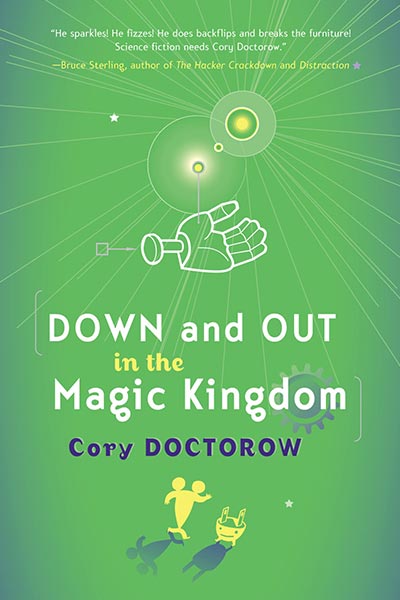
My first novel was published in January 2003. It concerns the machinations of technologically immportals who have occupied Walt Disney World’s Haunted Mansion and who aim to preserve it from the depredations of modernizers who would renovate it.

The book won the 2003 Locus Award for Best First Novel and is a finalist for the 2004 Nebula for Best Novel.

The whole text of the novel is available as a free download in a multitude of formats, as well as a physical object at bookstores everywhere.

Slovakian fan-translation by Pavol Hvizdos.