/ / News

Great Writing, a volunteer run alternative to the BBC’s defunct Get Writing program, has the first part of a two-part interview with me online today:

Science fiction is one of the most vibrant forms of literature. It’s one in which traditional storytelling is still very important; using narrative arcs to build tension and having likeable, identifiable and sympathetic characters – they’re the key elements of most successful work. In that sense it’s a great reaction against a lot of modern literature which tends to deride those things or replace them with more experimental forms – some of which is quite good but it’s not something that suits my own palate. I think as a literature of ideas or a literature of speculation SF speaks to me, because we live in an era where the future is not only up for grabs but also steadily overtaking us. It’s hard to make sense of those two things without a literature of the ideas of what it means to live in an era of change. The stories and novels that I write are increasingly about change and how people cope with it. Not specific changes per se but about the idea of change in general. Futureshock and then some…

For example, what does it mean to live in a market economy that’s almost perfectly competitive – such that your goods go from having a 50% margin at the time that you invent them (because no-one else offers a comparable good in the market and so you can charge whatever you want for it), to basically a 0% margin in six months, when global competitors can move in and drive the costs down and down? What does that mean as a citizen? What does that mean to people as entrepreneurs? I think they’re good questions to ask and they’re the kind of things I try to answer in the stories that I work on.

/ / News

I gave a talk on copyright reform last month to librarians and other interested parties at the University of California at San Diego. The video
is online now:

Doctorow talked about Digital Rights Management (DRM) and the new Access to Knowledge movement underway to safeguard the rights of archivists, disabled people, and educators. This movement has been successful in helping to create a development agenda at the World Intellectual Property Organization (WIPO). For some background see “WIPO to convene meetings on ‘development agenda'”.

(Thanks, James!)

/ / Down and Out In the Magic Kingdom, News

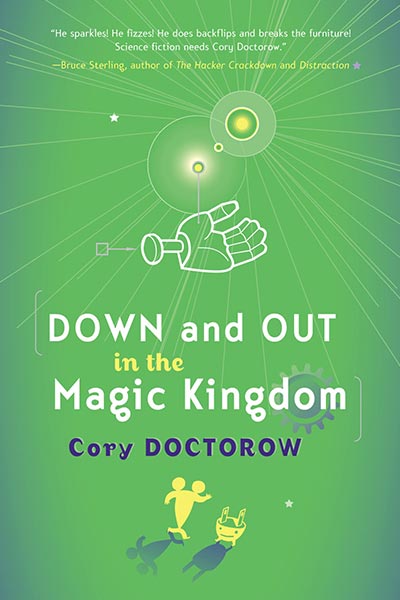
In honor of Talk Like a Pirate Day, Sydd Souza has run my Down and Out in the Magic Kingdom through a perl script that translated it into pirate speak:

I lived long enough t’ be seein’ th’ cure fer Davy Jones’ locker; t’ be seein’ th’ rise o’ th’ Bitchun Society, t’ learn ten languages; t’ compose three symphonies; t’ reckon me boyhood dream o’ takin’ up residence in Disney World; t’ be seein’ th’ Davy Jones’ locker o’ th’ workplace an’ o’ work.

I nerethought I’d live t’ be seein’ th’ tide when Keep A-Movin’ Dan would decide t’ deadhead until th’ heat Davy Jones’ locker o’ th’ Universe.

/ / Down and Out In the Magic Kingdom, News

A conceit in my novel Down and Out in the Magic Kingdom is that our cellphones will disappear into our bodies, silently feeding us audio via cochlear implants and micing our throats to pick up sub-vocalizations (something I think I ripped off from Harry Harrison, though others have done it too). Now a DARPA program has produced a functional prototype of a subvocal pickup that can turn words you haven’t spoken into signals on the wire.

One system, being developed for DARPA by Rick Brown of Worcester Polytechnic Institute in Massachusetts, relies on a sensor worn around the neck called a tuned electromagnetic resonator collar (TERC). Using sensing techniques developed for magnetic resonance imaging, the collar detects changes in capacitance caused by movement of the vocal cords, and is designed to allow speech to be heard above loud background noise.

DARPA is also pursuing an approach first developed at NASA’s Ames lab, which involves placing electrodes called electromyographic sensors on the neck, to detect changes in impedance during speech. A neural network processes the data and identifies the pattern of words. The sensor can even detect subvocal or silent speech. The speech pattern is sent to a computerised voice generator that recreates the speaker’s words.

(Thanks, John!)

/ / News

The fall edition of Currents in Electronic Literacy contains a tremendous scholarly essay on my novel Down and Out in the Magic Kingdom by Eric Mason, called “Remediating the Magic Kingdom: Notes Toward a Poetics of Technology.”

This description of the process of flash-baking reveals the textuality of technology because the experience of the Presidents’ lives that the technology delivers is achieved specifically through texts such as “newspaper headlines, speeches, distilled biographies, personal papers.” The technologicity of texts that this description constructs is one that downplays the specific technological context of these textual genres (i.e. attempts to obscure their specific technologicities). The techno-logic of “gestalts” presented above suggests as well that the experience of a technology is irrelevant to its content–that you can place content from newspapers and biographies into the technology of flash-baking without any loss or change. Such a technologicity of texts works to undermine the specificity of a text’s technological context and the lived experience of technology. Conversely, a responsible poetics of technology refuses to ignore and refuses to obscure the irreducible differences of technologies, arguing that a text and the technology used to create and consume it are consubstantial elements that can be articulated but never transcended.

/ / Down and Out In the Magic Kingdom, News

The fall edition of Currents in Electronic Literacy contains a tremendous scholarly essay on Down and Out in the Magic Kingdom by Eric Mason, called “Remediating the Magic Kingdom: Notes Toward a Poetics of Technology.”

This description of the process of flash-baking reveals the textuality of technology because the experience of the Presidents’ lives that the technology delivers is achieved specifically through texts such as “newspaper headlines, speeches, distilled biographies, personal papers.” The technologicity of texts that this description constructs is one that downplays the specific technological context of these textual genres (i.e. attempts to obscure their specific technologicities). The techno-logic of “gestalts” presented above suggests as well that the experience of a technology is irrelevant to its content–that you can place content from newspapers and biographies into the technology of flash-baking without any loss or change. Such a technologicity of texts works to undermine the specificity of a text’s technological context and the lived experience of technology. Conversely, a responsible poetics of technology refuses to ignore and refuses to obscure the irreducible differences of technologies, arguing that a text and the technology used to create and consume it are consubstantial elements that can be articulated but never transcended.

/ / News

I’m speaking at next week’s Computers, Freedom and Privacy conference in Seattle, Washington. I’ll be doing two appearances:

  • a panel called “Cyberliberties and the World of Tomorrow—Science Fiction Authors on the Future of Computers, Freedom, and Privacy” with David Brin and Eileen Gunn, Thursday April 14 at 4:15PM and,
  • emceeing EFF’s Pioneer Awards at the Sci Fi Museum, 7:00PM on Wednesday, April 13th.

Hope to see you there!

/ / News

If you’re seeing this, it’s because I’ve successfully completed the changeover from the original craphound.com to my spiffy new MT site. Yay me. Here’s an RSS feed — it will get updated with all new pubs, appearances, reviews, articles, press mentions, etc.