Here’s my latest column for CBC’s Search Engine — my Facebook Faceplant editorial.

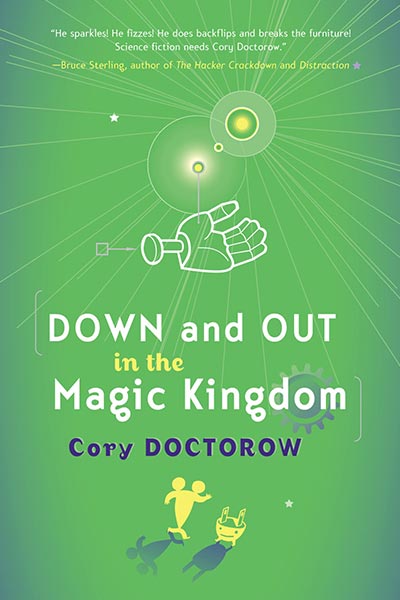
Matt sez, “The science fiction and software event Penguicon is converting its volunteer rewards system into Whuffie, the reputation economy from Cory Doctorow’s science fiction novel Down and Out in the Magic Kingdom. The attendance badges and currency will use a barcode system to track individual work throughout multiple years. It is described in this post to the Penguicon blog.”
Stupendous! I had a completely rockin’ time a Penguicon a couple years back — it’s the perfect mix of geek passions. Plus, Whuffie’s about as stable a currency as you’re likely to find these days as half a petabuck of toxic debt gets de-leveraged.
(Thanks, Matt!)

Matt sez, “The science fiction and software event Penguicon is converting its volunteer rewards system into Whuffie, the reputation economy from Cory Doctorow’s science fiction novel Down and Out in the Magic Kingdom. The attendance badges and currency will use a barcode system to track individual work throughout multiple years. It is described in this post to the Penguicon blog.”
Stupendous! I had a completely rockin’ time a Penguicon a couple years back — it’s the perfect mix of geek passions. Plus, Whuffie’s about as stable a currency as you’re likely to find these days as half a petabuck of toxic debt gets de-leveraged.
(Thanks, Matt!)
Wired’s Clive Thompson has a thought-provoking column about science fiction and philosophy in the latest ish, and he was kind enough to cite my story After the Siege as an example of what sf does well:
Technically, After the Siege is a work of science fiction. But as with so many sci-fi stories, it works on two levels, exploring real-world issues like the plight of African countries that can’t afford AIDS drugs. The upshot is that Doctorow’s fiction got me thinking — on a Lockean level — about the nature of international law, justice, and property.
Which brings me to my point. If you want to read books that tackle profound philosophical questions, then the best — and perhaps only — place to turn these days is sci-fi. Science fiction is the last great literature of ideas.
From where I sit, traditional “literary fiction” has dropped the ball. I studied literature in college, and throughout my twenties I voraciously read contemporary fiction. Then, eight or nine years ago, I found myself getting — well — bored.
One of the coolest things about using Creative Commons licenses on my work is how they allow readers to try stuff that I’d never be able to do on my own — like the fan-translations of my stories.
This week, I’ve got news of four more fan-translations of my Radar story Scroogled, which tries to paint a picture of what the world would be like on the day that Google turned evil. The story has been translated into sixteen languages now, including the latest additions:
Additionally, Pavol Hvizdos (who previously translated my novel Someone Comes to Town, Someone Leaves Town and my story Truncat into Slovak) has also translated my story 0wnz0red into Slovak, where he’s translated the title as 0v1adany.
My latest Guardian column is online: “Personal data is as hot as nuclear waste,” which looks at the immortality of databases — just as it’s impossible for the Internet to scourge itself of Paris Hilton’s terrible genitals, it is likewise impossible that the personal information hemorrhaged by the likes of Her Majesty’s Revenue and Customs (25 million records!) will ever go away. In the era of infinite copying, this information is like a nuclear disaster, immortal and terrible in its consequence. The only way to contain future spills is to make every person who gathers information on his neighbours pay in advance for the long-term handling and storage of that undying, toxic sludge:
If we are going to contain every heap of data plutonium for 200 years, that means that every single person who will ever be in a position to see, copy, handle, store, or manipulate that data will have to be vetted and trained every bit as carefully as the folks in the rubber suits down at the local fast-breeder reactor.
Every gram – sorry, byte – of personal information these feckless data-packrats collect on us should be as carefully accounted for as our weapons-grade radioisotopes, because once the seals have cracked, there is no going back. Once the local sandwich shop’s CCTV has been violated, once the HMRC has dumped another 25 million records, once London Underground has hiccoughed up a month’s worth of travelcard data, there will be no containing it.
And what’s worse is that we, as a society, are asked to shoulder the cost of the long-term care of business and government’s personal data stockpiles. When a database melts down, we absorb the crime, the personal misery, the chaos and terror.
Here’s part twenty-eight — the conclusion of my reading of Bruce Sterling’s brilliant, seminal book The Hacker Crackdown, a 1992 book that recounts the events that led to the founding of The Electronic Frontier Foundation, my former employer.
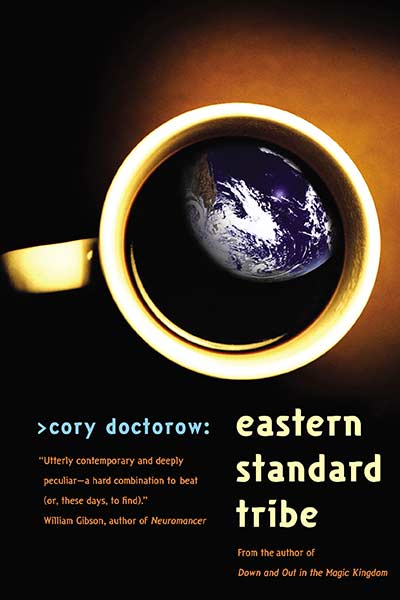
Ben Rankin has converted my novels Eastern Standard Tribe and Someone Comes to Town, Someone Leaves Town so that they’ll read on your iPod Touch or iPhone. To read ’em, you’ll have to “jailbreak” your Apple device so it’ll run third-party software. Here’s hoping I can be part of the reason you hack your iPhone!