/ / News

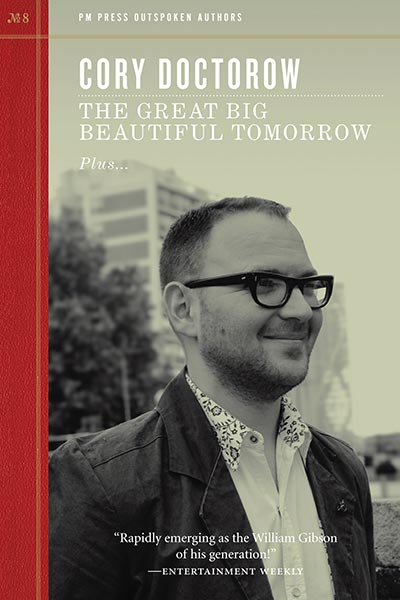
I’m one of the guests of honor at this summer’s Pi Con, the annual science fiction convention held Aug 22-24 in West Springfield, MA, appearing alongside of Randall Munroe, the creator of the brilliant geek webcomic XKCD. I’m really looking forward to this — I’ve never met Randall and I’m an ardent admirer of his work. Discount registration is open until May 31.


This year Pi-Con, the convention located in the belly button of the universe (or more specifically, The Pioneer Valley) is lucky enough to have both Cory Doctorow and Randall Munroe as guests of honor.

Pi-Con has a lot to offer. We have a gaming (both table top and electronic), panels of all types (including virtual and pool panels) and flavors (from hard science to gaming, web comics to polyamory, and quite possibly everything in between), and vendors to fit all your geeky needs.

Link

/ / News, Podcast

Here’s the first installment of a podcast reading of a new novella that I co-wrote with Hugo- and Nebula-nominee Benjamin Rosenbaum. The story’s a big, 32,000-word piece called “True Names” (in homage to Vernor Vinge’s famous story of the same name), and it involves the galactic wars between vast, post-Singularity intelligences that are competing to corner the universe’s supply of computation before the heat-death of the universe.

Ben and I will be reading the story in weekly installments, taking turns as our schedules allow. The reading is Creative Commons licensed — Attribution-ShareAlike-NonCommercial — and the story itself will be published this fall in Fast Forward 2, Lou Anders’ followup to his knockout 2007 anthology, Fast Forward (regular Boing Boing readers will remember Paul Di Filippo’s Wikiworld story from that volume). Lou’s given us permission to post the story’s text simultaneous with the book’s publication, under the same Creative Commons license.

I had a nearly illegal amount of fun working on this story with Ben, who is a gonzo comp-sci geek with a real flair for phrasing, and I hope you’ll enjoy hearing it as much as we enjoyed writing it!

MP3 Link

/ / News

Here’s my latest InformationWeek column: “17 Tips For Getting Bloggers To Write About You.” It’s a checklist of the stuff that keeps me — and many other bloggers — from posting about sites. There are companies and causes out there spending their time and money trying to get people to talk about them online, while shooting themselves in the foot by not having permalinks (duh), by resizing your browser window (duh), or by having “linking policies” that seek to set out the circumstances under which you can link to them.

Have a link. Seriously: if you want bloggers to link to you, you need to have something linkable. Your upcoming TV show, protest march, product or soccer tournament is literally unbloggable unless you put it on the Web somewhere first.

Have a permanent link. Don’t just change the front page of your site every time a new speaker for your speaker-series in announced. A blogger who links to the front page of your site today in a post about the upcoming address by Philo T Farnsworth, wants that link to stay good for in the future, and not point to the upcoming address by Paris Hilton when you change it next week. Put up a separate, permanently linkable page for everything you want to get blogged.

Have a link for everything. Don’t have a single page with ten items on it. Blogging a link to the top of your fifty-screen-long page with a blurb about something halfway down generates 200 e-mails from readers who can’t find the referenced item.

Use real links. Don’t have links with expiring session-keys that are no good if someone revisits the URL later. If a blogger can’t send the URL to a friend or put it on the Web, then that blogger can’t send people to go look at your stuff. Likewise, avoid the giant, 800-character gobbledegook URLs filled with junky alphabet-soup GUIDs — if it can’t be pasted into IRC without linebreaking, there’s some group of compulsive communicators who’ll be unable to get to it.

Link

/ / News

My latest Guardian column just went live: “Time to fight security superstition.” It talks about the growing number of strictures on talking about, recording, and arguing with the security measures in our society, and how this makes us all less safe:

Unfortunately, today’s security cheerleaders have regressed to a more superstitious era, a time from before Bletchley Park’s wizards won the second world war. The public isn’t supposed to take photographs of CCTV cameras in case this knowledge can be used against them (despite the fact that surely terrorists can memorise their locations).

We can’t mention terrorist attacks at the airport while we’re being subjected to systematic anti-dignity depredations; your bank won’t let you open an account with a passport – you need to supply a laser-printed utility bill as well (“to prevent money laundering” … you can just hear Osama’s chief forgers gnashing their teeth for lack of a piece of A4).

The superstitions that grip airport checkpoints and banks are themselves a threat to security, because the security that does not admit of examination and discussion is no security at all.

If terrorists are a danger to London, then the only way to be safe is to talk about real threats and real countermeasures, to question the security around us and shut down the systems that don’t work.

Link