A couple weeks back, I stopped into KQED, the San Francisco NPR affiliate, and did an interview with Rick Kleffel, the top science fiction person on NPR nationwide. As with all my Kleffel interviews, this one was wide-ranging and interesting.
Publishers Weekly’s Young Adult supplement has a great feature interview with me, conducted by Brooklyn Alternative School’s Julian Bennett Holmes.
I once asked a young adult writer what she thought the soul of young adult fiction was. She said, “Being an adolescent is the state of perpetually going through these one-way changes, where you’re very brave, and you jump off cliffs. You can’t go back again. Like one day you’re someone who has never told a lie of consequence and then you’re someone who has. You can never go back and be that other person again.”
I don’t think it’s a coincidence that the centers of our brain that govern risk don’t fully develop until we’re out of our teens. There was a court case last year or the year before in which a teen had done something very foolish, and part of the defense was that his capacity to understand risk was not physiologically fully developed. He literally couldn’t parse risk the way an adult would. I think if you could parse those risks, you probably wouldn’t take all kinds of momentous steps in your life. From a plotting perspective, I like to keep that in mind.
The only other big difference was that when it was all done, my editor said, you know Scholastic has some interest in distributing this as part of their book club. But they won’t do that if it’s got the F word in it, so do you mind if we just take it out of the two places where it is? And I said, take the F word out. No big deal.
The initial print run for Little Brother is almost completely shipped, so my publisher has just ordered a new batch of hardcovers. Those books on the shelf now? They’re the last of the first edition — get ’em while they last!

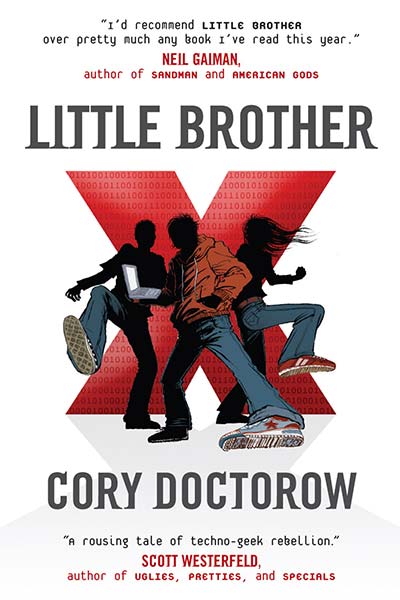
Yesterday, I got two really awesome new graphics related to my young adult novel Little Brother (now in its third week on the bestseller lists!). The first, seen above, was a side-project by Tor Books’s Pablo Defendini, a poster design that started out as concept art for the paperback of Little Brother. Pablo actually gave me one of the very small number of prints he made of this and now I can’t wait to get it framed and hung up — I love every little thing about it, from the RFID tag to the hidden message in the binary around the border. Oh, and Pablo does great hands.
Next up is this:

It’s the artwork (not yet final) for the UK edition of Little Brother, which will be published in November by HarperCollins UK. It’s a little less upbeat than the US cover, but I like the stencil-graffiti look, which hearkens to all the political movements (starting with early Christianity) that were bound together by illegal writing on walls. (If you’d like to get a notice when the UK edition is available, mail me).
Last week, I recorded a vlog for BBtv from my Seattle hotel room, offering a rare glimpse into the precaffeinated life of a book-tour author. There’s a reading from Little Brother, and a tour of the rather extraordinary minibar (the highlights: canned designer oxygen and an “intimacy kit”).
Last week in Chicago, I sat down with Jason Pettus of the CCLaP Podcast podcast for a wide-ranging interview that covered a lot of ground that doesn’t usually show up in my interviews. It’s online now!
Here’s the final installment in the amazing Instructables series of HOWTOs inspired by my young adult novel Little Brother. This week, it’s a HOWTO on TOR, The Onion Router, a technology for increasing your privacy and anonymity when you look at the web, and for getting around censorwalls.
The Instructables folks did an amazing job with this — and the response has been great!
When you go online, you leave tracks all over the place. You could be hanging out with friends on IM, checking out websites, or downloading music. If you live in a country where snoops are prying into what ordinary citizens do online (lke, um, the US) you want a way to cover those tracks.If you’re in school, though, then it’s even worse. No matter what country you’re in, chances are that your access to the internets is as snooped-on as any police state in the world.
So, how do we escape our little virtual prisons? In this Instructable, I’ll tell you about something called Tor (The Onion Router.) I’ll tell you how it works, and then offer some simple instructions on how to get your web browser hooked up. No more getting snooped!
ZOMG — Writing in the comment section of Making Light, Abi Sutherland penned this Little Brother ditty, to be sung to the tune of How Can I Keep From Singing?:
My high school days were simple once
But now that time is ending.
I’ve learned how much I have to lose
And what is worth defending.
My freedom and my privacy
Depend on one another.
And those who threaten either one
Will deal with Little Brother.Encryption guards my web of trust
Against the infiltration
Of DHS officials who
Would pry for information.
The Xnet grows with leaps and bounds
No outside force can smother
The message spreads from peer to peer:
We all are Little Brother.The army trucks and prison cells
That caught us and confined us
Stripped all the innocence away
That we had thought defined us.
But now we know how strong we are
When we work with each other
So anyone who’s watching us:
Watch out for Little Brother.

Boing Boing and I get another nice nod today in XKCD, Randall Munroe’s fantastic geeky comic. I’m really looking forward to meeting Randall in person for the first time at 3PiCon in Massachusetts this summer where we’ll both be guests of honor.
(Thanks to everyone who suggested this!)