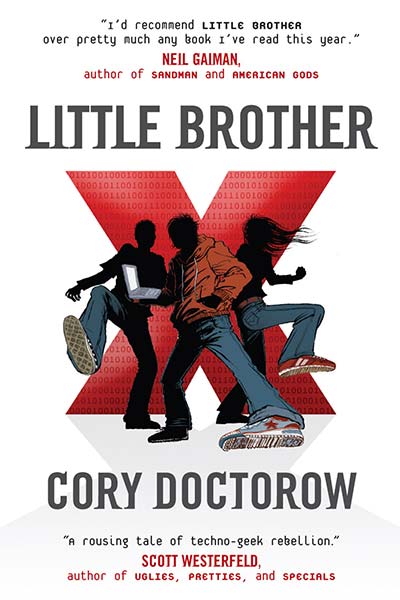
I did a fun interview about Little Brother with the Podcrash podcast from the Bureaucrash folks:
My latest Locus Magazine column is live: “Macropayments” explains why I don’t have a tipjar:
Two columns back, in “Think Like a Dandelion,” I talked about the reproductive strategies employed in species where reproduction is cheap, like dandelions. Unlike humans, dandelions don’t worry about the disposition of each of their children — they only want to be sure that every opportunity for success is fulfilled, that every crack in every sidewalk has a dandelion growing out of it. It’s a damned successful strategy, for dandelions at least. You’d be hard pressed to find a lawn, no matter how carefully tended and how thoroughly poisoned, that doesn’t have a dandelion or two sprouting on it.
To concretize the metaphor: I don’t care about making sure that everyone who gets a copy of my books pays me for them — what I care about is ensuring that the everyone who would pay me decent money for a book has the opportunity to do so. I don’t want to hold 13-year-olds by the ankles and shake them until their allowance falls out of their pockets, but I do want to be sure that when their parents are thinking about a gift for them, the first thing that springs to mind is my latest $20-$25 hardcover.
I wrote a feature for this week’s issue of the journal Nature on “petascale” data-centers — giant data-centers used in scholarship and science, from Google to the Large Hadron Collider to the Human Genome and Thousand Genome projects to the Internet Archive. The issue is on stands now and also available free online. Yesterday, I popped into Nature’s offices in London and recorded a special podcast on the subject, too. This was one of the coolest writing assignments I’ve ever been on, pure sysadmin porn. It was worth doing just to see the the giant, Vader-cube tape-robots at CERN.
At this scale, memory has costs. It costs money — 168 million Swiss francs (US$150 million) for data management at the new Large Hadron Collider (LHC) at CERN, the European particle-physics lab near Geneva. And it also has costs that are more physical. Every watt that you put into retrieving data and calculating with them comes out in heat, whether it be on a desktop or in a data centre; in the United States, the energy used by computers has more than doubled since 2000. Once you’re conducting petacalculations on petabytes, you’re into petaheat territory. Two floors of the Sanger data centre are devoted to cooling. The top one houses the current cooling system. The one below sits waiting for the day that the centre needs to double its cooling capacity. Both are sheathed in dramatic blue glass; the scientists call the building the Ice Cube.
Blank slateThe fallow cooling floor is matched in the compute centre below (these people all use ‘compute’ as an adjective). When Butcher was tasked with building the Sanger’s data farm he decided to implement a sort of crop rotation. A quarter of the data centre — 250 square metres — is empty, waiting for the day when the centre needs to upgrade to an entirely new generation of machines. When that day comes, Butcher and his team will set up in that empty space the yet-to-be-specified systems for power, cooling and the rest of it. Once the new centre is up, they’ll be able to shift operations from the obsolete old centre in sections, dismantling and rebuilding without a service interruption, leaving a new patch of the floor fallow — in anticipation of doing it all again in a distressingly short space of time.
The first rotation may come soon. Sequencing at the Sanger, and elsewhere, is getting faster at a dizzying pace — a pace made possible by the data storage facilities that are inflating to ever greater sizes. Take the human genome: the fact that there is now a reference genome sitting in digital storage brings a new generation of sequencing hardware into its own. The crib that the reference genome provides makes the task of adding together the tens of millions of short samples those machines produce a tractable one. It is what makes the 1000 Genomes Project, which the Sanger is undertaking in concert with the Beijing Genomics Institute in China and the US National Human Genome Research Institute, possible — and with it the project’s extraordinary aim of identifying every gene-variant present in at least 1% of Earth’s population.

Roy Trumbull (who previously recorded a free podcast of my story The Super Man and the Bugout) has just recorded another podcast, this time of my story Craphound, my first-ever professional publication. It’s a nostalgic story about aliens who come to earth for our yardsales and the humans whom they befriend. It’s the third audio adaptation so far, and it sounds great. Roy’s a terrific reader.
Craphound had wicked yard-sale karma, for a rotten, filthy alien bastard. He was
too good at panning out the single grain of gold in a raging river of
uselessness for me not to like him — respect him, anyway. But then he found the
cowboy trunk. It was two months’ rent to me and nothing but some squirrelly
alien kitsch-fetish to Craphound.So I did the unthinkable. I violated the Code. I got into a bidding war with a
buddy. Never let them tell you that women poison friendships: in my experience,
wounds from women-fights heal quickly; fights over garbage leave nothing behind
but scorched earth.Craphound spotted the sign — his karma, plus the goggles in his exoskeleton,
gave him the advantage when we were doing 80 kmh on some stretch of back-highway
in cottage country. He was riding shotgun while I drove, and we had the radio on
to the CBC’s summer-Saturday programming: eight weekends with eight hours of old
radio dramas: “The Shadow,” “Quiet Please,” “Tom Mix,” “The Crypt-Keeper” with
Bela Lugosi. It was hour three, and Bogey was phoning in his performance on a
radio adaptation of _The African Queen_. I had the windows of the old truck
rolled down so that I could smoke without fouling Craphound’s breather. My arm
was hanging out the window, the radio was booming, and Craphound said “Turn
around! Turn around, now, Jerry, now, turn around!”

Craphound on Internet Archive, MP3 download
See also: Super Man and the Bugout reading: what if Superman had been a nice Jewish boy from Toronto
Roy Trumbull (who previously recorded a free podcast of my story The Super Man and the Bugout) has just recorded another podcast, this time of my story Craphound, my first-ever professional publication. It’s a nostalgic story about aliens who come to earth for our yardsales and the humans whom they befriend. It’s the third audio adaptation so far, and it sounds great. Roy’s a terrific reader.
Craphound had wicked yard-sale karma, for a rotten, filthy alien bastard. He was
too good at panning out the single grain of gold in a raging river of
uselessness for me not to like him — respect him, anyway. But then he found the
cowboy trunk. It was two months’ rent to me and nothing but some squirrelly
alien kitsch-fetish to Craphound.So I did the unthinkable. I violated the Code. I got into a bidding war with a
buddy. Never let them tell you that women poison friendships: in my experience,
wounds from women-fights heal quickly; fights over garbage leave nothing behind
but scorched earth.Craphound spotted the sign — his karma, plus the goggles in his exoskeleton,
gave him the advantage when we were doing 80 kmh on some stretch of back-highway
in cottage country. He was riding shotgun while I drove, and we had the radio on
to the CBC’s summer-Saturday programming: eight weekends with eight hours of old
radio dramas: “The Shadow,” “Quiet Please,” “Tom Mix,” “The Crypt-Keeper” with
Bela Lugosi. It was hour three, and Bogey was phoning in his performance on a
radio adaptation of _The African Queen_. I had the windows of the old truck
rolled down so that I could smoke without fouling Craphound’s breather. My arm
was hanging out the window, the radio was booming, and Craphound said “Turn
around! Turn around, now, Jerry, now, turn around!”
Craphound on Internet Archive, MP3 download
See also: Super Man and the Bugout reading: what if Superman had been a nice Jewish boy from Toronto

Last weekend, I was one of the guests of honor at 3PiCon in Springfield, MA, along with Randall “XKCD” Munroe, who once infamously depicted me as blogging from a hot-air balloon in cape and goggles. This has become a motif for me, so that wherever I go, people give me capes and/or goggles. I brought along a set and wore them to our final panel together on Sunday, and Dan Noe, the Pi-Con photographer, got some nice shots of the event.
(Thanks, Dan!)
The fan-translations of my short-short story Printcrime keep on rolling in: today there’s one in Hiligaynon (an Austronesian language spoken in Western Visayas in the Philippines) and another in Romanian, contributed, respectively, by Lorna Belviz-Pajo and Alex Brie. It’s just so wicked-cool to see your work take on a life of its own — I didn’t even know that Hiligaynon existed until a few minutes ago!
Krimen nga pang-imprenta (Hiligaynon), Crima Printării (Romanian)
The fan-translations of my short-short story Printcrime keep on rolling in: today there’s one in Hiligaynon (an Austronesian language spoken in Western Visayas in the Philippines) and another in Romanian, contributed, respectively, by Lorna Belviz-Pajo and Alex Brie. It’s just so wicked-cool to see your work take on a life of its own — I didn’t even know that Hiligaynon existed until a few minutes ago!
Krimen nga pang-imprenta (Hiligaynon), Crima Printării (Romanian)