/ / News

Here’s my latest column for Internet Evolution: “Big Entertainment Wants to Party Like It’s 1996” explains how the entertainment industry’s greedy, naked lobbying tactics will be their undoing, since these victories end up backfiring because they arouse such public ire.

It’s not that these companies can’t get their laws on the agenda, and not that they can’t cook the process to make it run favorably for themselves. For example, when Canada was considering its own version of the WCT, the entertainment giants saw to it that the parliamentarians in charge of the process only talked to multinational entertainment giants, without conducting any kind of embarrassing public consultation. They wouldn’t even talk to the Canadian record companies — just the multinationals.

The proposed laws — Bill C60 and Bill C61 — were complicated and took a lot of explaining. But here’s what didn’t take any explaining at all: “Your government is about to introduce sweeping, controversial regulations to the Internet, and they won’t talk with anyone except the jerks who are suing all those music downloaders in the States about it — they won’t even talk to Canadian record companies!”

This made the Canadian lawmakers who backed the proposal look like sellouts (which they were); made the laws look like conspiracies (which they were); and made the geeks who cared about this stuff look like heroes (which they were). The complicated story about the law became a simple story about the process.

Likewise in New Zealand, where a new copyright provision called “Section 92A” made every geek in the country freak out in unison. 92A allows a rightsholder to have your Internet connection terminated by filing three unsubstantiated accusations of copyright infringement against you. No judge and no jury: just a rightsholder standing over you, able to administer the death penalty to your participation in electronic life without showing a shred of evidence.

Now, this is a little easier to explain to the general public — the entertainment lobby isn’t just stupid about process, they’re also greedy in what they ask for — but 92A was rammed through Parliament in a dodgy process that got those people who weren’t interested in copyright or the Internet outraged anyway.

New Zealand’s brilliant, tireless geeks organized around the clock, mounted a huge, high-profile global campaign through Twitter and blogs (they probably tripled the amount of international coverage New Zealand received), and forced the government to back down on its plans, sending the entertainment industry packing.

In France, the “colorful” Nicolas Sarkozy faced a revolt after trying to pass the New Zealand law there — where it was called HADOPI — and having it rejected by his own government.

Big Entertainment Wants to Party Like It’s 1996

/ / News

Here’s a talk I gave earlier this year at the O’Reilly Tools of Change for Publishing conference in NYC, about the way that DRM gives distributors control over publishers and writers. This talk went down very well, and is the source of “Doctorow’s Law,” which a lot of people have asked me about: “Any time someone puts a lock on something you own, against your wishes, and doesn’t give you the key, it’s not being done to your benefit.”

There’s some errata here, though: the Overdrive debacle was due to a licensing dispute, not a bankruptcy; and there’s now a “DRM-free” option for the Kindle, but I can’t find out if the file comes with legal encumbrances that would prevent people who buy one of these from moving it to a competing device (no one at Amazon will answer my queries about this). And I’ve also been told by Amazon that supposedly Audible will do DRM-free audiobooks, but they haven’t answered repeated queries about the details of this.

TOC 09 “Digital Distribution and the Whip Hand: Don’t Get iTunesed with your eBooks”

/ / News

The Guardian’s just published my latest column, “Developers still finding that it pays to get in the game,” about the increasingly prevalent online game practice of selling items to players, and the parallels this has to the download wars:

Official, game-sponsored exchanges for real-money trades (RMTs) are more than places where players can swap goods for money. Fundamentally, these exchanges act as an honest broker between two extremely different types of player: cash-rich/time-poor players (people with jobs, for the most part) and time-rich/cash-poor players (retirees and young people). Seen through this lens, a “game” is just a bunch of applied psychology that makes kids work long hours to earn virtual gewgaws that adults are trained to desire. In this “Free to play, pay for stuff” world, kids are alienated from the product of their leisure by a marketplace where the game-company skims a piece off of every transaction.

The psychology of this is fascinating, since it all only works to the extent that the game remains “fun”. One key element is that skilled players (eg kids) must not feel like the rich players are able to buy their way into positions of power. Game devs are advised to sell defensive items – shields, armour, dodging spells, but not offensive ones. A skilled player will still be able to clobber a heavily armoured rich player, given enough time (and skilled players have nothing but time, by definition), but may quit in disgust at the thought that some rich wanker is able to equip himself with a mega-powerful sword or blaster that gives him ultimate killing power. No one wants to play in a game where one player has an “I win” button.

For me, the most fascinating thing about this is how it can be seen as the application of the business model that downloaders have been advocating since Napster: “Don’t sue the kids who download your music or movies, rather, see them as the marketing that sells the same media to cash-rich adults who lack the time to use P2P software.”

Developers still finding that it pays to get in the game

/ / Futuristic Tales Of The Here And Now, News

Last year, IDW published a collection of six comics adapted from my short stories called Cory Doctorow’s Futuristic Tales of the Here and Now, all of these stories also licensed under Creative Commons.

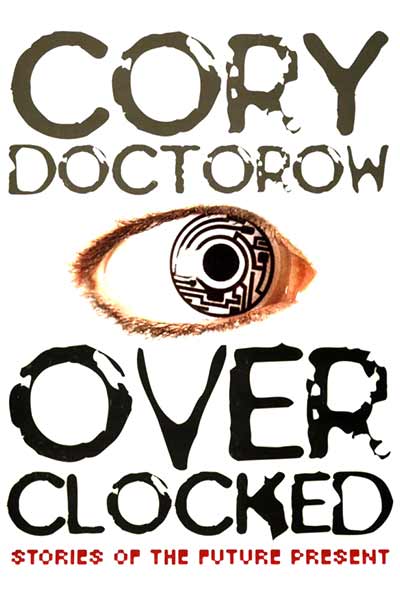
Now, Robot Comics, a firm that provides comics for Android mobile phones, has begun to make the comics available free under the same CC license for mobile phones, beginning with my story Anda’s Game (which was also included in my short story collection Overclocked, and podcasted as a reading by Alice Taylor of Wonderland. The adaptation is by the excellent Dara Naraghi, illustrated by Esteve Polls.

The story is a riff on the way that property-rights are coming to games, and on the bizarre spectacle of sweat-shops in which children are paid to play the game all day in order to generate eBay-able game-wealth. When I was a kid, there were arcade kings who would play up Gauntlet characters to maximum health and weapons and then sell their games to nearby players for a dollar or two — netting them about $0.02 an hour — but this is a very different proposition indeed.

Cory Doctorow’s Anda’s Game

Previously:

/ / News

The Serbian City Magazine just published the first-ever interview with me in Serbo-Croatian!

Gomila mojih prijatelja je napisala knjige za mlade i odlično su se zabavljali. Moja prijateljica Kathe Koja je bila poznata horor spisateljica koja je pisala veoma živopisan horor, kada je, za svaki slučaj, odlučila da piše te skoro hemingvejske romane za mlade(ž). Iskustva koja mi je opisala su bila tako cool, pisati za decu koja ne čitaju samo iz zabave nego iz potrebe da prokljuve kako svet funkcioniše.

Povratna informacija koju je dobila je bila tako otvorena i iskrena i ona je bila tako jako, jako, jako uzbuđena da je promenila žanr.

Druga stvar koju sam želeo je bila da napišem roman u kom tehnologija zbilja funkcioniše, gde je tehnologija – prava tehnologija. Mislio sam da je young adult pravi žanr za to. U fikciji prozi za mlade postoji časna tradicija pisanja o tome kako tehnologija radi – prave lekcije – i stvarno mi se sviđao taj način rada. [Robert Anson] Heinlein je bio veliki zagovornik toga. Kada sam bio dete dosta sam saznao o finansijama i politici u knjigama kao što je Have Space Suit—Will Travel. Moja knjiga (Little Brother) je neka vrsta radikalne, političke Have Space Suit—Will Travel. Tako da se literatura za mlade nametnula kao pravi žanr za taj posao.

Intervju: Cory Doctorow

(Thanks, Zoran!)