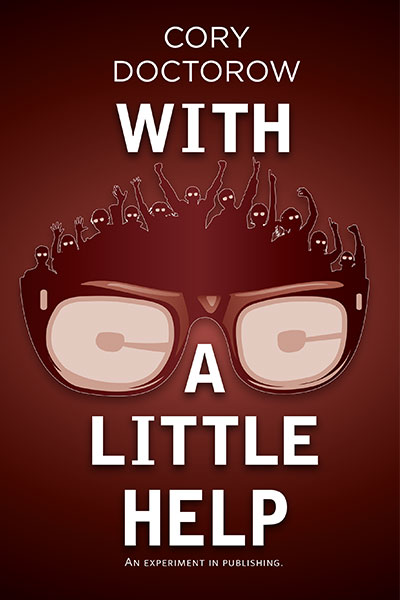
Here’s the seventh installment of a story-in-progress, Epoch, commissioned by Mark Shuttleworth for my forthcoming short story collection WITH A LITTLE HELP.
I’m giving two talks in the UK this week — the first in Cambridge, as part of the Arcadia Seminar, held at Robinson College; the second is at Sheffield, as part of the DocFest premiere of RIP: A Remix Manifesto, a documentary on copyfighting and art that features some interviews with me. Hope to see you at them!
Cambridge: 3 November 2009, 6PM
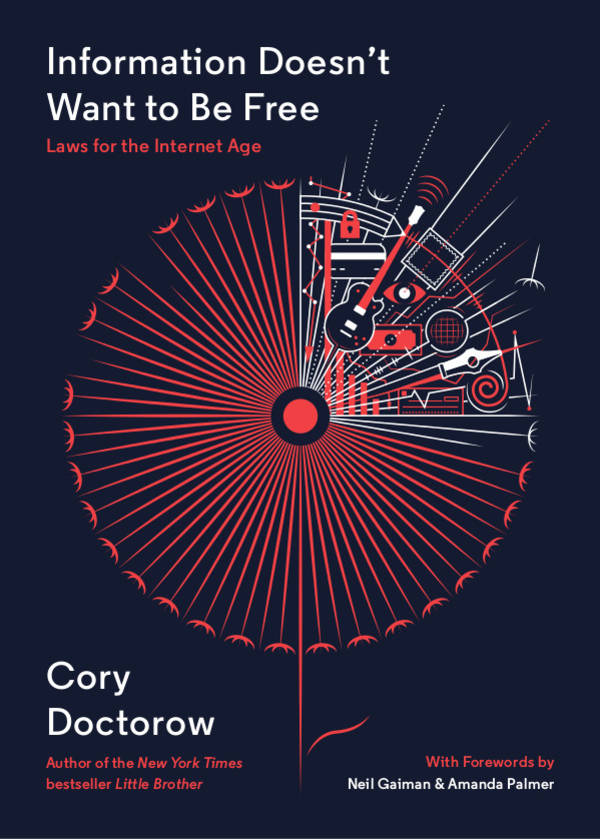
Arcadia Seminar: 3rd Nov. “Thinking Like a Dandelion: Cory Doctorow on copyright, Creative Commons and creativity”
Umney Theatre, Robinson College, Cambridge. Please email mh569@cam.ac.uk if you are planning to attend.Sheffield: 5 November 2009, 2:25PM-4:30PM
RiP! A Remix Manifesto
Showroom 1, Sheffield DocFest (tickets)
Update: CORRECTION — I’m at Sheffield Doc/Fest from 1425h-1630h, not 1600-1800h as previously stated!
I’m giving two talks in the UK this week — the first in Cambridge, as part of the Arcadia Seminar, held at Robinson College; the second is at Sheffield, as part of the DocFest premiere of RIP: A Remix Manifesto, a documentary on copyfighting and art that features some interviews with me. Hope to see you at them!
Cambridge: 3 November 2009, 6PM
Arcadia Seminar: 3rd Nov. “Thinking Like a Dandelion: Cory Doctorow on copyright, Creative Commons and creativity”
Umney Theatre, Robinson College, Cambridge. Please email mh569@cam.ac.uk if you are planning to attend.Sheffield: 5 November 2009, 2:25PM-4:25PM
RiP! A Remix Manifesto
Showroom 1, Sheffield DocFest (tickets)
Update: CORRECTION — I’m at Sheffield Doc/Fest from 1425h-1630h, not 1600-1800h as previously stated!

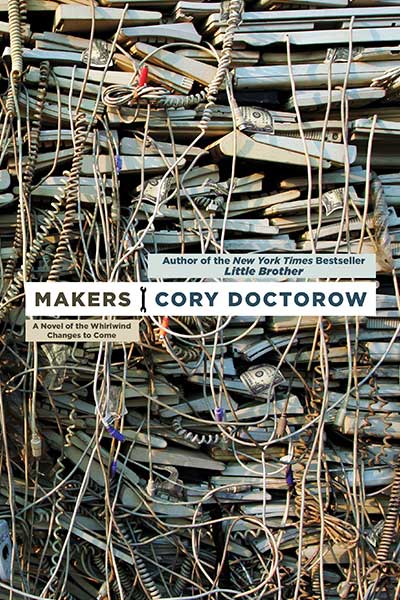
As promised, here’s the details on the short Canada/US tour for my novel Makers in November:
November 12, 7PM
Toronto, ON, Canada
The Merril Collection of Science Fiction, Speculation, and Fantasy
239 College Street, 3rd Floor, +1 416 393-7748
Books by Bakka Phoenix
(you can pre-order signed copies from them if you can’t make it).
November 16, 7PM
Cambridge, Mass
Harvard Bookstore
1256 Massachusetts Avenue
November 17, 7PM
New York City, NY
Borders Columbus Circle
10 Columbus Circle (@59th St and Central Park West)
November 20, 11AM and 1PM
Philadelphia, PA
Free Library of Philadelphia
1901 Vine Street
NOTE: The library dates are apparently not open to the public — something I just found out. I’m really sorry!
November 20-22
Philcon, Cherry Hill, NJ
If you’re with the press and you’d like to arrange an interview, please contact Justin Golenbock (USA) (Justin.Golenbock@tor.com/646.307.5413) or Katherine Wilson (Canada) (Katherine.Wilson@hbfenn.com/905.951.6600 x271).
As promised, here’s the details on the short Canada/US tour for my novel Makers in November:
November 12, 7PM
Toronto, ON, Canada
The Merril Collection of Science Fiction, Speculation, and Fantasy
239 College Street, 3rd Floor, +1 416 393-7748
Books by Bakka Phoenix
(you can pre-order signed copies from them if you can’t make it).
November 16, 7PM
Cambridge, Mass
Harvard Bookstore
1256 Massachusetts Avenue
November 17, 7PM
New York City, NY
Borders Columbus Circle
10 Columbus Circle (@59th St and Central Park West)
November 20, 11AM and 1PM
Philadelphia, PA
Free Library of Philadelphia
1901 Vine Street
NOTE: The library dates are apparently not open to the public — something I just found out. I’m really sorry!
November 20-22
Philcon, Cherry Hill, NJ
If you’re with the press and you’d like to arrange an interview, please contact Justin Golenbock (USA) (Justin.Golenbock@tor.com/646.307.5413) or Katherine Wilson (Canada) (Katherine.Wilson@hbfenn.com/905.951.6600 x271).
I have an op-ed in today’s Times about the British plan to disconnect people from the internet if someone in their home is accused — without proof — of infringing copyright, and how utterly unjust this is.
Even more radical is the Mandelson proposal to disconnect entire families from the internet if a single member — or a neighbour who uses their internet connection — is accused, without proof, of violating copyright. Leave aside the fundamental injustice of collective punishment, a practice so abhorrent that it is outlawed in the Geneva Convention; think instead of the utter disproportionality of this.
The internet is an integral part of our children’s education; it’s critical to our employment; it’s how we stay in touch with distant relatives. It’s how we engage with government. It’s the single wire that delivers freedom of speech, freedom of the press and freedom of assembly. It isn’t just a conduit for getting a few naughty free movies, it is the circulatory system of the information age.
The Publishing Point, a salon on the future of publishing conducted this brief interview with me on the state of publishing at the Tools of Change conference in Frankfurt earlier this month.
I’m speaking at London’s Battle of Ideas this Saturday, Oct 31, on a panel called “Rethinking Privacy in an age of Disclosure and Sharing.” The event goes 1:30-3:30 and there are still a few tickets left!
The increasing reach of information technology into all areas of life, from social networking websites to data sharing in public services, has thrown up a number of questions about privacy. Information about our medical records, financial circumstances and shopping habits is increasingly likely to be stored in electronic media that are out of our control. Some critics worry more about Tesco’s data-gathering than any ‘surveillance state’. The controversy about Google Maps’ Street View function, which captured thousands of unwitting people walking or standing on the streets, is a reminder that new technology constantly raises new questions about our privacy. So how worried should we be? Does the convenience of easily accessed information outweigh the danger of abuse? How are our conceptions of privacy changing? And following the success of the Pirate Party in Sweden, can we expect privacy to move up the political agenda in the UK too.
I’m speaking at London’s Battle of Ideas this Saturday, Oct 31, on a panel called “Rethinking Privacy in an age of Disclosure and Sharing.” The event goes 1:30-3:30 and there are still a few tickets left!
The increasing reach of information technology into all areas of life, from social networking websites to data sharing in public services, has thrown up a number of questions about privacy. Information about our medical records, financial circumstances and shopping habits is increasingly likely to be stored in electronic media that are out of our control. Some critics worry more about Tesco’s data-gathering than any ‘surveillance state’. The controversy about Google Maps’ Street View function, which captured thousands of unwitting people walking or standing on the streets, is a reminder that new technology constantly raises new questions about our privacy. So how worried should we be? Does the convenience of easily accessed information outweigh the danger of abuse? How are our conceptions of privacy changing? And following the success of the Pirate Party in Sweden, can we expect privacy to move up the political agenda in the UK too.