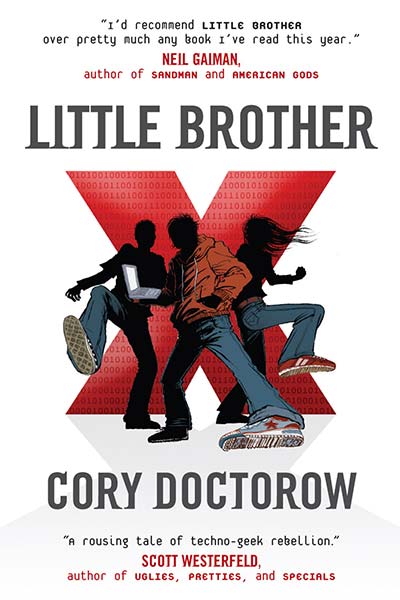
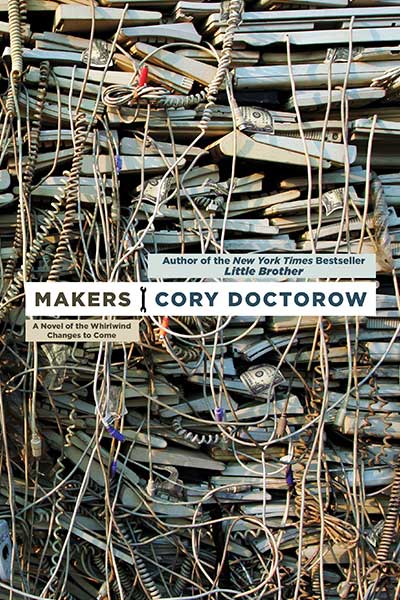
I’m absolutely tickled to announce that my novel Makers is up for the 2010 Prometheus Award, given annually by the Libertarian Futurist Society. My last novel, Little Brother won in 2009, and it was an incredible honor. Once again, I’m sharing the ballot with some tremendous books and authors, including Liberating Atlantis by Harry Turtledove and The Unincorporated Man by Dani and Eytan Kollin.
I’m absolutely tickled to announce that my novel Makers is up for the 2010 Prometheus Award, given annually by the Libertarian Futurist Society. My last novel, Little Brother won in 2009, and it was an incredible honor. Once again, I’m sharing the ballot with some tremendous books and authors, including Liberating Atlantis by Harry Turtledove and The Unincorporated Man by Dani and Eytan Kollin.

I’ve just set up a store selling direct MP3 downloads of the Random House audiobook for my last novel, Makers, thanks to the good offices of Random House Audio, the eShop WordPress plugin, and Mike Little, my WordPress tech guy.
The Makers audiobook runs 18.5 hours and is formatted for burning onto 15 CDs. It’s read by Bernadette Dunne. I really like Dunne’s reading (here’s a sample) and RHA’s production job is tops. The MP3s are 128K/44KHz.
I get an additional 20 percent on top of my customary royalty if you buy it from me, and you get a book that has no DRM and no crappy “license agreement” requiring you to turn over your firstborn in exchange for the privilege of handing me your hard-earned money.
Right now, sales are only available through PayPal, though I hope that’ll change soon. And if this is successful, I hope to add the audio for Little Brother and my forthcoming YA novel, For the Win.

The Open Rights Group is looking for British individuals and organisations to sign onto its comments to the UK TV regulator, who is on the verge of giving into blackmail from the BBC and an offshore DRM cartel, crippling TV in Britain forever.
The BBC has asked Ofcom, the UK telcoms regulator, to give it permission to put DRM on digital TV signals. Anyone who wants to make a receiver that can unscramble the DRM will have to sign up with an offshore consortium called DTLA, agreeing to a whole raft of DRM requirements, including a ban on making TV receivers and recorders that users can modify (which amounts to a ban on free/open TV equipment like MythTV, as well as free/open drivers for laptop TV cards).
This is a bad idea for lots of reasons: it’s our TV, paid for with the license fee. The BBC claims that some unspecified rightsholders will withhold some unspecified programming from TV if they don’t get this, but so far, no one’s come forward to specifically say, “I won’t release the following programmes,” so we’re just left with this kind of vague, nonspecific threat.
If that wasn’t bad enough, the BBC hasn’t identified anyone who has promised to make programmes available if the DRM is added — so we’re being asked to turn regulatory control over the public service broadcaster to a corporate cartel without even being promised anything in return!
Worst of all: the BBC’s DRM scrambles a block of data that includes the assistive information used by visually impaired and hearing impaired people to watch TV, meaning that it will be harder than ever to deliver low-cost, robust technologies for these audiences. Fancy using blind and deaf people as human shields in the copyright wars! Now that’s public service!
The rightsholder companies made the same threats in 2003 when the USA was considering adding DRM to its digital TV, and none of them followed through. The idea that broadcasters will simply stop airing programmes, or that new suppliers won’t show up to sell shows if old ones boycott the system, is just ludicrous. These businesses have shareholders who want to see a return on their investment, not a public tantrum.
ORG has written a thorough response to the Ofcom consultation on BBC DRM, and now we’re looking for individuals and organisations to sign on to it. We’ve already got sign-on from the Free Software Foundation, the Electronic Frontier Foundation, Somethin’ Else, and many other consumer rights groups, tech groups, and entertainment companies are considering signing up.
We’re open to signons from any license payer or UK resident, but we’re especially interested in:
- Programmers, especially those who work on digital TV technologies
- Video creators, especially BBC suppliers
- MythTV users and users of tuner cards with open/free drivers
- People with visual and hearing disabilities
- Teachers and tinkerers who play with receiver technology
- People who travel within the EU and would have to buy a second TV or card specifically to receive DRM broadcasts from the BBC
- Anyone else who feels an especially strong connection to the public service value of open platforms
Stop BBC “Digital Rights Management” from disabling your HD TV
Previously:
- BBC wants to put DRM on the TV Brits are forced to pay for – Boing …
- BBC's outrageous plan to put DRM on TV broadcasts shot down in …
- Why is the UK TV regulator planning to allow BBC DRM?
- BBC's plan to kick free/open source out of UK TV devices
- Regulators order BBC Trust to meet with open source consortium …
- BBC wants to encrypt "free" TV — talking points debunked – Boing …
I’ve just set up a store selling direct MP3 downloads of the Random House audiobook for my last novel, Makers, thanks to the good offices of Random House Audio, the eShop WordPress plugin, and Mike Little, my WordPress tech guy.
The Makers audiobook runs 18.5 hours and is formatted for burning onto 15 CDs. It’s read by Bernadette Dunne. I really like Dunne’s reading (here’s a sample) and RHA’s production job is tops. The MP3s are 128K/44KHz.
I get an additional 20 percent on top of my customary royalty if you buy it from me, and you get a book that has no DRM and no crappy “license agreement” requiring you to turn over your firstborn in exchange for the privilege of handing me your hard-earned money.
Right now, sales are only available through PayPal, though I hope that’ll change soon. And if this is successful, I hope to add the audio for Little Brother and my forthcoming YA novel, For the Win.
Buy my novel Makers as a DRM-free download.
The Makers audiobook runs 18.5 hours and is formatted for burning onto 15 CDs. It’s read by Bernadette Dunne and produced by Random House Audio. I really like Dunne’s reading (here’s a sample) and RHA’s production job is tops. The MP3s are 128K/44KHz.
I get an additional 20 percent on top of my customary royalty if you buy it from me, and you get a book that has no DRM and no crappy “license agreement” requiring you to turn over your firstborn in exchange for the privilege of handing me your hard-earned money.
Right now, sales are only available through PayPal, though I hope that’ll change soon.
Lab out Loud, a podcast for science teachers, interviewed me — they’re fun guys!
I’m pretty sure I just had a second day in Leipzig, but it’s a kind of blur. Some thoughts to record however:
* Cosplayers, cosplayers, cosplayers. Mr Jenkins to the white courtesy phone please, your meme is ready
* The Viennese coffee stand: I had to actually stop myself from going back because I’d drunk so goddamned much amazing coffee
* US consular folks: pretty nice
* Rohwolt’s CFO: pretty reasonable on the subject of free downloads!
* German press: Extremely sweet
* German sound guys: Tell you what: when I’m doing a reading and I get WAY close to the mic and speak WAY loud during a dramatic moment, I’m doing it for a REASON. It is not a call for you to turn the gain on my mic down so low I have to swallow it from then on in order to get any amplification. Work with me here.
* Leipzig airport only sells broadband in two increments: 1 hour and 30 days. Can you say screwjob? Danke T-Mobile, und get screwed.

It’s 1206AM in Germany and I’m ready to drop — left the flat in London at 0445 this morning to get to the Leipzig Book Fair and have had a high old time in my first of two days onsite.
Leipzig: pretty, in that particularly German way of mid-sized cities that have great swathes of cobbeldy wobbeldy old charming pedestrian streets that are nevertheless spotless and incredibly efficiently managed and fitted out. Too many of the same bloody high-street shops (the world doesn’t need more H&Ms), but a trip into a vast Conrad electronics shop to buy a plug adapter reminded me of the incredible and resilient German passion for making and fixing stuff. Something just wonderful about confronting whole walls full of locally made tools and parts for fixing the things in your house.
The fair: Young! Very young! Full of kids in cosplayer regalia, like some kind of existence proof of a Henry Jenkins essay! (Kids in manga outfits get in free). Discovered a motherlode of cosplayers in a “Japanese Tea Room” in hall 2, in the midst of a football-field-sized kawaii of anime booths (“kawaii” being the collective noun for anime booths, I am reliably assured).
So cool to see kids just totally in love with books and running around surrounded by them all day.
Lots of international pavilions. The former Yugo states have free booze at their pavilions and are swarmed. The US has Obama cardboard dollies and free pamphlets of Twain’s “The Awful German Language” in German and English. Canada didn’t show up at all.
There seems to be no WiFi, free or paid in the hall. FAIL FAIL FAIL FAIL FAIL. Hey bookfair, a hint: when foreigners travel to your event, their phones’ data-plans don’t work. Which means that people here to do business need WiFi to stay in touch. Way to make publishing seem far behind the times. It’s 20-goddamned-10. You are a huge, bustling international event. Every last centimetre of your hall should be bathed in so much broadband that you get a sunburn if you stand still for too long. Christ.
The event: The Rohwolters have been lovely, and have shown me a good time. They took me and Michael — the translator for the .de Little Brother — down to a university hall where the public, critics, the press and 40-some schoolkids from a reading group met us. Michael read some of chapter three of LB, I read my traditional Delores Park concert scene. The Q&A afterwards was marvellous — the kids were sharp as tacks. Reminded me of the Berkeley High kids from the LB tour, hands-down the sharpest kids I met on that trip.
Dinner was lovely — delicious, with great conversations with my German audiobook publisher, who have incredible plans afoot for the LB audiobook.