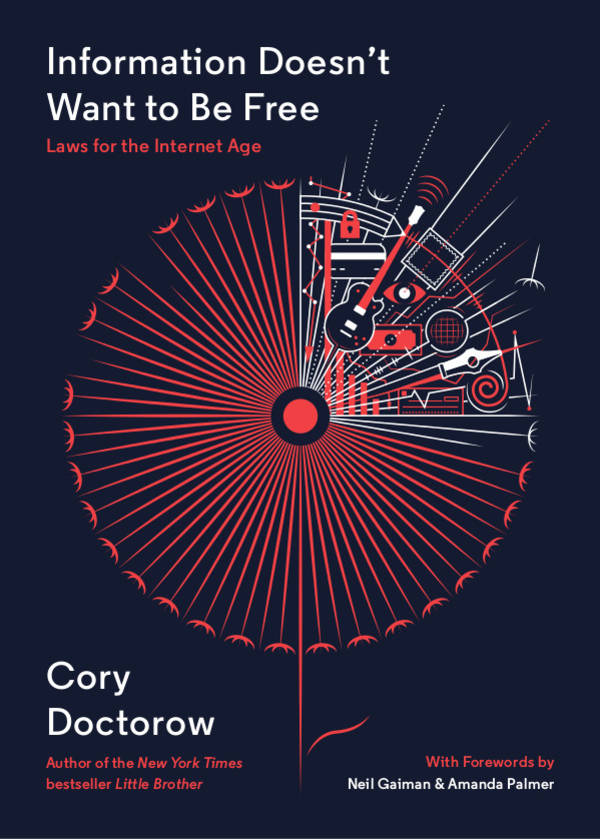
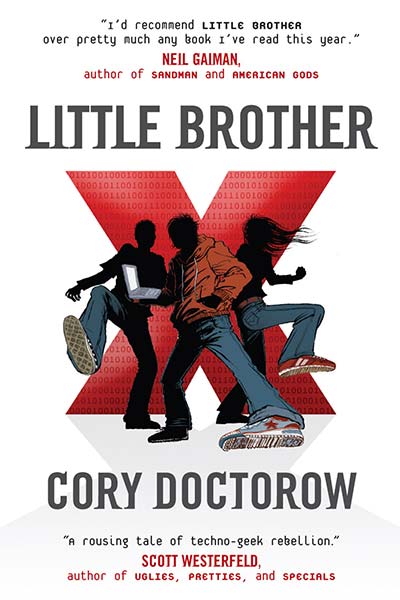
Corrinne Hite is a fifteen-year-old singer/songwriter who has just finished an album of songs based on the novels she loves. She’s done me the honor of writing a song based on my novel Little Brother: stream it here.
Corrine’s band, CORY & THE TIGERMEN, is in the SchoolJamsUSA finals (northeast region). US residents can vote for her — she’d have my vote if I was eligible!
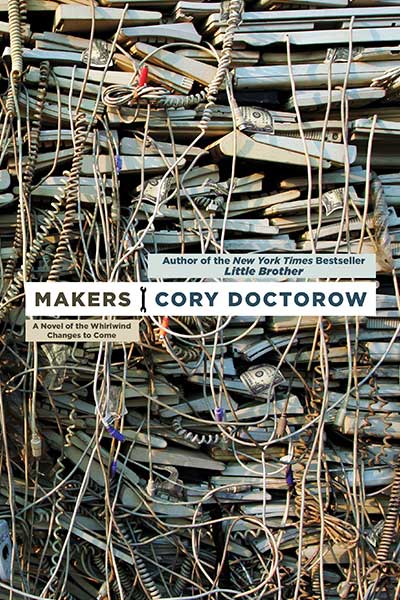
I recently spoke to the CBC’s Shelagh Rogers on The Next Chapter about my novel Makers. The interview just aired, and they’ve put up streaming audio of it as well.
I’ll be on CBC’s The Next Chapter with Sheelagh Rogers this Monday at 1PM Eastern, discussing my novel Makers (it’ll also be streamable after it airs).
I’ll be on CBC’s The Next Chapter with Sheelagh Rogers this Monday at 1PM Eastern, discussing my novel Makers (it’ll also be streamable after it airs).
My latest Locus column, “A Cosmopolitan Literature for the Cosmopolitan Web,” is up: it’s a piece on the way that science fiction’s insistence that all laws are local prefigures the web’s weird and wonderful diversity:
One of science fiction’s greatest tricks is playing ‘‘vast, cool intelligence’’ and peering through a Martian telescope aimed Earthwards and noticing just how weird and irrational we all are. At its best, science fiction is a literature that can use the safe distance of an alien world or a distant future as a buffer-zone in which all mores can be called into question – think, for example, of Theodore Sturgeon’s story of the planet of enthusiastic incest-practitioners, ‘‘If All Men Were Brothers, Would You Let One Marry Your Sister?’’ published in Dangerous Visions in 1967.
Behind every torturer’s mask, behind every terrible crusade, behind every book-burning and war-drum is someone who has forgotten (or never learned) that all laws are local. Forgetting that all laws are local is the ultimate in hubris, and it is the province of yokels and bumpkins who assume that just because they do something in a particular way, all right-thinking people always have and always will. For a mild contemporary example, consider the TV executive who blithely asserts that her industry is safe, because no matter what happens in the future, the majority of us will want to come home, flop down on the sofa, and turn on the goggle-box – despite the fact that TV has existed for less than a century, a flashing eyeblink in the long history of hominids, most of whom have gotten by just fine without anesthetizing themselves with a sitcom at the end of a long day.
Which is not to say that cosmopolitans don’t believe in anything. To be cosmopolitan is to know that all laws are local, and to use that intellectual liberty to decide for yourself what moral code you’ll subscribe to. It is the freedom to invent your own ethics from the ground up, knowing that the larger social code you’re rejecting is no more or less right than your own – at least from the point of view of a Martian peering through a notional telescope at us piddling Earthlings.
My latest Guardian column, “Jack and the interstalk: why the computer is not a scary monster,” explains the way my 2.5-year-old daughter and I use my computer as part of our imaginative play and storytelling, using YouTube searches, Flickr image searches, paper story books, toys, and trips around town to play and explore.
Now that she’s more active, she usually requests something – often something from YouTube (we also download her favourite YouTube clips to our laptops, using deturl.com), or she’ll start feeding me keywords to search on, like “doggy and bunny” and we’ll have a look at what comes up. It’s nice sharing a screen with her. She points at things in her video she likes and asks me about them (pausable video is great for this!), or I notice stuff I want to point out to her. At the same time, she also looks at my screen – browser windows, email attachments, etc – and asks me about them, too.
But the fun comes when we incorporate all this into our storytelling play. It started with Jack and the Beanstalk. I told her the story one morning while we were on summer vacation. She loved the booming FEE FI FOE FUM! but she was puzzled by unfamiliar ideas like beanstalks, castles, harps and golden eggs. So I pulled up some images of them (using Flickr image search). Later, I found two or three different animated versions of Jack’s story on YouTube, including the absolutely smashing Max Fleischer 1933 version. These really interested Poesy (especially the differences between all the adaptations), so one evening we made a Lego beanstalk and had an amazing time running around the house, play-acting Jack and the Beanstalk with various stuffed animals and such as characters. We made a golden egg out of wadded up aluminium foil, and a harp out of a coat-hanger, tape and string, and chased up and down the stairs bellowing giant-noises at one another.
Then we went back to YouTube and watched more harps, made sure to look at the geese the next Saturday at Hackney City Farm, and now every time we serve something small and bean-like with a meal at home, there’s inevitably a grabbing up of two or three of them and tossing them out the window while shouting, “Magic beans! Magic beans! You were supposed to sell the cow for money!” Great fun.
I’m just finalizing my schedule and packing list for ICON 35 A Steam Powered Convention of the Future, the science fiction convention in Cedar Rapids, IA, where I’m guest of honor this weekend. The event’s got several kinds of gaming (including two weekend-long LARPs), its own Stormtrooper garrison, an art show and masquerade, a writers’ workshop, and appearances from writers including Joe and Gay Haldeman (and many others). I’m really grateful to the ICON volunteers for bringing me to Iowa for the first time in my life, and can’t wait for the event, which promises to be a delight!