no one can dole out technological cautionary tales while simultaneously celebrating technology as cunningly as Doctorow
Daniel Kraus, Booklist
no one can dole out technological cautionary tales while simultaneously celebrating technology as cunningly as Doctorow
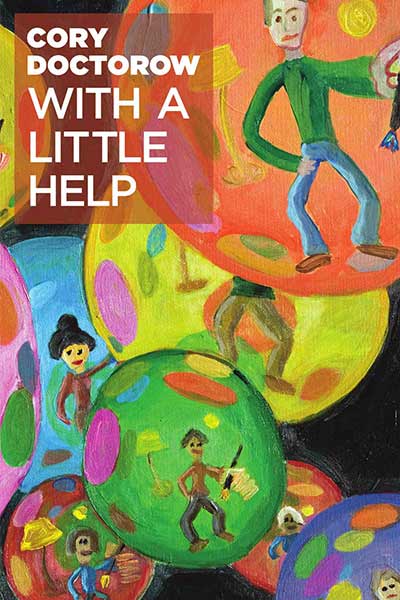
“With a Little Help” is a fun read of science fiction, highly recommended.
ALA Booklist has posted a stonking review of With a Little Help:
Anyone who grooved to the counterculture vibe of Doctorow’s young-adult novels Little Brother (2008) and For the Win (2010) will embrace these stories heartily—no one can dole out technological cautionary tales while simultaneously celebrating technology as cunningly as Doctorow. This volume’s single never-before-published story, “Epoch,” is the standout, an ethically thorny but heartfelt update on the classic sf conceit of an AI that becomes too self-aware. Never one to avoid the jugular, Doctorow doesn’t bother to assign Google an alias in “Scroogled”; the depiction of a world where we’re all “Googlestalked” until we’re “guilty of something” feels chillingly immediate. It’s not always easy to warm up to Doctorow’s purposeful characters, but it’s easy to be swept up in their just-barely-futuristic travails of surveillance gone wrong and privacy shattered. Reading this on your iPhone? Then these stories are probably for you.
ALA Booklist has posted a stonking review of With a Little Help:
Anyone who grooved to the counterculture vibe of Doctorow’s young-adult novels Little Brother (2008) and For the Win (2010) will embrace these stories heartily—no one can dole out technological cautionary tales while simultaneously celebrating technology as cunningly as Doctorow. This volume’s single never-before-published story, “Epoch,” is the standout, an ethically thorny but heartfelt update on the classic sf conceit of an AI that becomes too self-aware. Never one to avoid the jugular, Doctorow doesn’t bother to assign Google an alias in “Scroogled”; the depiction of a world where we’re all “Googlestalked” until we’re “guilty of something” feels chillingly immediate. It’s not always easy to warm up to Doctorow’s purposeful characters, but it’s easy to be swept up in their just-barely-futuristic travails of surveillance gone wrong and privacy shattered. Reading this on your iPhone? Then these stories are probably for you.
Here’s part two of my reading of my story-in-progress, Knights of the Rainbow Table, a story commissioned by Intel’s Chief Futurist, Brian David Johnson. Brian oversees Intel’s Tomorrow project, which uses science fiction to spark conversations about product design and use among Intel’s engineers, and he was kind enough to invite me to write a story of my choosing for the project. Intel gets first dibs on putting it online, but that’s it — I retain full creative control and the right to re-use it as I see fit.
Mastering by John Taylor Williams: wryneckstudio@gmail.com
J ohn Taylor Williams is a full-time self-employed audio engineer, producer, composer, and sound designer. In his free time, he makes beer, jewelry, odd musical instruments and furniture. He likes to meditate, to read and to cook.
The Escape Pod people had some technical problems with their Shannon’s Law podcast. Here’s the fixed MP3.
I have a short story called “Shannon’s Law” in the new Welcome to Bordertown anthology, the first Bordertown book in decades. I was absolutely delighted to be invited to contribute a story, and had a fun time writing my piece, which is about the application of information theory to the problem of bridging the lands of Faerie with the mundane world. Escape Pod will be podcasting the story shortly as well:
The Net’s secret weapon is that it doesn’t care what kind of medium it runs over. It wants to send a packet from A to B, and if parts of the route travel by pigeon, flashing mirrors, or scraps of paper cranked over an alleyway on a clothesline, that’s okay with the Net. All that stuff is slower than firing a laser down a piece of fiber-optic, but it gets the job done.At BINGO, we do all of the above, whatever it takes to drop a node in where a customer will pay for it. Our tendrils wend their way out into the Borderlands. At the extreme edge, I’ve got a manticore trapper on contract to peer into the eyepiece of a fey telescope every evening for an hour. He’s the relay for a kitchen witch near Gryphon Park whose privy has some magick entanglement with the hill where he sits. When we can’t get traffic over Danceland in Soho because the spellboxes that run the amps and the beer fridges are fritzing out our routers, our kitchen witch begins to make mystic passes over her toilet, which show up as purple splotches through the trapper’s eyepiece. He transcribes these—round splotches are zeroes, triangular splotches are ones—in 8-bit bytes, calculates their checksum manually, and sends it back to the witch by means of a spelled lanthorn that he operates with a telegraph key affixed to it with the braided hair of a halfie virgin (Tikigod’s little sister, to be precise). The kitchen witch confirms the checksum, and then he sends it to another relay near the Promenade, where a wharf rat who has been paid handsomely to lay off the river water for the night counts the number of times a tame cricket sings and hits a key on a peecee in time with it. The peecee pops those packets back into the Net, where they are swirled and minced and diced and routed and transformed into coffee, purchase orders, dirty texts, desperate pleas from parents to runaways to come home, desperate pleas from runaways to their parents to send money, and a million Facebook status updates.
Mostly, this stuff runs. On average. I mean, in particular, it’s always falling apart for some reason or another. Watch me knock some heads and you’ll get the picture.
The heliographer’s tower is high atop The Dancing Ferret. Everyone told me that if Farrel Din could be persuaded to get involved with BINGO, all of Soho would follow, so I did some homework, spread some money around, and then I showed up one day with a wheelbarrow filled with clothbound books that I’d had run up by the kids who put out Stick Wizard.
Update: The Escape Pod podcast is live! (here’s the MP3)
All time:
Income: $36,826.67
Outgo: $22,453.40
Net: $14,373.27
This reporting period:
Income: $4,558.80
Expenses: $2,316.97
Special editions: $2,206.27 (all time $11,503.21)
All editions: $58.91 (all time $4,444.99)
Donations:$51.79 (all time $92.20)
Sales:
Hardcovers: 8 (all time 69)
Paperback (Leider cover): 5 (all time 36)
Paperback (Rucker cover): 8 (all time 32)
Paperback (Wu cover): 7 (all time 36)
Paperback (Defendini cover): 23 (all time 87)
MP3 CDs: 3 (all time 15)
Ogg CDs: 2 (all time 7)
Amazon paperbacks: 12 (all time 12)
Inventory:
My latest Guardian column, “Why poor countries lead the world in piracy,” discusses the groundbreaking independent research presented in “Media Piracy in Emerging Economies,” a 400+ page report that took 35 researchers three years to compile. The project’s lead, Joe Karganis, is giving a free talk tomorrow in London:
So why do it at all? Karganis and co explain that the entertainment industry’s dilemma comes, fundamentally, from wanting to have its cake and eat it too. The entertainment industry can’t afford to set its price to locally appropriate equivalents. Not because it can’t profitably sell software or games or other intangibles at much lower prices – after all, the incremental cost of a new copy of Windows or Toy Story or Spore is the pennies necessary to transfer it over the net or burn it onto a disc. But if you could fly to Sri Lanka or Morocco or Mexico and buy a legit, licensed copy of Windows for a few pounds, you might be tempted to pick up a couple of dozen copies for your friends, or for the local car-boot sale. The entertainment industry fears this kind of arbitrage, so it sells its commodity goods at luxury prices in countries full of starving people and acts alarmed and hurt when people choose not to pay full freight.
But by asking taxpayers – here in the rich world and also in the poor world – to foot the bill for trade sanctions, enforcement, new civil and criminal penalties, even global treaties like ACTA, the entertainment industry can still get a profit out of the poorest people in the world by externalising the costs and reaping whatever sliver of legit market they can drag out of the poor world by brute force.
As good a read as Media Piracy is, many people might find the idea of getting to grips with more than 400 pages of research at home. Luckily, there’s an alternative: Karaganis is on tour with his report, heading to Brussels where he’ll be presenting the work to the EU. On the way, he’s stopping in London to give a free lecture on Wednesday morning, presented by the Open Rights Group and the LSE.