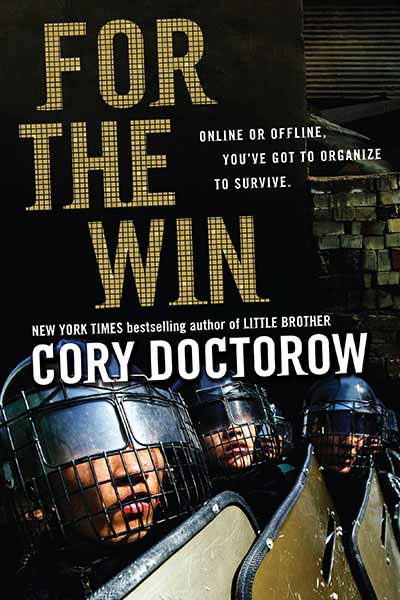
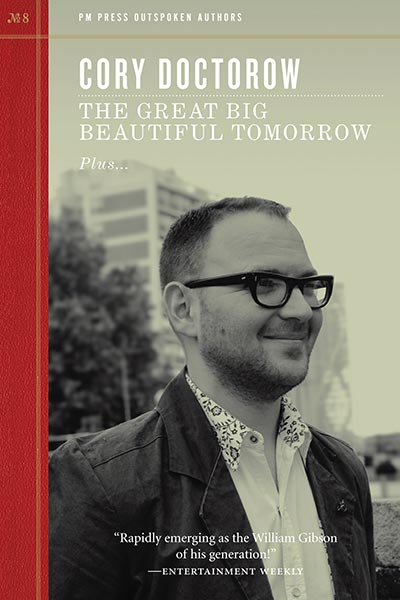
Anastasia Salter gave a presentation on my novel For the Win at the Children’s Literature 2011 conference; I haven’t seen the presentation, but her notes (embedded above) are fascinating!
Anastasia Salter gave a presentation on my novel For the Win at the Children’s Literature 2011 conference; I haven’t seen the presentation, but her notes (embedded above) are fascinating!
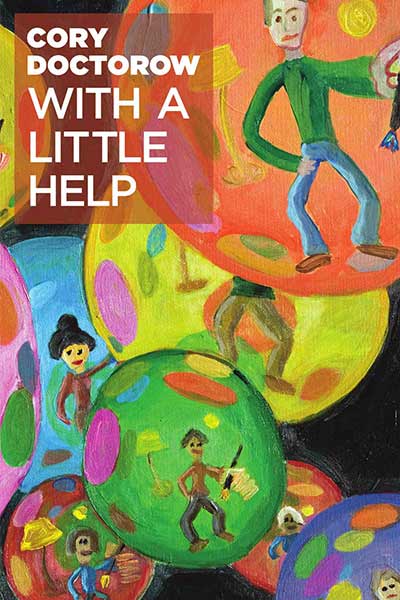
Last week, New York’s McNally-Jackson Books started printing and carrying my DIY short story collection, With a Little Help using their on-site print-on-demand machine. Now, the most excellent Harvard Bookstore has begun to do the same, retailing the book in its Cambridge, Mass store.
Last week, New York’s McNally-Jackson Books started printing and carrying my DIY short story collection, With a Little Help using their on-site print-on-demand machine. Now, the most excellent Harvard Bookstore has begun to do the same, retailing the book in its Cambridge, Mass store.
My latest Guardian column, “Networks are not always revolutionary,” argues that networks are necessary, but not sufficient, for many disruptive commercial, cultural and social phenomena, and that this character has led many people to either overstate or dismiss the role and potential of networked technology in current events:
“For most artists,” as the famous Tim O’Reilly aphorism has it “the problem isn’t piracy, it’s obscurity.” To me, this is inarguably true and self-evident – the staying power of this nugget has more to do with its admirable brevity and clarity than its novelty.
And yet, there are many who believe that O’Reilly is mistaken: they point to artists who are well-known, but who still have problems. There are YouTube video-creators who’ve racked up millions of views; bloggers with millions of readers, visual artists whose work has been appropriated and spread all around the world, such as the photographer Noam Galai, whose screaming self-portrait has found its way into everything from stencil graffiti to corporate logos, all without permission or payment. These artists, say the sceptics, have overcome obscurity, and yet they have yet to find a way to convert their fame to income.
But O’Reilly doesn’t say, “Attain fame and you will attain fortune” – he merely says that for most artists, fame itself is out of their grasp.
I’m coming through Pittsburgh tomorrow for a private event and I’m going to drop in to the CMU bookstore from 2-5 for a signing. This is all very last minute and there hasn’t been much public notice, so please let your friends know!
I’ve teamed up with McNally-Jackson, a most excellent indie bookstore in Soho, NYC, to print and sell my DIY short story collection With a Little Help right in the store, using an Espresso book-machine. You can order them here, or buy them in-store. It’s similar to the deal I’ve struck with The University of Melbourne’s Custom Book Centre for sales and distribution in Australia in New Zealand. I’m really excited to see how this works out, as there are plenty of amazing stores in the USA with Espresso machines with whom I’d be delighted to make similar arrangements.
I’ve teamed up with McNally-Jackson, a most excellent indie bookstore in Soho, NYC, to print and sell my DIY short story collection With a Little Help right in the store, using an Espresso book-machine. You can order them here, or buy them in-store. It’s similar to the deal I’ve struck with The University of Melbourne’s Custom Book Centre for sales and distribution in Australia in New Zealand. I’m really excited to see how this works out, as there are plenty of amazing stores in the USA with Espresso machines with whom I’d be delighted to make similar arrangements.

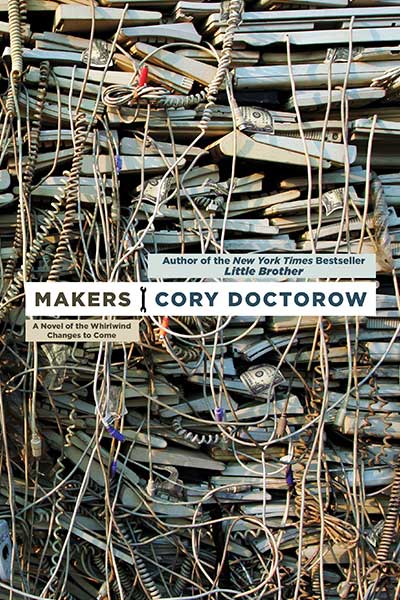
Michael created a dog-shirt equipped with persistence-of-vision LEDs controlled by a LilyPad soft Arduino, and programmed it to output the text of my novel Makers as his pooch ran gleefully around the park at night. Then he photographed it and sent it to me, and my head exploded with delight.
Mounting 5 LEDs on a moving object creates one of the cheapest and largest displays: Persistence of Vision. It’s been done on bicycle wheels, fans and other rotating objects.
In this project i am sewing a Lilypad wearable Arduino board and five LEDs with conductive thread on my dog’s shirt. She’s a Miniature Pinscher running very fast for fun. In curves fast enough for Persitence of Vision. And she likes running in large circles in the park! Light writing.