/ / News

Salon has just posted part two of its ten-part serialization of my novel-in-progress, “Themepunks.” Last week, we met Andrea Fleeks, a tech journalist; Lionel Kettlewell, a brazen Silicon Valley VC; and Rat-Toothed Freddy, a sleazy UK tabloid tech journalist, and learned that Kettlewell had bought up and liquidated Kodak and Duracell, two companies that have no place in a filmless, batteryless twenty-first century. Kettlewell proposes to use the money to fund micro-startups that combine cool commodity hardware, open source software and imagination to create new tools that are profitable for 3-6 months, until they are cloned and the margin on them falls to near-zero.

In this week’s installment, Andrea goes on assignment to Hollywood, Florida, where she meets Lester and Perry, a pair of tech-freaks who live in a junkyard where they remix dead high-tech toys into one-of-a-kind works of art:

Perry set Boogie Woogie Elmo down on a workbench and worked a miniature USB cable into his chest cavity. The other end terminated with a PDA with a small rubberized photovoltaic cell on the front.

“This thing is running InstallParty — it can recognize any hardware and build and install a Linux distro on it without human intervention. They used a ton of different suppliers for the BWE, so every one is a little different, depending on who was offering the cheapest parts the day it was built. InstallParty doesn’t care, though: one click and away it goes.” The PDA was doing all kinds of funny dances on its screen, montages of playful photoshopping of public figures matted into historical fine art.

“All done. Now, have a look — this is a Linux computer with some of the most advanced robotics ever engineered. No sweatshop stuff, either, see this? The solder is too precise to be done by hand — that’s because it’s from India. If it was from Malaysia, you’d see all kinds of wobble in the solder: that means that tiny, clever hands were used to create it, which means that somewhere in the device’s karmic history, there’s a sweatshop full of crippled children inhaling solder fumes until they keel over and are dumped in a ditch. This is the good stuff.

“So we have this karmically clean robot with infinitely malleable computation and a bunch of robotic capabilities. I’ve turned these things into wall-climbing monkeys; I’ve modded them for a woman from the University of Miami at the Jackson Memorial who used their capability to ape human motions in physiotherapy programs with nerve-damage cases. But the best thing I’ve done with them so far is the Distributed Boogie Woogie Elmo Motor Vehicle Operation Cluster. Come on,” he said, and took off deeper into the barn’s depths.

/ / News

Doublefiltered, a webzine, has published a fine interview with me:

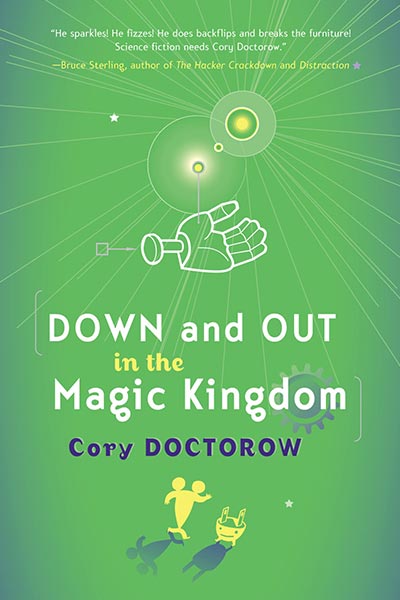
DF: You set one of your novels, Down and Out In the Magic Kingdom, in Disneyland. How does Disney relate to all this?

CD: I am a huge Disneyfile, I love the park and I am always fascinated to see how it shows up in other peoples storylines – the same way that Vancouverites seek out bits of the Vancouver skyline in movies that have been filmed there.

Disney theme parks are a good backdrops against which to play out dramas because they embody so much utopianism themselves, so much science-fictional thinking. Walt was an optimist, and a science fiction writer whose canvas was people and social systems, like Henry Ford, and like a lot of other American entrepreneurs of that era. He was an experimenter, a social experimenter who tried out explicitly crazy communities.

DF: Do you find it at all ironic that the someone like yourself who is lobbying heavily for copyright reform is in this intimate imaginative relationship with Disney who today are one of the biggest proponents of tighter copyright restrictions?

CD: Not at all. I think that it is possible to create great art and still be an asshole. And that is Disney in a nutshell. The company does some very good things. There is hardly a company in the world that is as progressive as they are with respect to same sex spousal benefits, they are the larger employer of homosexuals in the southlands, they were the first to offer same sex benefits in the teeth of the crazy, loony, Christian right, Baptist constituency who accused them of destroying family values. And the same thing goes for their creativity.

I think that the Disney park is brilliant and wonderful. There are a lot of people who hope that we can have a popular revolution without popular entertainment – I say to them:

If your popular revolution demands that we give up on popular entertainment it won’t be very popular.

/ / News

I’ve been working on a new novel since last December, working title “Themepunks.” The first third is in the can, and it is a short novel unto itself. The book is about a post-dotcom boom and bust, built on the ready availability of commodity hardware and open source code, and concerns itself with the lives of a gang of visionary tech entrepreneurs, journalists, bloggers, as well as Florida squatters, students in the midwest, and Brazilian geek activists. I’ve read aloud from it on a number of occasions, most recently at the Worldcon in Glasgow in August, and always to enthusiastic responses.

Salon magazine has begun to serialize the book, and they will publish a section every Monday for ten weeks. By that time, I hope act two will be done and Salon will be interested in it, though of course there’s no guarantee of either (but act one is self-contained and stands on its own). When the whole thing is done, Tor will publish it between covers and I’ll be doing my normal Creative Commons release, but I relish the opportunity to do what Dickens did — write a novel in serial form just a few weeks ahead of my readers.

Andrea Fleeks almost never had to bother with the blue blazer these days. Back at the height of the dot-boom, she’d put on her business journalist drag — blazer, blue sailcloth shirt, khaki trousers, loafers — just about every day, putting in her obligatory appearances at splashy press conferences for high-flying IPOs and mergers. These days, it was mostly work at home or one day a week at the San Jose Mercury’s office, in comfortable light sweaters with loose necks and loose cotton pants that she could wear straight to yoga after shutting her PowerBook’s lid.

Blue blazer today, and she wasn’t the only one. There was Morrow from the NYT’s Silicon Valley office, and Spetzer from the WSJ, and that despicable rat-toothed jumped-up gossip columnist from one of the U.K. tech-rags, and many others besides. Old home week, blue blazers fresh from the dry-cleaning bags that had guarded them since the last time the NASDAQ broke 4000.

The man of the hour was Landon Kettlewell — the kind of outlandish prep-school name that always seemed a little made up to her — the new CEO and front for the majority owners of Kodak/Duracell. The despicable rat-toothed Brit had already started calling them Kodacell. Buying the company was pure Kettlewell: shrewd, weird and ethical in a twisted way.

“Why the hell have you done this, Landon?” Kettlewell asked himself into his tie-mic. Ties and suits for the new Kodacell execs in the room, like surfers playing dress-up. “Why buy two dinosaurs and stick ’em together? Will they mate and give birth to a new generation of less-endangered dinosaurs?”

/ / News

Peter Morrison, an audioblogger who attended last week’s World Science Fiction Convention in Glasgow, recorded my reading of my new novel-in-progress (working title “Themepunks”). The audio is live now — I’m really happy with how it came out. I love hearing writers read their own work, and I love reading my stuff aloud: it’s so much cooler than just reading off the printed page.

He reached down below a work-table and hosted up a huge triptych made out of three hinged car-doors stood on end. Carefully, he unfolded it and stood it like a screen on the cracked concrete floor.

The inside of the car-doors had been stripped clean and polished to a high metal gleam that glowed like sterling silver. Spot-welded to it were all manner of soda tins, pounded flat and cut into gears, chutes, springs and other mechanical apparatus.

“It’s a mechanical calculator,” he said, proudly. “About half as powerful as Univac. I milled all the parts using a laser-cutter. What you do is, fill this hopper with GI Joe heads, and this hopper with Barbie heads. Crank this wheel and it will drop a number of M&Ms equal to the product of the two values into this hopper, here.” He put three scuffed GI Joe heads in one hopper and four scrofulous Barbies in another and began to crank, slowly. A music-box beside the crank played a slow, irregular rendition of “Pop Goes the Weasel” while the hundreds of little coin-sized gears turned, flipping switches and adding and removing tension to springs. After the weasel popped a few times, twelve brown M&Ms fell into an outstretched rubber hand. He picked them out carefully and offered them to her. “It’s OK. They’re not from the trash,” he said. “I buy them in bulk.” He turned his broad back to her and heaved over a huge galvanized tin washtub full of brown M&Ms. “See, it’s a bit-bucket!” he said.

/ / News

I’m off to the WorldCon as soon as they call my flight, then I’m headed off on holidays: long story short, I won’t be reading much email between now and the 15th of August and will be facing too gigantic a pile of mail to carefully filter then, so anything you send between now and oh, say, August 17th won’t get much attention from me and stands a good chance of getting accidentally deleted when I come to sort through received mail on my return.

If it’s not urgent, don’t send it until after the 15th. If it’s urgent and related to EFF, email Ren Bucholz, and if it’s urgent and related to writing, email my agent’s assistant, Ann Behar. If you’ve got a Boing Boing suggestion, please don’t ever email it to me, ever! Use the suggest a site form.

/ / News

Becky Heydermann, an attendee at Glasgow’s World Science Fiction Convention later this week, has organized an informal session on the future of the book:

Discuss the nature of books, the idea of a book and what can be done with books, both as concept and as object.

This is a subject near and dear to my heart. It will be nice to cover this subject in a discussion rather than the traditional convention panel, where five people speak for ten minutes each, field one or two questions, and beat it. Naturally, I’ll be attending, and I hope you’ll come, too:

Date/Time: Sunday, 5PM
Location: Fan Lounge, at the Moat House. (apparently, real ale is on tap here)