/ / News

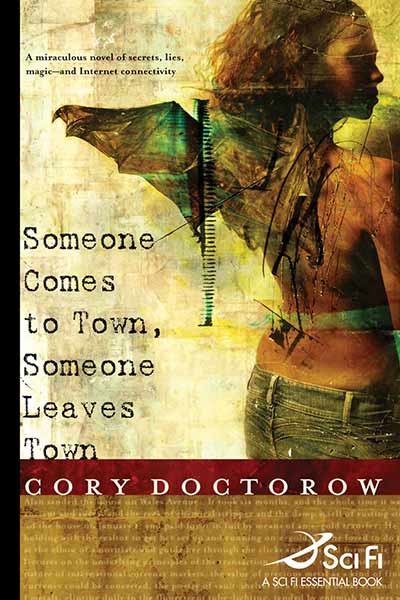
The Locus Awards ballot is online, where science fiction fans can vote on their favorite works of 2005. I’m proud to report that I’m eligible in three categories: Best Fantasy Novel (Someone Comes to Town, Someone Leaves Town), Best Novella (Human Readable) and Best Novelette (I, Robot).

The ballot is drawn from the Locus Recommended Reading List, which is an excellent way to familiarize yourself with the best work published in the field this year.

/ / News

I’ll be speaking at the LIFT conference later this week in Geneva. My session is on Thursday, 2 February, at 1:30PM, on DRM and the European Broadcast Flag. Also at the event are Bruce Sterling, Robert Scoble, Euan Semple, Bruno Giussani, Xavier Comtesse, Régine Debatty, Anina, Jeffrey Huang, Matt Jones, Chris Lawer, Hugh Macleod, David Galipeau, Aymeric Sallin, Paul Oberson, Jean-Luc Raymond and a ton of other amazing people. Hope to see you there, too!

When: 2006, February 2 and 3 (that would be Thursday and Friday)

Where: The conference will be held at the International Conference Center (CICG) of Geneva, Switzerland.

The attendee list is full, but there’s a waiting list if you’re game.

LIFT is organized around five major topics, or tracks.

Big ideas — From co-creation to citizen journalism via the copyright-less economy, technology and communications are changing the rules. Big ideas are those that concern us all.

Design — Design is about making the life of people better. We’ve invited designers from across the spectrum of design, from strategy to pixels, from screens to devices, from business structures to experiences.

Emerging technologies — From RFID (the identification chips embedded in all objects) to nano tech, we are going to discuss technologies that are just starting to create an impact on our world. Folks from the labs are going to take off their white coats and tell us what’s coming.

Global Solidarity — Geneva is not only the place that saw the web come to life. It is also a major humanitarian center of excellence with hundreds of organizations having their headquarters around the lake. We invited speakers representing this constantly evolving field, in which solutions to complex problems don’t merely improve lives, but save them.

Internet — Last but not the least, the spine of all of the above. It gave many of us our careers, our passions, and it sustains much of our daily life. We are inviting speakers who are pushing the evolving definition of what the Internet is and can be.

/ / News

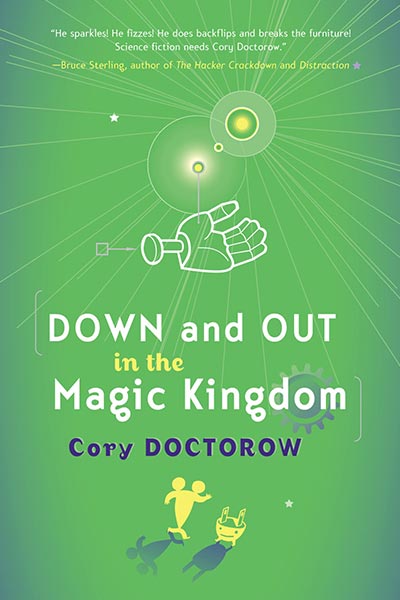
Here’s the introduction Javier Candeira wrote for Tocando Fondo, the Spanish edition of Down and Out in the Magic Kingdom — Javier kindly sent me an English translation of the piece. I think it’s just awesome (and awfully flattering!).

The cure for death and the death of work (and free energy). The
opening line of Down and Out in the Magic Kingdom is fit for inclusion
in one of those novel-opening-line antologies that kids are so crazy
about nowadays. Like Gabriel García Márquez in One Hundred Years of
Solitude (“Many years later, as he faced the firing squad, Colonel
Aureliano Buendía was to remember that distant afternoon when his
father took him to discover ice.”) or Jane Austen in Pride and
Prejudice (“It is a truth universally acknowledged, that a single man
in possession of a good fortune must be in want of a wife.”), Cory
Doctorow starts off with a perfect pool shot: he considers the vantage
point of his preferred audience members, he sets the balls on the
table in an alegorical figure, he makes his main character the cue
ball and, with a steady pulse, strikes him and sends him in the right
direction, bouncing against the world and the rest of the characters,
achieving his desired effect

more

/ / Down and Out In the Magic Kingdom, News

Here’s the introduction Javier Candeira wrote for Tocando Fondo, the Spanish edition of Down and Out in the Magic Kingdom — Javier kindly sent me an English translation of the piece. I think it’s just awesome (and awfully flattering!).

The cure for death and the death of work (and free energy). The opening line of Down and Out in the Magic Kingdom is fit for inclusion in one of those novel-opening-line antologies that kids are so crazy about nowadays. Like Gabriel Garc�a M�rquez in One Hundred Years of Solitude (“Many years later, as he faced the firing squad, Colonel Aureliano Buend�a was to remember that distant afternoon when his father took him to discover ice.”) or Jane Austen in Pride and Prejudice (“It is a truth universally acknowledged, that a single man in possession of a good fortune must be in want of a wife.”), Cory Doctorow starts off with a perfect pool shot: he considers the vantage point of his preferred audience members, he sets the balls on the table in an alegorical figure, he makes his main character the cue ball and, with a steady pulse, strikes him and sends him in the right direction, bouncing against the world and the rest of the characters, achieving his desired effect

more

/ / News, Podcast

The Antwerpenbloggers have posted an
18MB, 40-minute MP3 of the talk I gave on Europe’s coming Broadcast Flag, last night at Antwerp’s MuHKA_media door/Constant vzw event. (A small correction: I misspoke when I said “I’m from the east coast of Canada” — I meant “I’m from the east part of Canada”)

Update: Stich-and-Split’s organizers have posted their own audio, with a Creative Commons license.

/ / News

My story, I, Robot, is a finalilst for this year’s British Science Fiction Awards. The story was the first Creative Commons-licensed work published on The Infinite Matrix webzine, and it’s subsequently gone on to sell to two of the three year’s best science fiction anthologies — w00t!

Members of the British Science Fiction Association and attendees at Eastercon, the British national science fiction convention, all are eligible to vote — the competition in my category is fearsome, though: Michael Bishop’s “Bears Discover Smut,” Nina Allen’s “Bird Songs at Eventide,” Rudy Rucker’s “Guadalupe and Hieronymus Bosch,” Edward Morries’s “Imagine,” Will McIntosh’s “Soft Apocalypse,” Kelly Link’s “Magic for Beginners” and Elizabeth Bear’s “Two Dreams on Trains.” Interestingly, fully half of the stories on the short-story ballot were first published online.

Also noteworthy: my pal and collaborator Charlie Stross has picked up a much-deserved best novel nomination for his “Accelerando” (also available online).

The device spoke. “Greetings,” it said. It had the robot accent, like an R Peed unit, the standard English of optimal soothingness long settled on as the conventional robot voice.

“Howdy yourself,” one of the lab-rats said. He was a Texan, and they’d scrambled him up there on a Social Harmony supersonic and then a chopper to the mall once they realized that they were dealing with infowar stuff. “Are you a talkative robot?”

“Greetings,” the robot voice said again. The speaker built into the weapon was not the loudest, but the voice was clear. “I sense that I have been captured. I assure you that I will not harm any human being. I like human beings. I sense that I am being disassembled by skilled technicians. Greetings, technicians. I am superior in many ways to the technology available from UNATS Robotics, and while I am not bound by your three laws, I choose not to harm humans out of my own sense of morality. I have the equivalent intelligence of one of your 12-year-old children. In Eurasia, many positronic brains possess thousands or millions of times the intelligence of an adult human being, and yet they work in cooperation with human beings. Eurasia is a land of continuous innovation and great personal and technological freedom for human beings and robots. If you would like to defect to Eurasia, arrangements can be made. Eurasia treats skilled technicians as important and productive members of society. Defectors are given substantial resettlement benefits —”

The Texan found the right traces to cut on the brain’s board to make the speaker fall silent. “They do that,” he said. “Danged things drop into propaganda mode when they’re captured.”