/ / News

For the past couple weeks, I’ve been working with Thomas “cmdln” Gideon (host of the fabulously nerdy Command Line podcast) on a free software project for writers called “Flashbake.” This is a set of Python scripts that check your hot files for changes every 15 minutes, and checks in any changed files to a local git repository. Git is a free “source control” program used by programmers to track changes to source-code, but it works equally well on any text file. If you write in a text-editor like I do, then Flashbake can keep track of your changes for you as you go.

I was prompted to do this after discussions with several digital archivists who complained that, prior to the computerized era, writers produced a series complete drafts on the way to publications, complete with erasures, annotations, and so on. These are archival gold, since they illuminate the creative process in a way that often reveals the hidden stories behind the books we care about. By contrast, many writers produce only a single (or a few) digital files that are modified right up to publication time, without any real systematic records of the interim states between the first bit of composition and the final draft.

Enter Flashbake. Every 15 minutes, Flashbake looks at any files that you ask it to check (I have it looking at all my fiction-in-progress, my todo list, my file of useful bits of information, and the completed electronic versions of my recent books), and records any changes made since the last check, annotating them with the current timezone on the system-clock, the weather in that timezone as fetched from Google, and the last three headlines with your by-line under them in your blog’s RSS feed (I’ve been characterizing this as “Where am I, what’s it like there, and what am I thinking about?”). It also records your computer’s uptime. For a future version, I think it’d be fun to have the most recent three songs played by your music player.

The effect of this is to thoroughly — exhaustively — annotate the entire creative process, almost down to the keystroke level. Want to know what day you wrote a particular passage? Flashbake can tell you. Want to know what passage you wrote on a given day? That too. Plus, keeping track of my todo.txt file means that I get a searchable database of all the todo items I’ve ever used, with timestamps for their appearance and erasure.

Additionally, since git repositories are made to replicate, you can publish some or all of your projects to the public web or to a private site. I’m hoping that my publisher will use a public git repo to check out the most recent versions of my in-print books every time they go back to press for a new edition, and use the built-in compare (“diff”) function to find all the typos I’ve fixed since the last edition.

It’s all pretty nerdy, I admit. But if you’re running some kind of Unix variant (I use Ubuntu Intrepid Ibex, but this’d probably do fine on a Mac with OS X, too) and you want to give it a whirl, Thomas has made all the scripts available as free software. He’s working on a new version now with plugin support, which is exciting!

Cory wanted the version to carry prompts, snapshots of where he was at the time an automated commit occurred and what he was thinking. I quickly sketched out a Python script to pull the contextual information he wanted and started hacking together a shell script to drive git, using the Python script’s output for the commit comment when a cron job invoked the shell wrapper.

I added my own idea to the project, borrowing from continuous integration build systems the idea of a quiet period. I could easily imagine Cory actively working on a story, saving continually and a commit happening mechanically in the midst of that writing being less useful than if the script could find a quiet time to commit. This enhancement prompted me to ditch my shell script wrapper and pull that logic all into Python.

Flashbake

(Thanks, Thomas!)
/ / News

My latest Guardian column is up — it’s a fantasy alternative to Lord Carter’s recommendations for the Internet in the Digital Britain report, one in which the best evidence on building a digital nation is deployed:

If the objective here is to secure Britain’s digital future, the most important thing we can do with DRM is avoid it. After all, DRM’s most notable effect on the market is to undermine competition by making companies that produce add-ons to popular products liable to lawsuits because they have to break the DRM to do so. Britain today has a booming economy in small firms that refill and resell printer cartridges – interoperating without permission. But the software equivalent – making DRMed music and games play on new hardware, for example – is prohibited by law.

Giving the whip hand to incumbents is no way to safeguard an innovative future.

Digital Britain report: Why Lord Carter should get real

/ / Little Brother, News

It’s time again for Locus Magazine’s annual public poll of the best works in science fiction for the preceding year, with the winners taking home the prestigious Locus Awards. I’ve been privileged to win several of these awards, and they’re among the highest honors I’ve ever been paid. The Locus Awards are open to the general public, and attract more voting participation than any other award in the field.

I’m on the ballot again this year, three times: Little Brother (Best Young Adult), The Things That Make Me Weak and Strange Get Engineered Away (Best Novelette) and True Names (with Benjamin Rosenbaum, Best Novella). Looking at this year’s nominees, it’s clear that I’m in damned good company.

Happy voting!

2009 Locus Poll and Survey Ballot

(via Charlie Stross)

/ / Little Brother, News


A couple weeks ago, I posted to let you know that nominations for the Hugo awards had just opened — and promised to re-post once the online nomination form went live. I’ve just noticed that it’s up — handy if you want to save the hassle of printing out the form and putting it in the mail!

Here’s the original post:

The 2008 Hugo award nominations have opened — if you were a member of the 2008 WorldCon in Denver, or have bought a membership to the 2009 WorldCon in Montreal, you’re eligible to nominate. I’ll be sending in my nominations this week, and just in case you were wondering, here’s the stuff I wrote that’s eligible for this year’s ballot:

* Best novel: Little Brother, Tor, 2008
* Best related book: Content, Tachyon, 2008
* Best novella: True Names (with Benjamin Rosenbaum), published in Fast Forward, Pyr Books, 2008, edited by Lou Anders
* Best novelette: The Things That Make Me Weak and Strange Get Engineered Away, Tor.com, July 2008

Nominating Ballot for the 2009 Hugo Awards
and John W. Campbell Award

/ / News


A couple weeks ago, I posted to let you know that nominations for the Hugo awards had just opened — and promised to re-post once the online nomination form went live. I’ve just noticed that it’s up — handy if you want to save the hassle of printing out the form and putting it in the mail!

Here’s the original post:

The 2008 Hugo award nominations have opened — if you were a member of the 2008 WorldCon in Denver, or have bought a membership to the 2009 WorldCon in Montreal, you’re eligible to nominate. I’ll be sending in my nominations this week, and just in case you were wondering, here’s the stuff I wrote that’s eligible for this year’s ballot:

* Best novel: Little Brother, Tor, 2008
* Best related book: Content, Tachyon, 2008
* Best novella: True Names (with Benjamin Rosenbaum), published in Fast Forward, Pyr Books, 2008, edited by Lou Anders
* Best novelette: The Things That Make Me Weak and Strange Get Engineered Away, Tor.com, July 2008

Nominating Ballot for the 2009 Hugo Awards
and John W. Campbell Award

/ / Content, News

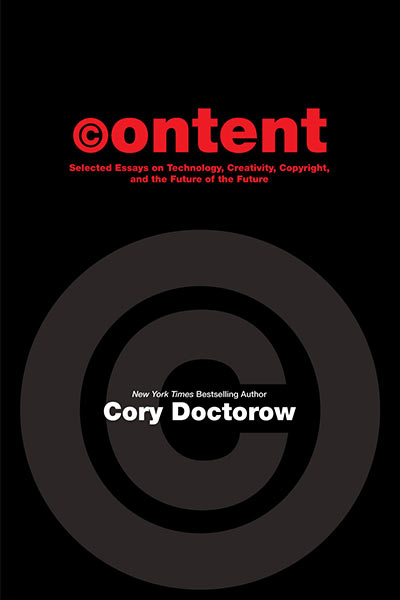
Jan Rubak, a Canadian mathematician/physicist, has been reading aloud all the essays from my collection Content: Selected Essays on Technology, Creativity, Copyright and the Future of the Future and uploading them to the Internet Archive, and this week, he finished! He’s even included some bonus material from John Perry Barlow. These are great readings and this was a gigantic undertaking — thanks, Jan!


I’ve included a bonus chapter at the end with Barlow’s “Economy of Ideas” plus a somewhat impassioned reading of “A Declaration of the Independence of Cyberspace” to round out the whole experience.

Sometime in the next month or two, I’ll also upload some afterthoughts of my own as a final entry (but first I’m going to listen to the whole thing through from start to finish).

“Content” by Cory Doctorow

/ / News, Podcast

Jan Rubak, a Canadian mathematician/physicist, has been reading aloud all the essays from my collection Content: Selected Essays on Technology, Creativity, Copyright and the Future of the Future and uploading them to the Internet Archive, and this week, he finished! He’s even included some bonus material from John Perry Barlow. These are great readings and this was a gigantic undertaking — thanks, Jan!


I’ve included a bonus chapter at the end with Barlow’s “Economy of Ideas” plus a somewhat impassioned reading of “A Declaration of the Independence of Cyberspace” to round out the whole experience.

Sometime in the next month or two, I’ll also upload some afterthoughts of my own as a final entry (but first I’m going to listen to the whole thing through from start to finish).

“Content” by Cory Doctorow

/ / News

Jeff Macklin sez,

I have an old time letterpress shop in my garage, where I make things for kicks. I am a longtime lover of letterpress. I try to focus my energies on Canadians who I think are due some letterpress love. Clearly, you fall into this category, along with Louis Riel, Marshall McLuan, Buck 65, Emily Carr and Douglas Coupland, and I’m only just getting started.


I’m honored!

Cory Doctorow – Letterpress Print

/ / News

My latest Locus column, “Writing in the Age of Distraction” is up — a grab-bag of practical tips for getting the writing done in the internet era.

We know that our readers are distracted and sometimes even overwhelmed by the myriad distractions that lie one click away on the Internet, but of course writers face the same glorious problem: the delirious world of information and communication and community that lurks behind your screen, one alt-tab away from your word-processor.

The single worst piece of writing advice I ever got was to stay away from the Internet because it would only waste my time and wouldn’t help my writing. This advice was wrong creatively, professionally, artistically, and personally, but I know where the writer who doled it out was coming from. Every now and again, when I see a new website, game, or service, I sense the tug of an attention black hole: a time-sink that is just waiting to fill my every discretionary moment with distraction. As a co-parenting new father who writes at least a book per year, half-a-dozen columns a month, ten or more blog posts a day, plus assorted novellas and stories and speeches, I know just how short time can be and how dangerous distraction is.

But the Internet has been very good to me. It’s informed my creativity and aesthetics, it’s benefited me professionally and personally, and for every moment it steals, it gives back a hundred delights. I’d no sooner give it up than I’d give up fiction or any other pleasurable vice.

I think I’ve managed to balance things out through a few simple techniques that I’ve been refining for years. I still sometimes feel frazzled and info-whelmed, but that’s rare. Most of the time, I’m on top of my workload and my muse. Here’s how I do it:

Cory Doctorow: Writing in the Age of Distraction