Since the end of September, I’ve been podcasting a story-in-progress called “After the Siege,” reading it in installments as I wrote it. Last week, I finished writing the story and today I’ve uploaded the final piece. You can get the whole thing through my podcast page.
All About:
News
Part seven of Themepunks is live today. That’s the novel-in-progress whose first third Salon has been serializing every Monday — three more installments to go! Today we learn about how Perry and Lester’s crazy school of invention can be applied to urban squatting:
The new shantytown went up fast — faster than she’d dreamed possible. The boys helped. Lester downloaded all the information he could find on temporary shelters — building out of mud, out of sandbags, out of corrugated cardboard and sheets of plastic — and they tried them all. Some of the houses had two or more rickety-seeming stories, but they all felt solid enough as she toured them, snapping photos of proud homesteaders standing next to their handiwork.
Little things went missing from the workshops — tools, easily pawned books and keepsakes, Perry’s wallet — and they started locking their desk-drawers. There were junkies in amongst the squatters, and desperate people, and immoral people, them too. One day she found that her cute little gold earrings weren’t beside her desk-lamp, where she’d left them the night before, and she practically burst into tears, feeling set-upon on all sides.
She found the earrings later that day, in the bottom of her purse, and that only made things worse. Even though she hadn’t voiced a single accusation, she’d accused every one of the squatters in her mind that day. She found herself unable to meet their eyes for the rest of the week.
“I have to write about this,” she said to Perry. “This is part of the story.” She’d stayed clear of it for a month, but she couldn’t go on writing about the successes of the Home Aware without writing about the workforce that was turning out the devices and add-ons by the thousands, all around her, in impromptu factories with impromptu workers.
“Why?” Perry said. He’d been a dervish, filling orders, training people, fighting fires. By nightfall, he was hollow-eyed and snappish. Lester didn’t join them on the roof anymore. He liked to hang out with Francis and some of the young bucks and pitch horseshoes down in the shantytown, or tinker with the composting toilets he’d been installing at strategic crossroads through the town. “Can’t you just concentrate on the business?”
A reminder: I’m doing a a reading and signing tomorrow (Monday) night at London’s Stanhope Centre, near Marble Arch, at 6:30PM. Books will be on sale and light refreshments provided. Hope to see you there!
A reminder: I’m doing a a reading and signing tomorrow (Monday) night at London’s Stanhope Centre, near Marble Arch, at 6:30PM. Books will be on sale and light refreshments provided. Hope to see you there!
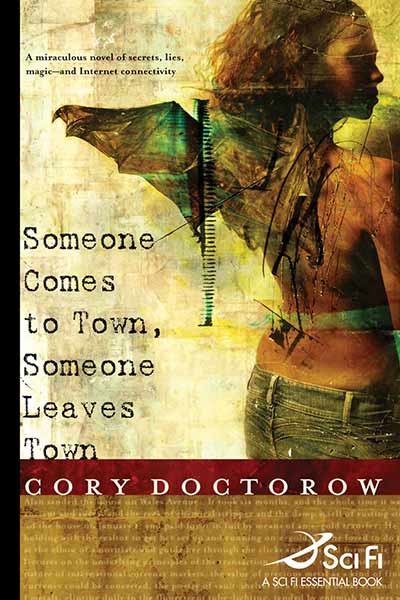
This is such a cool reminx of my novel Someone Comes to Town, Someone Leaves Town — an RSS feed that gives you a couple pages every day. No matter when you subscribe to it, it sends you the book starting from the beginning. Subscribe via Winksite and it’ll come to your phone in daily bite-sized pieces.
(Thanks, Charles!)
This is such a cool reminx of my novel Someone Comes to Town, Someone Leaves Town — an RSS feed that gives you a couple pages every day. No matter when you subscribe to it, it sends you the book starting from the beginning. Subscribe via Winksite and it’ll come to your phone in daily bite-sized pieces.
(Thanks, Charles!)
I’m giving a signing and reading for my latest book, Someone Comes to Town, Someone Leaves Town, at London’s Stanhope Centre next Monday, Oct 24 at 6PM. There will be copies of all my books on sale, and the kind folks at Stanhope are also providing “light refreshments.” Hope to see you there!
I’m giving a signing and reading for my latest book, Someone Comes to Town, Someone Leaves Town, at London’s Stanhope Centre next Monday, Oct 24 at 6PM. There will be copies of all my books on sale, and the kind folks at Stanhope are also providing “light refreshments.” Hope to see you there!
I’ve joined the Board of Directors of the Clarion Foundation, a new nonprofit that will manage the Clarion Writers’ Workshop, a “boot-camp for sf writers” at Michigan State University that I graduated from in 1992 and taught this past summer. The workshop runs every summer for six weeks, and accepts some 17 students each year. The format is intensive writing and daily critiquing, with tutelage from six instructors. Past grads include Octavia Butler, Bruce Sterling, Nalo Hopkinson, Kathe Koja, Jeff Vandermeer, Pat York, Lucius Sheppard and innumerable other leading lights of the field. You may recall my review of Kate Wilhelm’s amazing memoir/writing instruction book about her 25+ years teaching Clarion.
The workshop is open for applications for next year, and we’ve just announced our instructor roster:
Plans have been announced for the 2006 workshop, which will run from June 26 to August 4 and will be taught by Samuel R. Delany, Gardner Dozois, Nancy Kress, Joe and Gay Haldeman and, as the traditional anchor team, Kelly Link and Holly Black. The workshop will be returning to Owen Hall where it was held from 1990-2003.
The application deadline for the 2006 workshop is April 1, 2006. Application information is available online at www.msu.edu/~clarion, by email, or by writing to the Clarion Workshop, 112 Olds Hall, Michigan State University, Lansing, MI 48824-1047.
An EU body is negotiating the requirements for a pan-European DRM system. The requirements are really restrictive, and explicitly set out to eliminate both Creative Commons licensed works and free/open source software-based media players. I’ve written and submitted a critique of the proposal:
Given the total failure of DRM to date to enrich creators or prevent unauthorised Internet distribution of works, it is a pity that NAVSHP started with the premise that the world needs more DRM, rather than exploring whether that is indeed the best way to foster the development of the home audiovisual market.
A more reasonable and balanced approach would be to start by asking, “How can we enrich creators and encourage creation?” and “If DRM vendors claim to be able to enrich creators and prevent unauthorised Internet distribution, what evidence can they offer in support of these claims?”
The EU — and the world — is experiencing a revolution in creativity thanks to the Internet. An entire generation of remixers, talented amateurs, and Creative Commons enthusiasts have created over fifty million works that do not require DRM to thrive. A useful work product from NAVSHP would be a set of technology standards recommendations for systems that embrace unrestricted copying, in support of these new, Internet-native business-models. These European creators deserve every bit as much attention from the EU as do American film studios and other incumbents.
It is the author’s opinion that NAVSHP should begin a fresh inquiry to look at the broader question of how DRM technologies impact the marketplace for home audiovisual technologies. This inquiry should be based on the wide range of available empirical data at hand and focus on the following issues:
* Has DRM technology been successful at preventing the unauthorized Internet distribution of material, or have overly broad use-restrictions provided otherwise law-abiding consumers with incentives to find unrestricted material on peer to peer networks?
* What technological systems can enrich creators?
* What technological systems can encourage the creation of new works and new business models?
* What technological needs do “copy-friendly” creators have, and how could standardisation aid them?