All About:
News
My latest InformationWeek column just went live: “Don’t Let Self-Improvement Tools Be Used Against You” looks at “myware” tools that help you keep in control of your life and compares them to spyware tools used to give others control over your life:
Our computers are full of small pieces of “myware” — software that spies on you for your own benefit, helping you to know yourself better. Your browser’s History file autocompletes the URLs you type into the location bar; the search box remembers your previous searches. The recent-documents list in your word processor, your email program’s capacity to remember the people you’ve emailed before — all little bits of useful mental prosthesis, external systems that help you keep track of what you do, so that you can do it better.
But “Know Thyself” has an ugly, sinister cousin: “Know Thy Neighbor.” This is the curtain-twitching philosophy that drives us to spy on the people around us (sometimes at the behest of the government, who appear to have learned nothing from failed snitch states like East Germany). It’s the folly that drives merchants, bosses and governments to watch us through a million CCTV cameras, track us through spyware that keeps track of what we install on our PCs, follow us around the Web with beacons, count our keystrokes, and log our library books.
My latest Locus column is up: “Artist Rights” describes the terrible risk to artists that arises from expecting online services to police everything their users do for copyright infringement. If YouTube, Scribd, Blogger, LiveJournal and all the other sites where we’re allowed to put our work have to hire lawyers or erect technical filters that attempt to prevent infringement before it happens, it will dramatically raise the cost of expression. That’s not good for art, period. (Even worse — the automated filters won’t work, so you’ll pay the cost of reduced opportunities for expression and you won’t even get the benefit of control over distribution of your work)
But even worse for artists: when the cost of distributing art goes up, the number of companies involved in it goes down. We all know what that looks like: the record industry, cable TV, the studio system. All systems where there’s a buyer’s market for art, where the big companies have artists over a barrel.
We live in an age in which more people can express themselves in more ways to more audiences than ever before. The majority of this expression is intimate, personal maunderings — the half-spelled, quarter-grammatical newspeak adorning MySpace and Facebook pages. These are often intensely personal, with none of the self-conscious artifice that we’ve traditionally associated with “published work.” By turning the personal into the public, an entirely new aesthetic is coming into being — and a huge proportion of the invisible social interaction of a generation is being recorded forever. As Charles Stross notes, we are living at the end of “pre-history” — the last days of a patchwork human history. Tomorrow’s lives will be remembered by the historians of the day-after-tomorrow with astounding clarity and thoroughness, reconstructed through the midden of personal blips, twits, and chirps emitted by our social tools. By comparison, our own lives will be as opaque and unimaginable as the lives of the poor schmucks who inhabited the same cave for 200,000 years, generation after generation leaving no mark more permanent than a mouldering knucklebone lost in the soil.
Paradoxically, it is this very feature that leads many artists to view these sites with suspicion and derision. A common refrain goes like this: “These sites are filled with pirated material and they know it. They’re making money off our work, and the only ‘redeeming’ quality they have is that a bunch of idiots get to talk about their cats around the clock and around the world.”
Could these sites be remade to prevent infringement, and if they could, what would that mean for free expression?

The Hodgepodge blog has created a widget to track the number of days, hours, minutes and seconds until the launch of Little Brother — color me flattered!
Luke Kowalski’s just published a Polish translation of my story Printcrime — what a great way to start the new year!
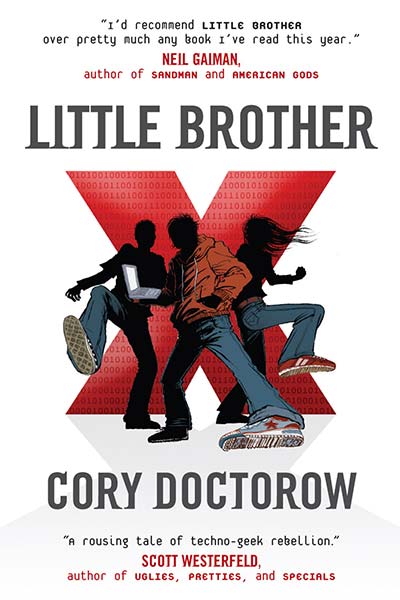
Neil Gaiman gave me an unexpected Christmas present this year — a stellar review of my forthcoming novel Little Brother (a YA novel that pits hacker kids in San Francisco against the DHS in a bid to restore the Bill of Rights to America) on his blog. He has a few quibbles with some of the plot elements, but closes with this:
I’d recommend Little Brother over pretty much any book I’ve read this year, and I’d want to get it into the hands of as many smart 13 year olds, male and female, as I can.Because I think it’ll change lives. Because some kids, maybe just a few, won’t be the same after they’ve read it. Maybe they’ll change politically, maybe technologically. Maybe it’ll just be the first book they loved or that spoke to their inner geek. Maybe they’ll want to argue about it and disagree with it. Maybe they’ll want to open their computer and see what’s in there. I don’t know. It made me want to be 13 again right now and reading it for the first time, and then go out and make the world better or stranger or odder. It’s a wonderful, important book, in a way that renders its flaws pretty much meaningless.

See also:
Cory’s Little Brother reading
Holy crap, I love the cover of my next book!

Happy xmas! I’ve just posted a 2:23 reading I did of Lewis Carroll’s Alice in Wonderland — the first book I ever read to myself, and one of my all time favorites. The reading’s under a Creative Commons Attribution-only license, so do anything you’d like with it!

Last month, I popped in on Taugshow, the madcap “talkshow” put on by the Monochrom net-arts collective in Vienna. I was interviewed along with Sean Bonner, Evelyn Fuerlinger, GameJew, Tim Pritlove and Jeff Moss. Monochrom just posted the video — there’s some damned funny stuff here and lots of good stuff to think about.
Hey, this is keen! I just made the Forbes Web Celebs 25 for the second year in a row! I’m in great company — two of my Boing Boing co-editors, Mark Frauenfelder and Xeni Jardin, are also on the list!
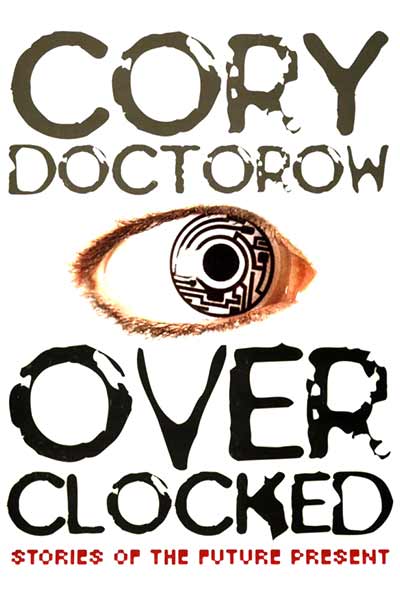
Cory Doctorow is a prominent activist for digital rights, and serves as a fellow of the Electronic Frontier Foundation. He’s one of the editors of Boing Boing, a hugely influential and popular blog about technology, culture and politics. And he’s also a science fiction novelist, particularly famous on the Web, where he gives his novels away for free (For more, see his essay, ” Giving It Away.”) In 2007, Doctorow raised his profile with a new short story collection, Overclocked, numerous columns and articles around the Web (including on Forbes.com) and participation in Boing Boing’s new podcasts and videocasts.

The fan-translations for Scroogled (my Creative Commons-licensed story from Radar Magazine in which I ponder “the day Google became evil”) keep on rolling in — this week, there’s been two Italian translations (one from Reginazabo, the other from Decio Biavati), a Portuguese one from Carlos Martins, and a Latvian translation from the Bar Camp Baltics folks. (Previous translations include Buglarian, Dutch, French, German, Macedonian, Persian, Polish, Russian and Spanish).
As an added bonus, the Italian magazine Delos Science Fiction has just posted Stefano Bonora’s Creative Commons-licensed translation of my award-winning story When Sysadmins Ruled the Earth.
It’s great to see such an emergent community of translators who are using their linguistic skills to make English-only works available in other parts of the world. I’ve done some amateur translation from Spanish, but it’s hard to keep the motivation up when you’re only working for yourself (as is necessarily the case when you’re working with traditional copyright). The “derivatives-friendly” Creative Commons licenses allow amateur translators to share the fruits of their work, get friendly feedback, collaborate and gain reputation, encouraging them to do more and more work.
Now, if only more non-English works would be translated for us Anglos! Everywhere I go, I meet non-English-speakers who’ve read English writers in translation, as well as French, German, Russian, Japanese, etc — lots of stuff gets translated out of English, but precious little comes to us, leaving us monolinguals with no choice but to live the provincial life of someone who can’t compare their native literature to those of other lands.
Link to Scroogled in Italian (Reginazabo),
Link to Scroogled in Italian (Decio Biavati),
Link to Scroogled in Portuguese,