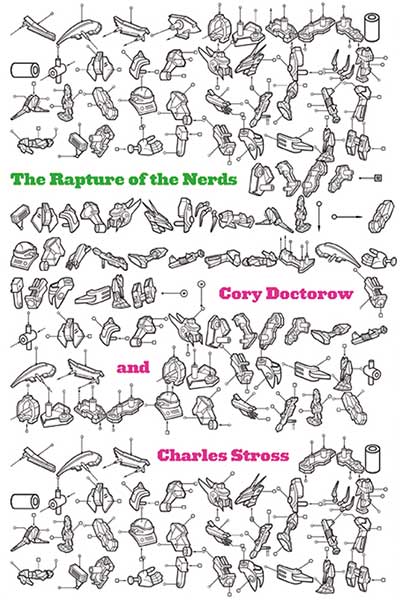
The UK edition of Rapture of the Nerds hits shelves on April 12, but we're having a sneaky early release at Forbidden Planet in London on Mar 23 at 1PM. Tell your friends! (I'm pretty sure that Forbidden Planet will take advance mail-orders for people who can't make it, and I'll sign and personalise every one of 'em).
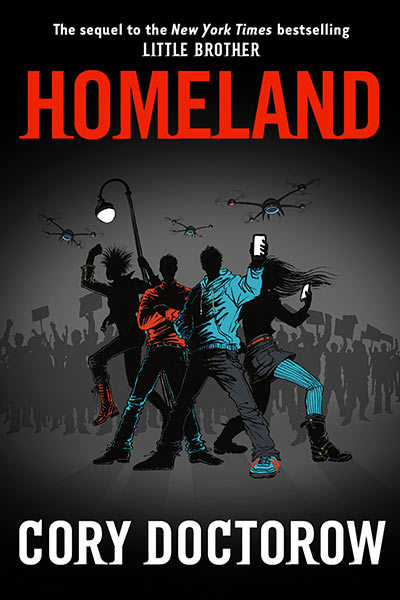
A pair of nice interviews about my new novel Homeland hit the Web today: this fun chat with Rob "CmdrTaco" Malda on the Washington Post, and this one with David Klein at Las Vegas City Life:
It’s about conveying your enthusiasm. My readers like that enthusiastic voice. The dirty secret about geeking out is that it becomes a meditation. What starts as a frivolous “whatever” and people go, “whatever, look at that guy with too much time on his hands” becomes a meditation. Thinking about anything and doing it well becomes meditative.
The folks at Beyond the Book interviewed me for a recent podcast (MP3). We talked about computer control, DRM, publishing, and my latest book, Homeland.
My latest column for Locus, "Ten Years On," looks back on my first decade as a novelist, and speculates about what a difficult utopia might be, and announces my next novel project:
And then I realized I had no idea what novel I’d write next. I have notes for about five books, but none of them feel quite… ripe. The closest is probably a prequel to Down and Out in the Magic Kingdom – it would be awfully nice to check in on those old friends and see what they’re up to after a decade. Down and Out is a utopian novel, modeled in part on Kim Stanley Robinson’s Pacific Edge, a brilliant, absolutely engrossing novel about a zoning fight over a baseball diamond in a small town in a future Orange County where all of humanity’s existential problems have been decisively solved.
Utopian fiction is often characterized as optimistic fiction, because it’s fiction about a future where the existential crisis is behind us – where we know that whatever else transpires, we are likely to survive as a species. Our children and their children will live. Our deeds will not be forgotten. Life will go on.
It’s tempting to say that people who are happy in the midst of peace and plenty are doing nothing much of much. This, of course, isn’t true. Being miserable or happy has as much to do with your internal state as it does with the stuff going on in the rest of the world. Safety and a lack of material want is not guarantee of happiness – indeed, for the traumatized, it’s the quiet moments when the yammering ghosts of past horrors can be heard best.
Part of the plot in Homeland revolves around "hidden services" on the Tor network. Now, a fan of mine in Norway called Tor Inge Røttum has set up a hidden service and stashed copies of all my books there. He writes:
A hidden service in Tor is a server, it can be any server, a web server, chat server, etc. A hidden service can only be accessed through Tor. When accessing a hidden service you don't need an exit node, which means that they are more secure than accessing the "clearnet" or the normal Internet (if you want). Because then the exit nodes can't snoop up what you are browsing. Hidden services are hard to locate as most of them aren't even connected to the clearnet.
I don't have any servers or computers that I can run 24/7 to host a hidden service, but fortunately there is a free webhost that is hosting websites on Tor: http://torhostg5s7pa2sn.onion.to
After creating the domain I wrote a dirty bash script to download most of Cory's books and create a HTML file linking to them. It's available on pastebin: http://pastebin.com/3YR6j8zJ
I did a pair of appearances at the O'Reilly Tools of Change conference in NYC as part of the tour for Homeland -- the first a solo talk for writers, the second a panel with Henry Jenkins and Brian David Johnson. The latter is online now, as well as an interview.
I wrote a guest editorial for the Raincoast Books site, in honour of Freedom to Read Week. It's called "Libraries, Hackspaces and E-waste: how libraries can be the hub of a young maker revolution," and it's about the role of libraries in the 21st century:
Every discussion of libraries in the age of austerity always includes at least one blowhard who opines, "What do we need libraries for? We've got the Internet now!"
Facepalm.
The problem is that Mr. Blowhard has confused a library with a book depository. Now, those are useful, too, but a library isn't just (or even necessarily) a place where you go to get books for free. Public libraries have always been places where skilled information professionals assisted the general public with the eternal quest to understand the world. Historically, librarians have sat at the coalface between the entire universe of published material and patrons, choosing books with at least a colorable claim to credibility, carefully cataloging and shelving them, and then assisting patrons in understanding how to synthesize the material contained therein.
Libraries have also served as community hubs, places where the curious, the scholarly, and the intellectually excitable could gather in the company of one another, surrounded by untold information-wealth, presided over by skilled information professionals who could lend technical assistance where needed. My own life has included many protracted stints in libraries — for example, I dropped out of high-school when I was 14 took myself to Toronto's Metro Reference Library and literally walked into the shelves at random, selected the first volume that aroused my curiosity, read it until it suggested another line of interest, then chased that one up. When I found the newspaper microfilm, I was blown away, and spent a week just pulling out reels at random and reading newspapers from the decades and centuries before, making notes and chasing them up with books. We have a name for this behavior today, of course: "browsing the Web." It was clunkier before the Web went digital, but it was every bit as exciting.
Thanks to Darius Dunlap 2013 for shooting and uploading this CC-BY video from the first stop on my current Homeland tour, at the Seattle public library!
"Homeland" is as dead serious as "1984," as potentially important a "novel of ideas," with a much more engaging central character and an apparently inexhaustible supply of information on everything from brewing coffee to sneaky surveillance and how to defeat it.
Mr. Doctorow is bang up-to-date (as Orwell never was) on the uses of rapidly changing technology, both good and bad. If you want to keep up, there's a four-page appendix on how to protect your privacy and use the Net productively—so long as you're allowed, that is.