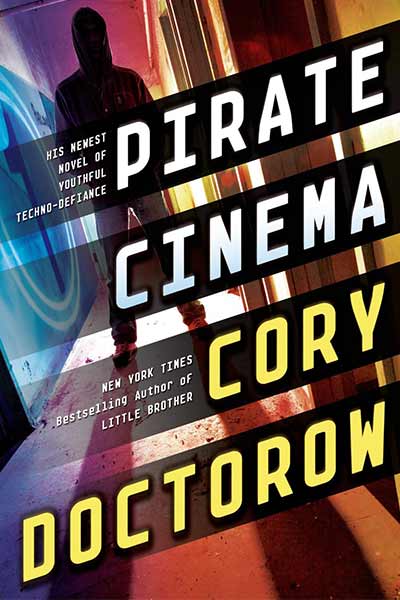
On the NYC leg of my Pirate Cinema tour, I’ll be stopping at Brooklyn’s wonderful indie bookstore WORD. The WORD folks have cooked up a remix video competition for the event, inviting you to make short remix videos, 1-3 minutes long. I’ll be judging the finalists, and the winner will be screened at my reading and signing on Oct 15. Submissions need to be in by Oct 12, so get cracking!
All About:
News
Hey, Berkeley! I’ll be at Books Inc tonight on 4th Street at 7PM, as part of the Pirate Cinema tour. Tomorrow, I’ll be in Pasadena and then Redondo Beach, then Lansing, MI, Chicagoland, and many (many!) other US and Canadian cities. Here’s the whole schedule — come on out and say hi!

Further to yesterday’s post about the availablity of a DRM-free, EULA-free MP3 download for the audiobook of Little Brother, I’m pleased to announce that I’m also selling the audiobook for my new novel Pirate Cinema. As with the Little Brother audio, this is a professionally voiced, unabridged audiobook from Random House Audio. This one is read by the rather fabulous Bruce Mann.
The reason I’m selling this direct from my site is that the largest retail channels for audiobooks — iTunes and Audible — refuse to carry audiobooks without DRM and onerous license-agreements. I don’t want to lock you into anyone’s platform, and I don’t want to take away any of the rights you get under copyright law. So I’ve taken matters into my own hands, offering the book directly, in a fair, straightforward, simple way. I’m immensely grateful to Random House for backing me in my fight against DRM, and for sacrificing the revenue they’d get from iTunes/Audible in order to leave me with my principles intact.
Hey, San Francisco! I’m at Borderlands Books in the Mission tonight at 7PM, for the Pirate Cinema tour! Tomorrow night it’s Berkeley, then south to LA, then all the way to Lansing, MI, and then a host of other cities across Canada and the USA. Check the full schedule — I hope I get to see you!
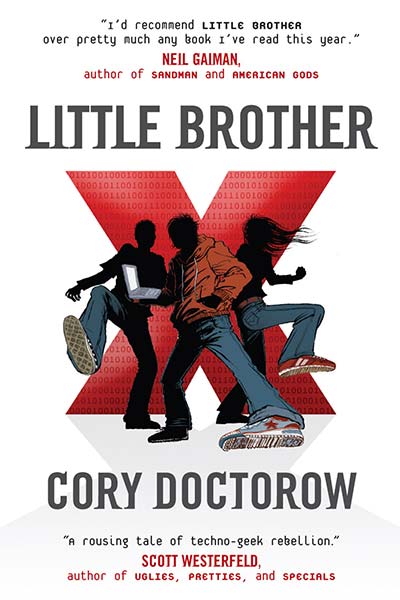
Thanks to the kind folks at Random House Audio, I’m now able to offer direct downloads of the unabridged audiobook of Little Brother, read by Kirby Heyborne. The download is DRM-free, and comes with no EULA — in other words, the only terms binding your use of it are: “Don’t violate copyright law.” It’s $20, cheap!
Thanks to the kind folks at Random House Audio, I’m now able to offer direct downloads of the unabridged audiobook of Little Brother, read by Kirby Heyborne. The download is DRM-free, and comes with no EULA — in other words, the only terms binding your use of it are: “Don’t violate copyright law.” It’s $20, cheap!

This unabridged reading of Pirate Cinema, read by Bruce Mann, is sold without DRM, or license agreement of any kind, and by buying it here, you more than triple the royalties I receive for it.
The audiobook was produced by Random House Audio. Once you’ve completed your purchase, you’ll get a download link for a collection of 128Khz MP3 files, in a ZIP archive. Simply open the archive and load into your favourite digital music player.
You’re free to do anything with this that copyright allows — play it, sing it, swing it, yodel it, I don’t give a dern (as Woody Guthrie once said!).

This unabridged reading of Little Brother, read by Kirby Heyborne, is sold without DRM, or license agreement of any kind, and by buying it here, you more than triple the royalties I receive for it.
The audiobook was produced by Random House Audio (I’ve embedded their preview below). Once you’ve completed your purchase, you’ll get a download link for a collection of 128Khz MP3 files, in a ZIP archive. Simply open the archive and load into your favourite digital music player.
You’re free to do anything with this that copyright allows — play it, sing it, swing it, yodel it, I don’t give a dern (as Woody Guthrie once said!).
Hey, Menlo Park! I’m coming to Kepler’s Books tonight at 7PM for the Pirate Cinema tour! I hope to see you there. I’ll be in San Francisco tomorrow (Thu), Berkeley on Friday, and then I head south to Pasadena and Redondo Beach, before going east to Lansing, MI, and then many other cities. Here’s the whole schedule. Be there or be unmutated!
Hey, St Louis readers! Looking forward to meeting you tonight at the first stop of my Pirate Cinema tour, at the St Louis County Library at 7PM! Next up, stops in northern and southern California, Lansing, Chicagoland, NYC, Edmonton, Vancouver, Victoria, Seattle, Toronto and Boston.