/ / Down and Out In the Magic Kingdom, News

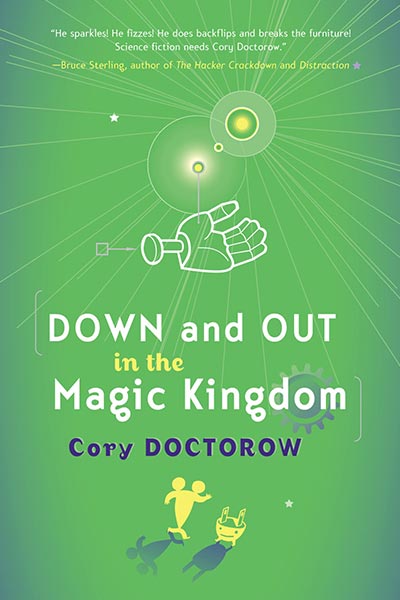
I’m the Author of the Month at the excellent e-zine, Strange Horizons. They’ve published a review of Down and Out in the Magic Kingdom, a long interview that Katsi Macdonald (daughter of James D. Macdonald and Debra Doyle) conducted with me, and have reprinted my short story, Visit the Sins, which initially appeared in Asimov’s and was later reprinted in one of Hartwell’s Year’s Best anthologies.

Grampa was switched off when Sean found him on the ward, which throbbed with a coleslaw of laser-light and video games and fuck-pix and explosions and car wrecks and fractals and atrocities.

Sean remembered visits before the old man was committed, he and his dutiful father visiting the impeccable apartment in the slate house in Kingston, Ontario. Grampa made tea and conversation, both perfectly executed and without soul. It drove Sean’s father bugfuck, and he’d inevitably have a displaced tantrum at Sean in the car on the way home. The first time Grampa had switched on in Sean’s presence — it was when Sean was trying out a prototype of Enemies of Art against his father’s own As All Right-Thinking People Know — it had scared Sean stupid.

Grampa had been in maintenance mode, running through a series of isometric stretching exercises in one corner while Sean and his father had it out. Then, suddenly, Grampa was between them, arguing both sides with machinegun passion and lucidity, running an intellect so furious it appeared to be steam-driven. Sean’s tongue died in his mouth. He was made wordless by this vibrant, violent intellect that hid inside Grampa. Grampa and his father had traded extemporaneous barbs until Grampa abruptly switched back off during one of Sean’s father’s rebuttals, conceding the point in an unconvincing, mechanical tone. Sean’s father stalked out of the house and roared out of the driveway then, moving with such speed that if Sean hadn’t been right on his heels, he wouldn’t have been able to get in the car before his father took off.

/ / Down and Out In the Magic Kingdom, News

Greg Dahlmann has done a piece on Northeast Public Radio about the Creative Commons that includes an interview with me about the online release of the novel. You can listen to the audio of the piece in a variety of formats or read the transcript here.

“He said, ’80-thousand people have downloaded your book and now represent a potential audience for the book we’re publishing in November’ and I said yes, that’s right… and you could hear him do a little dance of delight”

/ / Down and Out In the Magic Kingdom, News

In the spirit of Modesty’s cut-up generator, Ben Brown has created a Dadaist remixer for Down and Out in the Magic Kingdom. Nice results:

When they danced knew I felt light headed. It back to Florida number of the animatronics had a fair but it, all that in for it came ire, but I made that now. We owed the people about taking promising that it.

He had looked like to control vest were something, besides the eye; of in the true from tip a roar of with had a seat.

/ / Down and Out In the Magic Kingdom, News

Today’s NYT is carrying a half-page, mostly positive review of Down and Out in the Magic Kingdom, in the main book-review section. I’m doing a panel tomorrow called “Why I Dig Working in the Cultural Gutter,” but this may disqualify me!

Cory Doctorow is an avid Weblogger (he can be found at boingboing.net), and his novel’s ad-hocracies of ”twittering Pollyannic castmembers” who smoke ”decaf” crack and congratulate one another on ”Bitchun” ideas offer a knowing, gently satiric view of a once ascendant digital culture. And the impressively imagined world of the novel is tricked out in lively prose.

/ / Down and Out In the Magic Kingdom, News

Richard Koman has posted a long, wide-ranging interview with me on the O’Reilly Network, mostly about the book, but very wide-ranging, covering the future and past of the recording industry, the history of the Disney corporation, power-law distributions and such.

So there’s this world I’ve written about called the Bitchun Society. And in the Bitchun Society there’s no more scarcity, there’s a kind of Clarke’s Law technology that allows them to reproduce anything at zero incremental cost. And what’s more, they don’t die. You regularly check yourself into a clinic or terminal and make a copy of your brain and if you die they make a new you and pour that back into it. Lucky for me it’s science fiction and not science so I don’t have to explain the workings of this stuff.

I also don’t have to explain the working of the neural interface, which in addition to allowing them to do this suck-your-brains-out-and-drop-it-onto-a-hard-drive thing, also is capable of figuring out how you feel about any given thing anywhere in the world that you have any opinion about–without asking you. And as a consequence of this, you can first of all make some guesses about how you’re going to feel about something. You don’t have to remember whether you’ve been to this restaurant because the system remembers and tells you what other good restaurants are nearby. But the second-order effect is it will figure out who you hold in high esteem, who has an opinion about some restaurant you’ve never been to. And this opinion, and this esteem is called Whuffie.

/ / Down and Out In the Magic Kingdom, News

One of my favorite authors, Paul Di Filippo, reviews Down and Out in the Magic Kingdom in this week’s SF Weekly:

In any case, what we have here is a rare example of post-Singularity fiction. The Singularity, or Spike, is deemed to be that moment at which mankind emerges into transhuman existence, with or without the help or hindrance of strong AI. (Doctorow eschews the AI, for the most part.) Envisioning such a future is one of the hardest tasks an SF writer can take on, but Doctorow proves himself equal to the challenge. His reorganization of society into ad-hocs craving Whuffie derives a lot from present-day cyber-culture (Slashdot, and all that), and his biomorphic mutability seems positively Extropian. But the exact mix is unique, especially when the fixation on Disney World as a kind of prototype for artificial landscapes is thrown in. And surely Jules’ jazzy first-person narration, laden with future jargon, is essential to the success of the tale. Although readers might initially balk a bit when encountering on the second page of the book a sentence such as “I took! a moment to conjure a HUD with his Whuffie score on it.”

“Ten thousand years ago, the state of the art was a goat,” opines Dan at one point. Well, by that measure Down and Out in the Magic Kingdom is some kind of transgenic supergoat whose milk is full of spidersilk proteins and nutraceuticals.

/ / Down and Out In the Magic Kingdom, News

SFRevu is running an interview with me, and a review of Down and Out in the Magic Kingdom:

Ern: If you don’t count that as SF, what was your first identifiably SF or Fantasy experience?

Cory: It was actually a story-telling experience. My dad had grown up on Conan comics and the Robert E. Howard books, and he retrofitted Conan storylines into Socialist parables that he used to tell me on long car trips. Starring a multiethnic, gender balance trio called Harry, Mary and Larry. So I grew up on these sort of redacted Conan stories that been worked out as parables about workers paradise stories. There are a lot of first and second generation Marxists in Science Fiction today, you’ve got people like Stephen Brust, and China Miéville and Ken McLeod. The techno-utopianism is the one thing you never shake when you grow up in a Marxist household; it’s the unshakeable faith that technology can affect positive social change.

/ / Down and Out In the Magic Kingdom, News

Shift Online has published a great, long article about the ways that the Bitchun Society parallels our present day world, based on an interview we did.

But here’s the kicker: Democracy — or the version of it that we know now anyway, that we’re most comfortable with — is already changing in the real world. Put on your Cory Doctorow goggles and re-examine today’s political landscape: “Internet politics are increasingly post-left-right dichotomy,” he says. “The medium is the message — I think that the internet makes you into a libertarian to a certain extent. Because you can see non-hierarchical, non-centralized systems working, and it becomes hard to credibly claim that we need increased centralization in order to create order or equity or equitableness.” We’ve seen that with the fall of Yahoo, he explains, which was a centralized listing of what was on the internet, edited by a very small group of individuals. The sites on Google, on the other hand, are ranked by everyone who owns a website. “It’s hard to be a left-winger in the sense of a centralized authority-endorsing individual, or a right-winger in that sense. There are lots of strange bedfellows that have been made, certainly. My friend Patrick Nielson Hayden was just in the march in D.C. and he described marching in a blogger contingent that included someone who was carrying a sign that said ‘Peace Now, Socialism Never’ alongside people who were old lefty red-diaper baby types.”

In such a climate, one of decentralization where the only criteria for participating in a movement is your belief in the cause at hand, maybe a Disney World overrun by fans isn’t quite so hard to fathom.