/ / News

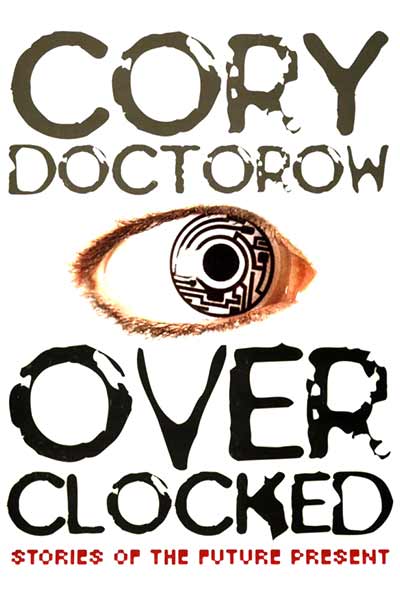
DailyLit is a fantastic service — they take public-domain and Creative Commons-licensed books and email them to you, one page per day. They put my novel Someone Comes to Town, Someone Leaves Town up last year to great response, and now they’ve added a whole slew of science fiction, including the rest of my novels and my latest short story collection, Overclocked, and many other sf books including Charlie Stross’s Accelerando, Flatland, Frankenstein, From the Earth to the Moon, and The Time Machine.

Link

(Thanks, Jeff!)

/ / News

In my latest column for Information Week, I talk about the Hollywood attempt to re-create the Napster Wars, suing all the funded, legit companies that want to do Internet video, like YouTube. When the record companies did this to Napster, all it did was ensure that the P2P market was saturated with companies that had no interest in doing deals with the record companies — instead, we got rogues like Kazaa and AllOfMP3, whose business-model was built around the difficulty of being sued offshore, not paying the record companies for the use of copyrights.

Now the TV and movie people are following suit — and there’s every chance that they’ll succeed at scaring off all the legit Internet distribution companies. Which will just make ThePirateBay into the world’s biggest, most successful video distribution system.

Napster had an industry-friendly business-model: raise venture capital, start charging for access to the service, and then pay billions of dollars to the record companies in exchange for licenses to their works. Yes, Napster kicked this plan off without getting permission from the record companies, but that’s not so unusual. The record companies followed the same business plan a hundred years ago, when they started recording sheet music without permission, raising capital and garnering profits, and then working out a deal to pay the composers for the works they’d built their fortunes on.

Napster’s plan was plausible. They had the fastest-adopted technology in the history of the world, garnering 52,000,000 users in 18 months — more than had voted for either candidate in the preceding US presidential election! — and discovering, via surveys, that a sizable portion would happily pay between $10 and $15 a month for the service. What’s more, Napster’s architecture included a gatekeeper that could be used to lock out non-paying users.

Link

/ / News

Voices for the Cure is a Lulu press anthology of science fiction stories published to benefit the American Diabetes Association. Many writers — including me — donated stories to the book (I gave them my story Craphound).


Some of the greatest voices in speculative fiction join forces in this one-of-a-kind anthology to benefit the American Diabetes Association. Join Robert J. Sawyer, Mike Resnick, Cory Doctorow, and others as a cop-for-hire solves a murder aboard a space station…a Chicano science fiction writer takes mind-blowing (literally!) ride through the Singularity…a third-rate superhero with useless powers finds a place to belong…an antique collector learns that one alien’s junk is mankind’s treasure…a geologist discovers that pretending to be a god isn’t all it’s cracked up to be…a journalist learns how to fend off zombies using Linux and a dead badger… All this and more await you in… Voices for the Cure: A Speculative Fiction Anthology to Benefit the American Diabetes Association

Link

/ / News

I’ve started writing a column for the MediaGuardian, the British website for media professionals, critiquing DRM and explaining “copy-friendly” business models. My first column is up today, explaining the way that DRM is like the Soviet Union’s Lysenkoism, a form of ideologically correct junk science.

The companies that sell this stuff are, at best, bunkum peddlers and, at worst, out and out fraudsters. Their wares simply can’t work – not without changing the laws of physics, maths and information science.

DRMs are often designed by ambitious, well-funded consortia, with top-notch engineers from every corner of the industry. They spend millions. They take years. They are defeated in days, for pennies, by hobbyists. It’s inevitable, because every time you give someone a locked item, you have to give them the key to unlock it too.

Link

/ / News

A t-shirt I helped to design is up for sale on Shirt.Woot — a new t-shirt site from the Woot! people. The shirt’s inspiration was this post about the British “Keep Calm and Carry On” tees.

My shirt features the text, “ZOMG TERRISTS GONNA KILL US ALL ZOMG ZOMG ALERT LEVEL BLOODRED RUN RUN TAKE OFF YOUR SHOES MOISTURE BOMBS ZOMG!” around a modified DHS logo, with the eagle clutching an empty water bottle and a pair of shoes.

Shirt.Woot has a funny pricing model. On the first day — today — the shirts cost $10 (including shipping!), but only 1000 of them are sold. Starting tomorrow, the shirts go up in price to $15 until August 6. After that, only the top selling Shirt.Woot designs will be offered for sale.

Woot and I have released the shirt’s art under a Creative Commons Attribution-NonCommercial-ShareAlike license for your remixing pleasure.

Link

/ / News

A reminder: I’ll be reading and signing at San Diego’s Mysterious Galaxy books tonight as part of a series of San Diego appearances by the writers who are teaching at the Clarion Science Fiction Writers Workshop at UCSD. The reading starts at 7PM — hope to see you then.

Also: I’ll be back in San Diego next week for ComicCon, where I’m one of the guests of honor. Here’s my schedule there:

* Thursday, Noon-1PM: Spotlight on Cory Doctorow, room 5AB, followed by a signing
* Friday, 11:30-12:30: IDW publishing, room 4
* Saturday, 1-2PM: Where Do They Get Those Marvelous Toys?, room 8, followed by a signing

A special request for any Canadians planning on attending the Mysterious Galaxy event tonight: I have come down with a miserable cold, and I have run out of Buckley’s Mixture (the surprisingly vile and effective Canadian cold-syrup). I would be forever in your debt if you could bring some down with you!

Link to Mysterious Galaxy details, Link to ComicCon schedule

/ / Eastern Standard Tribe, News

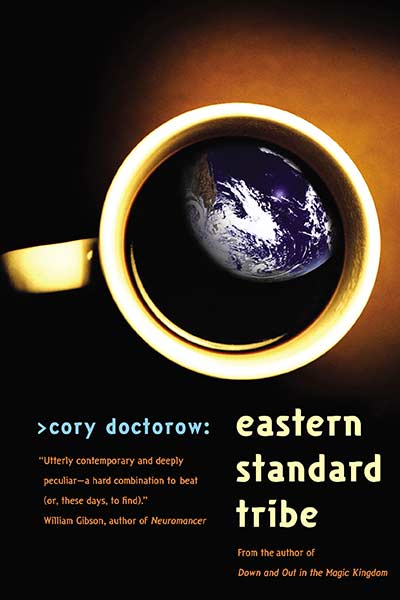
Dr. Graham J. Murphy, a prof in the Cultural Studies and Department of English at Trent University in Peterborough, Ontario, has written a swell academic paper about my novel Eastern Standard Tribe. The essay, “Somatic Networks and Molecular Hacking in Eastern Standard Tribe,” was originally published in Extrapolation Vol.48, Issue 1 (2007), from The University of Texas at Brownsville and Texas Southmost College. Graham and his publisher have given me permission to put a PDF of the article up, too!


Art’s Tribal activities as an agent-provocateur are obviously Doctorow’s
satirical critique of a wired marketplace that regularly has the end-user tied to the whims of a hostile corporate culture. Admittedly, Art is initially part of the end-user problem because his loyalty to the ESTribe requires his work at V/DT to be founded on maximizing end-user hostility. It is not until he is in the sanatorium that he has an epiphany that his life has been wasted. After roof-Art has been hurt while trying to escape off the roof, he is introduced to Dr. Szandor, a medical doctor who stands diametrically opposed to the sanatorium’s psychiatrists. Unlike the mental-health practitioners who have repeatedly ignored Art’s claims of wrongful incarceration and have opted to put him on medications that leave him in a drugged stupor, Dr. Szandor actually talks to Art and learns a great deal about the man. A key topic of discussion is the problems with mental-health facilities. During those discussions Art begins to sketch out potential alternatives to the sanatorium system that has him caged, a theoretical facility he dubs HumanCare. Dr. Szandor is noticeably impressed with Art’s acute vision of HumanCare while Art feels “a familiar swelling of pride. I like it when people understand how good I am at my job. Working at V/DT was hard on my ego: after all, my job there was to do a perfectly rotten job, to design the worst user experiences that plausibility would allow. God, did I really do that for two whole goddamned years?” (179). Art comes to recognize that the last two years of his life at V/DT have been a waste because his agent-provocateur mission, founded on end-user hostility and corporate stagnation, has stifled what amounts to his innate skills as a molecular hacker.


PDF Link

/ / News

Dr. Graham J. Murphy, a prof in the Cultural Studies and Department of English at Trent University in Peterborough, Ontario, has written a swell academic paper about my novel Eastern Standard Tribe. The essay, “Somatic Networks and Molecular Hacking in Eastern Standard Tribe,” was originally published in Extrapolation Vol.48, Issue 1 (2007), from The University of Texas at Brownsville and Texas Southmost College. Graham and his publisher have given me permission to put a PDF of the article up, too!


Art’s Tribal activities as an agent-provocateur are obviously Doctorow’s
satirical critique of a wired marketplace that regularly has the end-user tied to the whims of a hostile corporate culture. Admittedly, Art is initially part of the end-user problem because his loyalty to the ESTribe requires his work at V/DT to be founded on maximizing end-user hostility. It is not until he is in the sanatorium that he has an epiphany that his life has been wasted. After roof-Art has been hurt while trying to escape off the roof, he is introduced to Dr. Szandor, a medical doctor who stands diametrically opposed to the sanatorium’s psychiatrists. Unlike the mental-health practitioners who have repeatedly ignored Art’s claims of wrongful incarceration and have opted to put him on medications that leave him in a drugged stupor, Dr. Szandor actually talks to Art and learns a great deal about the man. A key topic of discussion is the problems with mental-health facilities. During those discussions Art begins to sketch out potential alternatives to the sanatorium system that has him caged, a theoretical facility he dubs HumanCare. Dr. Szandor is noticeably impressed with Art’s acute vision of HumanCare while Art feels “a familiar swelling of pride. I like it when people understand how good I am at my job. Working at V/DT was hard on my ego: after all, my job there was to do a perfectly rotten job, to design the worst user experiences that plausibility would allow. God, did I really do that for two whole goddamned years?” (179). Art comes to recognize that the last two years of his life at V/DT have been a waste because his agent-provocateur mission, founded on end-user hostility and corporate stagnation, has stifled what amounts to his innate skills as a molecular hacker.


PDF Link

/ / News

My latest Locus column is online: “The Progressive Apocalypse and Other Futurismic Delights,” from the July issue. This is an essay about the role that futurism (doesn’t) play in science fiction, and why so much “futuristic” sf can be set in the present.

Lapsarianism — the idea of a paradise lost, a fall from grace that makes each year worse than the last — is the predominant future feeling for many people. It’s easy to see why: an imperfectly remembered golden childhood gives way to the worries of adulthood and physical senescence. Surely the world is getting worse: nothing tastes as good as it did when we were six, everything hurts all the time, and our matured gonads drive us into frenzies of bizarre, self-destructive behavior.

Lapsarianism dominates the Abrahamic faiths. I have an Orthodox Jewish friend whose tradition holds that each generation of rabbis is necessarily less perfect than the rabbis that came before, since each generation is more removed from the perfection of the Garden. Therefore, no rabbi is allowed to overturn any of his forebears’ wisdom, since they are all, by definition, smarter than him.

The natural endpoint of Lapsarianism is apocalypse. If things get worse, and worse, and worse, eventually they’ll just run out of worseness. Eventually, they’ll bottom out, a kind of rotten death of the universe when Lapsarian entropy hits the nadir and takes us all with it.

Running counter to Lapsarianism is progressivism: the Enlightenment ideal of a world of great people standing on the shoulders of giants. Each of us contributes to improving the world’s storehouse of knowledge (and thus its capacity for bringing joy to all of us), and our descendants and proteges take our work and improve on it. The very idea of “progress” runs counter to the idea of Lapsarianism and the fall: it is the idea that we, as a species, are falling in reverse, combing back the wild tangle of entropy into a neat, tidy braid.

Of course, progress must also have a boundary condition — if only because we eventually run out of imaginary ways that the human condition can improve. And science fiction has a name for the upper bound of progress, a name for the progressive apocalypse:

We call it the Singularity.

Link

/ / News

My latest InformationWeek column just went live. It’s called “A Behind-The-Scenes Look At How DRM Becomes Law” and it a rarely seen look at the sausage factory that is DRM standards negotiation. This stuff all happens behind closed doors, and it’s ugly as sin. When you’ve watched them bury bodies in meeting after meeting, it’s pretty fun to exhume a couple and rattle their bones.

Intel’s presence on the committee was both reassurance and threat: reassurance because Intel signaled the fundamental reasonableness of the MPAA’s requirements — why would a company with a bigger turnover than the whole movie industry show up if the negotiations weren’t worth having? Threat because Intel was poised to gain an advantage that might be denied to its competitors.

We settled in for a long negotiation. The discussions were drawn out and heated. At regular intervals, the MPAA reps told us that we were wasting time — if we didn’t hurry things along, the world would move on and consumers would grow accustomed to un-crippled digital TVs. Moreover, Rep Billy Tauzin, the lawmaker who’d evidently promised to enact the Broadcast Flag into law, was growing impatient.

You’d think that a “technology working group” would concern itself with technology, but there was precious little discussion of bits and bytes, ciphers and keys. Instead, we focused on what amounted to contractual terms: if your technology got approved as a DTV “output,” what obligations would you have to assume? If a TiVo could serve as an “output” for a receiver, what outputs would the TiVo be allowed to have?

Link