Earlier this week, I gave a talk on the way that “Big Data” is underpinned with a kind of myth about how users trade privacy for services. Ciara Byrne from the NYT’s VentureBeat interviewed me afterwards about it. I think she did a really good job of condensing a hard, nuanced question into a brief and informative article.
All About:
News
TRSF is a new science fiction anthology of original stories commissioned by Technology Review, the tech magazine published by MIT. They commissioned a story from me, “The Brave Little Toaster,” and the brief asked me to look at near future science and technology issues — I tackled “The Internet of Things,” and told a story about a man whose refrigerator ends up hosting an unfortunate (very unfortunate!) Internet of Things object. The book is $7.95 for pre-order.
Featuring all-new stories by a dozen of the most visionary science fiction authors writing today, TRSF takes us to 12 possible worlds of tomorrow. Inspired by the real-life breakthroughs covered by MIT’s Technology Review, celebrated writers join the freshest talent from around the world to describe what the future may have in store for the Internet, biotechnology, energy, computing, and more.Illustrated with an original cover painting by legendary sci-fi illustrator Chris Foss, the TRSF also features classic Foss covers inside its pages.

My latest Guardian column, “Lib Dems get a chance to vote on copyright reform,” discusses the new Liberal Democrat IT white paper that’s being presented at the party conference this weekend, where members will get the chance to vote in favor of repealing some of the worst sections of the Digital Economy Act, dealing with web-censorship and disconnection over copyright claims. The paper is very good, but somewhere between the final draft prepared by the committee and the paper the membership will vote on this weekend, someone inserted a clause saying that “a form of theft” and goes on to say that “there is no reason why digital offenders should not be prosecuted under the criminal law in the same way as those who steal tangible goods.” I’ve spent the past few days trying to track down who put this language in, and everyone both denies it and says they don’t support it — which raises the question, what’s it doing there at all?
This is pretty outre stuff. Every developed nation’s legal system treats thefts of tangible goods as absolutely distinct from copyright violation. Applying criminal sanctions for copyright infringement would be unprecedented in the industrialised world.
Don Foster, the Lib Dem MP with the DCMS brief, apparently lobbied to have “a statement making clear that copyright infringement is as serious as theft” included in the document, though his staff disavows any involvement in the phrasing and says: “For Don, non-commercial copyright infringement has only ever been a civil issue.” Julian Huppert, the Lib Dem MP who was also involved in the drafting, says, “there is no intention to change the current system in this regard”.
My short story Clockwork Fagin, which will appear in the forthcoming YA anthology Steampunk! is available from today as a free file for Kindle, Nook, and other ebook platforms. The whole anthology comes out on Oct 11.
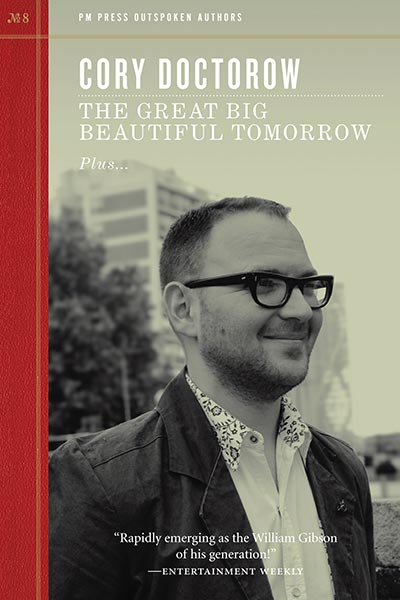
“Great Big Beautiful Tomorrow,” the PM Press “Outspoken Authors” chapbook that includes my novella “There’s a Great Big Beautiful Tomorrow/Now is the Best Time of Your Life,” an original interview with Terry Bisson, and two essays, is now available in various ebook forms. Print editions coming very shortly!
Hey, Torontonians, Ann Arborites, and New Yorkers!
I’ll be giving a free talk at the Art Gallery of Ontario in Toronto called “Can creativity and freedom peacefully co-exist in the Internet age?” on Sept 14 at 7PM, where I’ll be reprising my SIGGRAPH talk from August.
On Sept 15, I’ll be in Ann Arbor, MI for the Penny Stamps Lecture Series, doing a panel called “On Futurology: Optimism And Failure” with Mark Stevenson and James King.
I head to New York next. First I’ll be at the Brooklyn Book Festival on September 18, appearing on a 1200h panel called “Genres Crashers” with Jewell Parker Rhodes, Kelly Link and Stephanie Anderson.
Finally, I’m keynoting the O’Reilly Strata conference on September 20 at 1330h, with a talk called “Designing For Human Sensors, Not Human Barcodes.”
Hope to see you there!
“True Names,” the Hugo-nominated novella that Benjamin Rosenbaum and I published in 2008, has been republished in a CC-licensed Polish edition, courtesy of Ireneusz Dybczyński.
Here’s an interview I recorded with the Renovation Podcast, the official podcast of the World Science Fiction Convention in Reno, NV.
My latest Locus column, “Why Should Anyone Care?” looks at a hard question that many people interested in self-publishing ignore: “Why should anyone care that you’ve got a book out?”
I get a lot of e-mail from writers starting out who want to know whether it’s worth trying to get published by major houses. The odds are poor – only a small fraction of books find a home in mainstream publishing – and the process can be slow and frustrating. We’ve all heard horror stories, both legit (‘‘Why is there a white girl on the cover of my book about a black girl?’’) and suspect (‘‘My editor was a philistine who simply didn’t understand the nuances of my work’’). And we’ve all heard about writers who’ve met with modest – or stellar – success with self-publishing. So why not cut out the middleman and go direct to readers?
There’s not a thing wrong with that plan, provided that it is a plan. Mainstream publishers have spent hundreds of millions of dollars over decades learning and re-learning how to get people to care about the existence of books. They often do so very well, and sometimes they screw it up, but at least they’re methodically attempting to understand and improve the process by which large masses of people decide to read a book (even better, decide to buy and read a book).
I firmly believe that there are writers out there today who have valuable insights and native talent that would make them natural successes at marketing their own work. If you are one of those writers – if you have a firm theory that fits available evidence about how to get people to love your work – then by all means, experiment! Provided, of course, that you are pleased and challenged by doing this commercial stuff that has almost nothing in common with imagining stories and writing them down. Provided that you find it rewarding and satisfying.
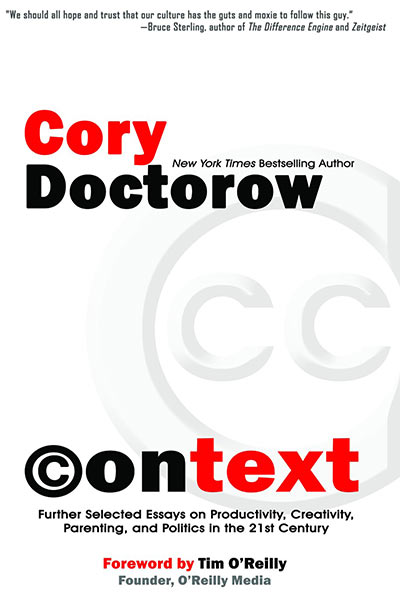
Today marks the publication of Context, the followup to my 2008 essay collection, Content, sporting a walloping 44 essays from various newspapers, magazines, and websites, along with a spiffing introduction from my friend and hero Tim O’Reilly. Like all my other books, it’s a free, Creative Commons licensed download, and like my other books, I’d like you to consider buying a copy, either for yourself or for a library or school.