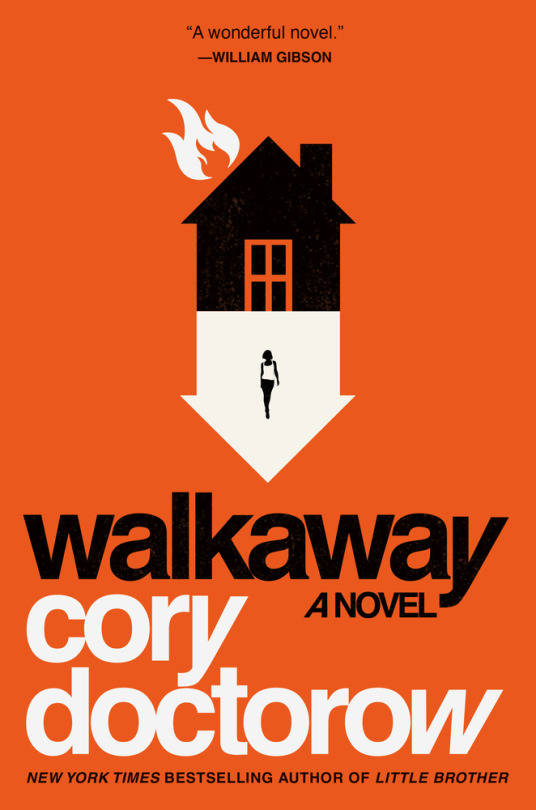
Here’s the audio from the chat Charlie Stross and I did with Mitch Wagner from Internet Evolution about our forthcoming book, Rapture of the Nerds.
All About:
News
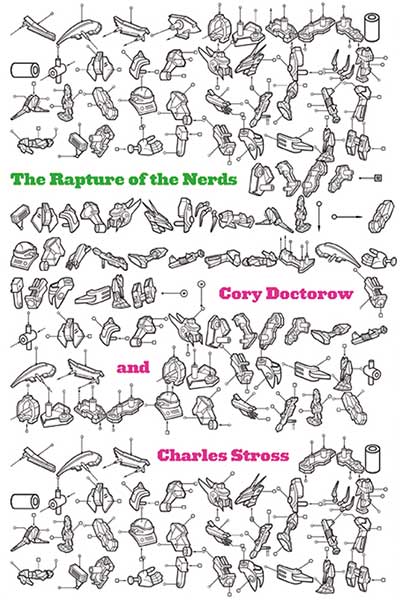
Tor.com’s just published an excerpt from Rapture of the Nerds, the comic science fiction novel that Charles Stross and I collaborated on, which comes out in September. Booklist just gave it a starred review, saying “Doctorow and Stross, two of the SF genre’s more exciting voices, team up to produce a story that is mindbendingly entertaining but almost impossible to explain….Peppered with references to pop-culture staples (The Matrix, Doctor Who, The Hitchhiker’s Guide to the Galaxy), and drawing on concepts from hard SF, cyberpunk, and videogames, the novel is a surefire hit for genre fans, especially those familiar with the works of its coauthors. Fans of
Adam Roberts’ elegant, intellectually challenging SF will also be on firm ground here.”
Huw awakens, dazed and confused.This is by no means unusual, but for once Huw’s head hurts more than his bladder. He’s lying head down, on his back, in a bathtub. He scrabbles for a handhold and pulls himself upright. A tub is a terrible place to spend a night. Or a morning, come to think of it—as he blinks, he sees that it’s midafternoon, and the light slanting in through a high window limns the strange bathroom’s treacly Victorian fixtures with a roseate glow.
That was quite a party. He vaguely remembers the gathering dawn, its red light staining the wall outside the kitchen window as he discussed environmental poli- tics with a tall shaven-headed woman with a blue fore- lock and a black leather minidress straight out of the twentieth century. (He has an equally vague memory of her defending a hard-core transhumanist line: Score nil–nil to both sides.) This room wasn’t a bathroom when he went to sleep in it: Bits of the bidet are still crawling into position, and there’s a strong smell of VOCs in the air.

Suicide Girls has published an excerpt from Rapture of the Nerds, the novel Charlie Stross and I wrote, which will come out in September. Charlie and I will be touring the book together briefly after Labor Day. The details are still being settled, but there’s going to be some very exciting stops!
Rapture is the novel-length version of the two novellas Charlie and I wrote, Jury Service and Appeals Court. For this volume, we re-wrote those two, and added a long third section, Parole Board, from which the Suicide Girls excerpt is drawn. It’s a comic novel of the Singularity, party mash-note to technophilia and part indictment. As the title suggests, we’re both a little ambivalent on the idea of machine transcendence.
Of course, the sim is far too realistic. A virtual champagne bath should somehow manage to keep the champagne drinking-temp cold while still feeling warm to the touch. And it shouldn’t be sticky and hot and flat; it should feel like champagne does when it hits your tongue—icy and bubbly and fizzy. And when Huw’s nonbladder feels uncomfortably full and relaxed in the hot liquid and she lets a surreptitious stream loose, it should be magicked away, not instantly blended in with the vintage Veuve to make an instant tubworth of piss-mimosa.
This is what comes of having too much compute-time at one’s disposal, Huw seethes. In constraint, there is discipline, the need to choose how much reality you’re going to import and model. Sitting on an Io’s worth of computronium has freed the Galactic Authority—and isn’t that an unimaginative corker of a name? — from having to choose. And with her own self simulated as hot and wide as she can be bothered with, she can feel every unpleasant sensation, each individual sticky bubble, each droplet clinging to her body as she hops out of the tub and into the six-jet steam-shower for a top-to-bottom rinse, and then grabs a towel —every fiber slightly stiff and plasticky, as if fresh out of the wrapper and never properly laundered to relax the fibers—and dries off. She discovers that she is hyperaware, hyperalert, feeling every grain of not-dust in the not-air individually as it collides with her not-skin.
I recently sat down for a video interview with the Singularity weblog to talk about about The Rapture of the Nerds, Singularity, science fiction, how fiction works, sf movies, and a lot of varied subjects.
Cory Doctorow on Singularity 1 on 1: The Singularity Is A Progressive Apocalypse
Joly McFie captured video of Charlie Stross’s and my tour-stop at Brooklyn’s MakerBot this week. We were there in support of our new novel Rapture of the Nerds, and did a talk, reading and Q&A that touched on the Singularity, its precedents, its discontents, and its inherent comedy — all while 3D printers chattered in the background. And afterwards everyone got 3D printed miniatures of our heads!
We’re making our final stops of tour tomorrow — Sunday! Sunday! Sunday! — in Rochester, NY, at RIT. Tell your friends!
Cory Doctorow & Charles Stross – The Rapture of the Nerds
(Thanks, Joly!)
Why SF movies make me insane
My latest Locus column is “Why Science Fiction Movies Drive Me Nuts,” in which I propose that the reason the science in sf movies is so awful is that they’re essentially operas about technology.
The reason that SF movies command such a titanic amount of attention and money from audiences is because they are brilliantly wrought spectacles. What they lack in depth and introspection, they make up for in polish and craftsmanship. Every costume is perfect. Not one polygon is out of place. An army of musicians, the greatest in the land, have picked up horns and stringed instruments by the orchestra-load and played precisely the right music to set the blood singing, written by genius composers and edited into the soundtrack by golden-eared engineers from the top of their trade. The product is perfectly turned out, and this perfection attracts the eye and captures the mind.
But although these spectacles look like movies, what they really are is opera – stylized, larger-than-life, highly symbolic work that is not meant to be understood literally. And it makes me nuts.
How else to explain the glaring inconsistencies that sit in the center of these movies, like turds floating in the precise center of a crystal punchbowl carved out of the largest, most perfect diamond in the whole world? I mean, look at Spider-Man again, and think for a moment about the absurdity of its set-pieces.
I gave my “Coming Civil War Over General Purpose Computers” talk three times this summer: at Defcon XX, the Long Now Foundation, and Google. Here’s a video of the Google talk.
Cory Doctorow: “The Coming Civil War over General-purpose Computing”, Talks at Google
Last month, I gave a talk called “The Coming Civil War Over General Purpose Computing” at DEFCON, the Long Now, and Google. We’re going to have a transcript with the slides on Monday, but in the meantime, here’s a video of the Long Now version of the talk. Stewart Brand summarized it thus:
Doctorow framed the question this way: “Computers are everywhere. They are now something we put our whole bodies into—airplanes, cars—and something we put into our bodies—pacemakers, cochlear implants. They HAVE to be trustworthy.”
Sometimes humans are not so trustworthy, and programs may override you: “I can’t let you do that, Dave.” (Reference to the self-protective insane computer Hal in Kubrick’s film “2001.” That time the human was more trustworthy than the computer.) Who decides who can override whom?
The core issues for Doctorow come down to Human Rights versus Property Rights, Lockdown versus Certainty, and Owners versus mere Users.

Daww, that was nice of him: Randall Munroe’s made me the punchline of another XKCD!
Here’s a podcast of my recent Publishers Weekly column, Doubling Down on DRM:
I’ve just seen a letter sent to an author who has published books under Hachette’s imprints in some territories and with Tor Books and its sister companies in other territories (Tor is part of Macmillan). The letter, signed by Little, Brown’s U.K. CEO Ursula Mackenzie, explains to the author that Hachette has “acquired exclusive publication rights in our territories from you in good faith,” but warns that in other territories, Tor’s no-DRM policy “will make it difficult for the rights granted to us to be properly protected.” Hachette’s proposed solution: that the author insist Tor use DRM on these titles. “We look forward to hearing what action you propose taking.”
The letter also contains language that will apparently be included in future Hachette imprint contracts, language that would require authors to “ensure that any of his or her licensees of rights in territories not licensed under this agreement” will use DRM.
It’s hard to say what’s more shocking to me: the temerity of Hachette to attempt to dictate terms to its rivals on the use of anti-customer technology, or the evidence-free insistence that DRM has some nexus with improving the commercial fortunes of writers and their publishers. Let’s just say that Hachette has balls the size of Mars if it thinks it can dictate what other publishers do with titles in territories where it has no rights. take black American music’s rock-n-roll rhythms without permission, but DJ Danger Mouse can’t take the Beatles’ melodies from the White Album to make the illegal hiphop classic The Grey Album.
Mastering by John Taylor Williams: wryneckstudio@gmail.com
John Taylor Williams is a audiovisual and multimedia producer based in Washington, DC and the co-host of the Living Proof Brew Cast. Hear him wax poetic over a pint or two of beer by visiting livingproofbrewcast.com. In his free time he makes “Beer Jewelry” and “Odd Musical Furniture.” He often “meditates while reading cookbooks.”