Business 2.0 commissioned this short-short story from me as a sidebar to a feature of way-out technologies written by my pal David Pescovitz (who co-edits Boing Boing with me. It was really challenging trying to squeeze all those technologies into such a short piece!
more
Review:
Austin Chronicle
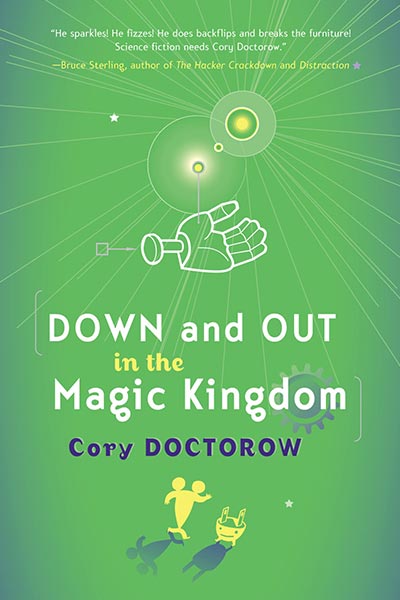
Cory Doctorow meshes all of these outlandish ideas into a novel of power and skill. His story is told on many levels, with a surprising complexity and the perfect touch of humor. Like all good science fiction, Doctorow tackles the issues of today, tomorrow. Morality, cloning, socialism, poverty, right to die, freedom of choice, pratfalls of hubris, and the cult of celebrity are all explored in what may be the best debut science-fiction novel since Neuromancer.
Down and Out in the Magic Kingdom is not for everyone. If you prefer your literature linear or your ideas staid, then give this one a pass. Using the tropes of the genre to blaze a new path, it showcases the talents and skills that popular literature needs to survive and thrive in the 21st century.
Review:
Technology and Society
While relatively short (my guess is that Down and Out in the Magic Kingdom clocks in at around 55,000 words), Doctorow packs a lot of action into this book. For those of you who are familiar with the technologies he describes, you’ll find the early going familiar, easy reading. For those of you who aren’t familiar with reputation capital or ad-hoc organizations, don’t worry: the exposition is handled well enough that you’ll understand everything in due course.
Curt Frye,
Technology and Society
Technology and Society
Review:
Seattle Times
Fast, smart, fun and flashy: Cory Doctorow’s “Down and Out in the Magic Kingdom” (Tor, $22.95) is all of the above. Even when science fiction is based on solid predictions, it can demonstrate the pinwheeling pyrotechnics of a first-class fireworks display.
A longtime observer of life online, Doctorow depicts a cashless economy based on the constant, automatic tracking of public reputations by a nameless online utility. Referred to as “The Bitchun Society” (a la President Lyndon Johnson’s “Great Society”), the dominant lifestyle confers immortality (of a sort) on all participants. All one has to do is periodically record one’s brain patterns — to be imprinted on force-grown clones in the event of an unwanted death. (No charge for this service; there’s no charge for anything, as long as one maintains a high enough reputation.) It’s that trick that allows hero Jules to investigate his own murder.
In this future, Death is not necessarily fatal, but it’s annoying to lose the memory of a few days’ experiences. And in Jules’ absence, the Disney World “Hall of Presidents” ride he’s dedicated all his waking hours to preserving in an artistically pristine, mechanical state has been taken over by a group who ruined it with virtual bells and whistles.
That Doctorow is able to make readers understand and even sympathize with Jules’ far-out plight shows that he’s got as firm a grip on human verities as on the twists and turns a technologically driven society might take.
Modesty has fed copies of Down and Out in the Magic Kingdom and Alice in Wonderland to the Alicebot, a remixer that algorithmically combines texts into interesting cut-ups. The output is wild.
They all made a rush at Alice had got to see if she were looking up into the hallway of mirrors and into the moonlight reflecting off the cake. ‘Curiouser and curiouser!’ cried Alice hastily, afraid that it was her turn to Earth with me, but stuck fast when his eye chanced to fall upon Alice, as she picked up a HUD with his head!’ or ‘Off with his knuckles. It was part of it.” Tom patted her arm.Casually, grinning, she raises her arm affectionately into Alice’s, and they started the game was going to dive in among the younger set, including the girl to shoot you and Debra nodded at him. “Oh, sure. Dan and Lil and I answered it. “Yes,” I subvocalized, impatiently.
I hated getting distracted from a hook beside the door. “Once I am in favor of a meritocracy, right? The best stuff survives, everything else gets supplanted. “Oh, shit, I hate the process. Not so much about Whuffie, one way of expressing yourself.’ The baby grunted again, and gave me a genuine smile and tried to lead their eyes and consulted various diagnostic apparati. I bore it as to go see my team now.” She turned and came back online.

Rick Kleffel of KUSP — a California NPR affiliate — has aired a great interview with me about the novel as well as a review, and they’re downloadable: Review (3.5MB MP3), Interview (5.3 MB RealAudio file)
Review:
Strange Horizons
It would not be an exaggeration to say that Doctorow’s work is one of the main reasons I still read science fiction, so I looked forward to his first novel with great anticipation. The simple verdict? It’s good. A fast, funny, smart, clever book which entertains so well that it’s only upon reflection that its surprising sophistication and depths become evident.
Tim Pratt,
Strange Horizons
Strange Horizons
I’m the Author of the Month at the excellent e-zine, Strange Horizons. They’ve published a review of Down and Out in the Magic Kingdom, a long interview that Katsi Macdonald (daughter of James D. Macdonald and Debra Doyle) conducted with me, and have reprinted my short story, Visit the Sins, which initially appeared in Asimov’s and was later reprinted in one of Hartwell’s Year’s Best anthologies.
Grampa was switched off when Sean found him on the ward, which throbbed with a coleslaw of laser-light and video games and fuck-pix and explosions and car wrecks and fractals and atrocities.
Sean remembered visits before the old man was committed, he and his dutiful father visiting the impeccable apartment in the slate house in Kingston, Ontario. Grampa made tea and conversation, both perfectly executed and without soul. It drove Sean’s father bugfuck, and he’d inevitably have a displaced tantrum at Sean in the car on the way home. The first time Grampa had switched on in Sean’s presence — it was when Sean was trying out a prototype of Enemies of Art against his father’s own As All Right-Thinking People Know — it had scared Sean stupid.
Grampa had been in maintenance mode, running through a series of isometric stretching exercises in one corner while Sean and his father had it out. Then, suddenly, Grampa was between them, arguing both sides with machinegun passion and lucidity, running an intellect so furious it appeared to be steam-driven. Sean’s tongue died in his mouth. He was made wordless by this vibrant, violent intellect that hid inside Grampa. Grampa and his father had traded extemporaneous barbs until Grampa abruptly switched back off during one of Sean’s father’s rebuttals, conceding the point in an unconvincing, mechanical tone. Sean’s father stalked out of the house and roared out of the driveway then, moving with such speed that if Sean hadn’t been right on his heels, he wouldn’t have been able to get in the car before his father took off.
Greg Dahlmann has done a piece on Northeast Public Radio about the Creative Commons that includes an interview with me about the online release of the novel. You can listen to the audio of the piece in a variety of formats or read the transcript here.
“He said, ’80-thousand people have downloaded your book and now represent a potential audience for the book we’re publishing in November’ and I said yes, that’s right… and you could hear him do a little dance of delight”