New York Times, November, 2003
Jack Willliam Bell has started a really interesting discussion about Whuffie and my novel on his Slashdot journal:
In these discussions the usual answer given is that human creativity will retain value and that people would still buy and sell hand-made items, artwork, books and songs. But this rings false to me on a number of levels, not the least of which is the fact that not everyone is talented enough to participate in such an ecomomy. A more important problem with this answer is the fact that, with the exception of hand-made items and original artwork, this actually relies on the continuation of false scarcity by requiring intellectual property limits which could not be maintained in a digitally networked world. (All this was before I ever heard of DRM of course.)
Reputation ecomonies, however, could be based on anything people valued in other people — not just their personal creativity. And such a currency would bring value to the creator of a song even if the song was freely traded without intellectual property limits. So, should money ecomonies collapse, you could still have a valuation system built on how others percieved you.
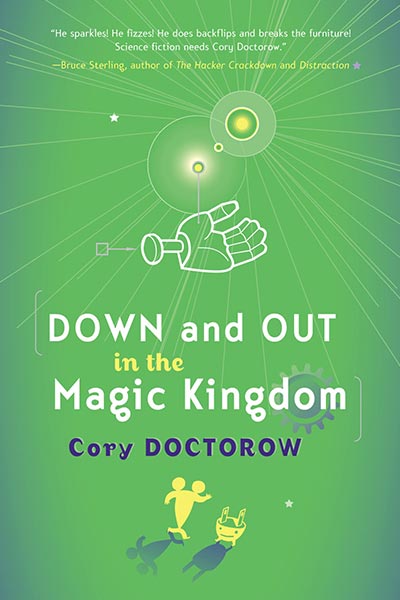
Canada’s Space Channel has posted a RealMedia stream of me reading from Down and Out in the Magic Kingdom.
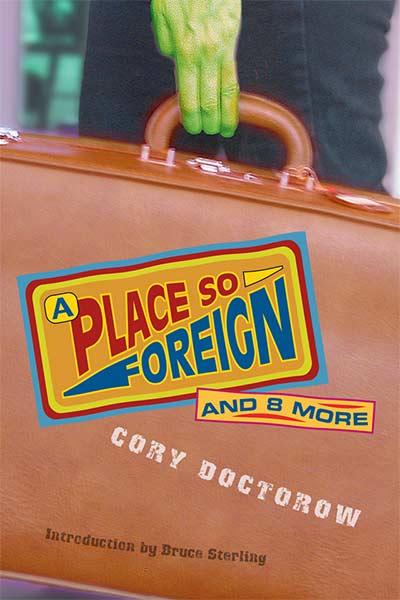
The (admittedly modest) initial print-run of my short story collection has nearly sold out in just over a month since the initial publication (w00t!). My publisher is going back to the press for a second run, and he’s asked me to provide him with any errata that I would like fixed before it goes to press (this means that the missing acknowledgements page will finally see print!).
If you’ve noticed any typos in the print edition (not the electronic texts), I’d love to know about them so we can get them fixed in the second printing (oh, also, this means that this is just about your last chance to get a copy of the first edition, which is sure to be an errata-filled collector’s item after my untimely death). Please email me by Friday with any tyopos, etc.
Review:
NYTimes
[It’s] a bracing collection of short stories by a Canadian writer whose influences range from Bruce Sterling and Rudy Rucker to Donald Barthelme and Roald Dahl.
As knowledgeable about computers as he is about flea markets, Doctorow uses science fiction as a kind of cultural WD-40, loosening hinges and dissolving adhesions to peer into some of society’s unlighted corners. His best known story, ”Craphound,” tells of a competitive friendship between two junk collectors, one human and one alien; what it says about the uses of the past is no more mysterious than the prices paid for a vintage Coke bottle or an early Barbie doll. Not every attempt to wrest truth from cliche works — but you won’t want to miss Doctorow’s satiric glance at co-opted dissent among the grade-school set or the insidious horror of his updated Pinocchio tale.
Gerald Jonas,
New York Times
New York Times
A reminder: I’ll be reading and signing books on Thursday night at Berkeley’s The Other Change of Hobbit (2020 Shattuck Ave, 1-510-848-0413) from 6-8PM. Hope to see you there!
A couple weeks ago, I did an in-game “book-signing” and interview in the Second-Life game-world. Wagner James Au, the Second Life “embedded reporter” who interviewed me, has posted the transcripts to the site, in two parts:
Part 1 and Part 2.
“That’s what the immortality in D&O is. You go to a backup kiosk and you decant a copy of yourself into a big storage cloud, and if you die — or even if you have a bad hangover, hell, why not — you have a force-grown clone, and you decant the consciousness into it and you off yourself. (Though [in the book] it’s dressed up in other language. That’s the existential view from today’s POV.)
“But everyone who gets squeamish about the euthanasia aspect just dies. Because they can’t use the backup-and-recover system. And there’s not a lot of social will to advance medical science beyond backup-and-recover, since it solves most every problem.
“It’s like [a medievalist’s view of] nutrition or hygiene. You may actually be right about the ‘ill humours’ that will invade you if you don’t smell like a bear’s [rear end]. But in the meantime, the people who bathe aren’t getting scabies and dying of infections started by the left-behind mouth-parts of dead ticks. And so everyone who thinks that way [about not bathing] ends up dead, and their ideas die with them. (A horribly simplified version of Darwinian mimetics, but you take my point.)
The Thackery T. Lambshead Pocket Guide to Eccentric and Discredited Diseases (Jeff Vandermeer and Mark Roberts, eds.)
My old Clarion classmate Jeff Vendermeer asked me to write something for his anthology of fictional, fantastical diseases and I came up with this — a twenty-first century illness that speaks to our ability to inaccurately sense our environment.
more
A reminder: I’ll be launching my new short story collection, A Place So Foreign and Eight More, at Borderlands Books in San Francisco this Thursday, at 7PM. I’m going to be signing copies and reading from a new work. Hope to see you!
A reminder: I’ll be launching A Place So Foreign and Eight More at Borderlands Books in San Francisco this Thursday, at 7PM. I’m going to be signing copies and reading from a new work. Hope to see you!