/ / Down and Out In the Magic Kingdom, News

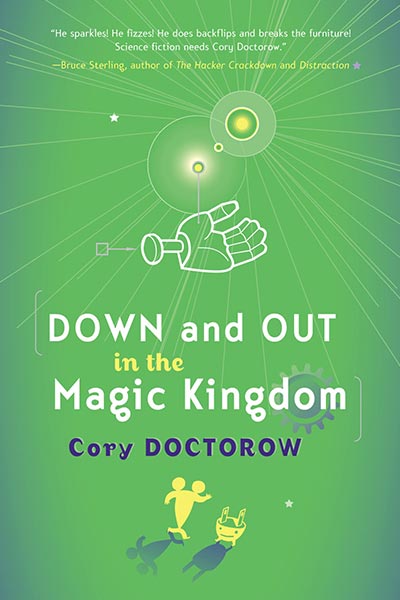
A conceit in my novel Down and Out in the Magic Kingdom is that our cellphones will disappear into our bodies, silently feeding us audio via cochlear implants and micing our throats to pick up sub-vocalizations (something I think I ripped off from Harry Harrison, though others have done it too). Now a DARPA program has produced a functional prototype of a subvocal pickup that can turn words you haven’t spoken into signals on the wire.

One system, being developed for DARPA by Rick Brown of Worcester Polytechnic Institute in Massachusetts, relies on a sensor worn around the neck called a tuned electromagnetic resonator collar (TERC). Using sensing techniques developed for magnetic resonance imaging, the collar detects changes in capacitance caused by movement of the vocal cords, and is designed to allow speech to be heard above loud background noise.

DARPA is also pursuing an approach first developed at NASA’s Ames lab, which involves placing electrodes called electromyographic sensors on the neck, to detect changes in impedance during speech. A neural network processes the data and identifies the pattern of words. The sensor can even detect subvocal or silent speech. The speech pattern is sent to a computerised voice generator that recreates the speaker’s words.

(Thanks, John!)

/ / News

The fall edition of Currents in Electronic Literacy contains a tremendous scholarly essay on my novel Down and Out in the Magic Kingdom by Eric Mason, called “Remediating the Magic Kingdom: Notes Toward a Poetics of Technology.”

This description of the process of flash-baking reveals the textuality of technology because the experience of the Presidents’ lives that the technology delivers is achieved specifically through texts such as “newspaper headlines, speeches, distilled biographies, personal papers.” The technologicity of texts that this description constructs is one that downplays the specific technological context of these textual genres (i.e. attempts to obscure their specific technologicities). The techno-logic of “gestalts” presented above suggests as well that the experience of a technology is irrelevant to its content–that you can place content from newspapers and biographies into the technology of flash-baking without any loss or change. Such a technologicity of texts works to undermine the specificity of a text’s technological context and the lived experience of technology. Conversely, a responsible poetics of technology refuses to ignore and refuses to obscure the irreducible differences of technologies, arguing that a text and the technology used to create and consume it are consubstantial elements that can be articulated but never transcended.

/ / Down and Out In the Magic Kingdom, News

The fall edition of Currents in Electronic Literacy contains a tremendous scholarly essay on Down and Out in the Magic Kingdom by Eric Mason, called “Remediating the Magic Kingdom: Notes Toward a Poetics of Technology.”

This description of the process of flash-baking reveals the textuality of technology because the experience of the Presidents’ lives that the technology delivers is achieved specifically through texts such as “newspaper headlines, speeches, distilled biographies, personal papers.” The technologicity of texts that this description constructs is one that downplays the specific technological context of these textual genres (i.e. attempts to obscure their specific technologicities). The techno-logic of “gestalts” presented above suggests as well that the experience of a technology is irrelevant to its content–that you can place content from newspapers and biographies into the technology of flash-baking without any loss or change. Such a technologicity of texts works to undermine the specificity of a text’s technological context and the lived experience of technology. Conversely, a responsible poetics of technology refuses to ignore and refuses to obscure the irreducible differences of technologies, arguing that a text and the technology used to create and consume it are consubstantial elements that can be articulated but never transcended.

/ / News

I’m speaking at next week’s Computers, Freedom and Privacy conference in Seattle, Washington. I’ll be doing two appearances:

  • a panel called “Cyberliberties and the World of Tomorrow—Science Fiction Authors on the Future of Computers, Freedom, and Privacy” with David Brin and Eileen Gunn, Thursday April 14 at 4:15PM and,
  • emceeing EFF’s Pioneer Awards at the Sci Fi Museum, 7:00PM on Wednesday, April 13th.

Hope to see you there!

/ / News

If you’re seeing this, it’s because I’ve successfully completed the changeover from the original craphound.com to my spiffy new MT site. Yay me. Here’s an RSS feed — it will get updated with all new pubs, appearances, reviews, articles, press mentions, etc.

/ / News


I carry a camera with me wherever I go, and shoot avidly. I upload the best of these photos to the incredible image-sharing service Flickr (disclosure: I once served on the advisory board for Ludicorp, the company that made Flickr). You can check out my pix here.

/ / News

I built the original craphound.com back in 1999, so that I could send Jim Van Pelt something to link to on his Campbell Awards site. I was the proverbial shoeless cobbler’s son: I had been earning my living on the Web for seven years, but I’d never bothered to build a personal site.

That was before there was anything like a blog-engine for easy management, so I did it all by hand, and I maintained it (or, in fact, didn’t maintain it) by hand for the intervening years.

It’s time to retire the old boy. The site did me well, but it’s an unmanageable mess. If you want to access it still, I’ve left all the old pages online — check them out here (if you must).

Now that I’ve got a sweet, ligthweight content management system on my back-end I’m hoping that I’m going to be able to keep the site more up-to-date, with each new publication and each new interview or press-mention.

/ / News

Back in 2003, Mena Trott was kind enough to build me a website for my first novel, Down and Out in the Magic Kingdom, putting together a beautiful Movable Type template that was simple, elegant and flexible.

I’ve now implemented variations on that template three more times: for my short story collection A Place So Foreign and Eight More, for my second novel, Eastern Standard Tribe, and now for this re-design of Craphound.com itself (I’ll be re-implementing it again, shortly, for my next novel, Someone Comes to Town, Someone Leaves Town).

Each time I re-implement this, I am struck anew by how easy and clean Mena’s design and implementation are. She is truly a virtuosa MT haxx0r, and I’m a lucky man to have had her assistance.

Thanks, Mena!