Review:

The Onion

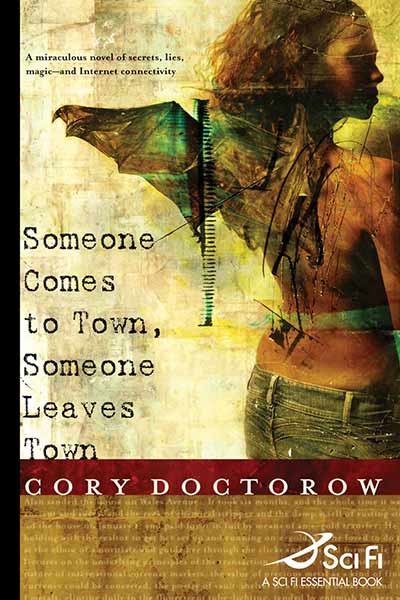
It’s official: Cory Doctorow has become the new Neal Stephenson. Or, rather, he’s become the new early-period Neal Stephenson, since Stephenson himself has moved away from quirky, computer tech-y, zippy future-kitsch. Doctorow began filling the resulting gap with his first novels, Down And Out In The Magic Kingdom and Eastern Standard Tribe. But his latest, Someone Comes To Town, Someone Leaves Town, is his most Stephenson-like novel to date, all bizarre characters, cutting-edge culture, and technological lectures, swirled into a refreshing, compellingly grounded semi-fable.

Tasha Robinson, The Onion AV Club

/ / News

I’m off to the WorldCon as soon as they call my flight, then I’m headed off on holidays: long story short, I won’t be reading much email between now and the 15th of August and will be facing too gigantic a pile of mail to carefully filter then, so anything you send between now and oh, say, August 17th won’t get much attention from me and stands a good chance of getting accidentally deleted when I come to sort through received mail on my return.

If it’s not urgent, don’t send it until after the 15th. If it’s urgent and related to EFF, email Ren Bucholz, and if it’s urgent and related to writing, email my agent’s assistant, Ann Behar. If you’ve got a Boing Boing suggestion, please don’t ever email it to me, ever! Use the suggest a site form.

/ / News

Becky Heydermann, an attendee at Glasgow’s World Science Fiction Convention later this week, has organized an informal session on the future of the book:

Discuss the nature of books, the idea of a book and what can be done with books, both as concept and as object.

This is a subject near and dear to my heart. It will be nice to cover this subject in a discussion rather than the traditional convention panel, where five people speak for ten minutes each, field one or two questions, and beat it. Naturally, I’ll be attending, and I hope you’ll come, too:

Date/Time: Sunday, 5PM
Location: Fan Lounge, at the Moat House. (apparently, real ale is on tap here)

/ / News

Last week I did a virtual book-signing of my novel Someone Comes to Town, Someone Leaves Town along with an interview in the massively multiplayer online world Second Life. All last week, Hamlet Linden, the game’s embedded reporter, has been running the transcript of the interview in the Second Life blog, New World Notes. Now the whole thing is online.

On a related note, Damon Wallace continues to add to his amazing collection of fan illustrations of scenes from my novel, including Alan’s tiny thumb, Marci in the family cave, a sketch of Davey and a wicked-creepy Davey attack on Alan. These illos are just gobsmackingly wonderful.

HL: [Audience member] Jarod Godel asks, “A lot of the backstory and universe in Someome Comes To Town was left open; was this done on purpose, trying to encourage fan fiction to fill in those gaps?

CD: Not to encourage fan fiction per se, but the human imagination has a lot higher polygon-count than prose could ever have. Leaving most of the world in shadow lets readers fill in very high rez pictures where you don’t have the throughput in the printed page. That said, if fan fiction emerged that filled that in, I’d be mightily chuffed.

/ / News, Someone Comes to Town, Someone Leaves Town

Last week I did a virtual book-signing of my novel Someone Comes to Town, Someone Leaves Town along with an interview in the massively multiplayer online world Second Life. All last week, Hamlet Linden, the game’s embedded reporter, has been running the transcript of the interview in the Second Life blog, New World Notes. Now the whole thing is online.

On a related note, Damon Wallace continues to add to his amazing collection of fan illustrations of scenes from my novel, including Alan’s tiny thumb, Marci in the family cave, a sketch of Davey and a wicked-creepy Davey attack on Alan. These illos are just gobsmackingly wonderful.

HL: [Audience member] Jarod Godel asks, “A lot of the backstory and universe in Someome Comes To Town was left open; was this done on purpose, trying to encourage fan fiction to fill in those gaps?

CD: Not to encourage fan fiction per se, but the human imagination has a lot higher polygon-count than prose could ever have. Leaving most of the world in shadow lets readers fill in very high rez pictures where you don’t have the throughput in the printed page. That said, if fan fiction emerged that filled that in, I’d be mightily chuffed.

/ / News

Alex Steffen of Worldchanging has posted a great interview with me about WIPO, the copyfight, and international development.

WIPO — the World Intellectual Property Organization — is the UN’s most captive agency. WIPO was originally a stand-alone organization, essentially an industry consortium for rightsholders’ interests, and they got brought in under the umbrella of the UN thirty or so years ago, with the understanding that they would change their practices to make them consistent with other UN instruments like the Universal Declaration on Human Rights — humanitarian instruments — and that it would become a humanitarian agency for development.

Which makes sense. Information goods are a critical piece of the development picture. Every successfully developed country made use of free information goods. More accurately, they all went through a stage when they were a pirate nation. America spent a century as a pirate nation, ripping off the intellectual property of every country around it, and in particular, of Britain, because when you’re a net importer of intellectual property, signing on to multilateral copyright and patent agreements is signing on to exporting your wealth off-shore. When you’re a net exporter of intellectual property, it makes economic sense.

The choice is not simply one of piracy or monopoly. There is a whole rich middle ground of public domain and open information regimes which could give developing world countries the tools they need to serve humanitarian purposes, while protecting the legitimate interests of authors, performers and inventors. WIPO could have created a global knowledge goods regime which protected both the commercial and the humanitarian fairly.

Review:

Globe and Mail

At the heart of these juxtapositions — back-country living versus high technology, freaks and monsters versus everyday, normal people — are Doctorow’s propositions about the democratic flow of information and communications. Who are the real “lumbering dinosaur[s] . . . thrashing in the tar pit,” the regimented, slow-moving corporation that regulates communications, or the characters like Alan, who argue that the free wireless network project is a protection of fundamental human rights?

One more interesting point about the science in this story: It isn’t futuristic or untried, except, maybe, that the citywide network will be enabled by hardware that has been constructed entirely from garbage (discarded computer parts found in dumpsters).

“What am I?” The question is ongoing. Doctorow uses Alan as an embodiment of self-discovery on individual and cultural levels. With Alan’s efforts to spearhead the wireless movement (executed by street people, squeegee kids and junkies), Doctorow suggests that the notions of high and low tech, archaic and advanced, have less to do with the technologies we create than with the ways that we use them.

Kelly McManus, The Globe and Mail

/ / News

Next week, Glasgow will host the Interaction, the 63rd World Science Fiction Convention. I’ll be attending and doing a number of program items, including some stufff on Creative Commons and a reading from my new novel-in-progress. Here’s an overview of my program items:

Friday August 5:
10:00am You’ve Plugged _What_ into It?
Hardware Hacking is an increasingly popular pastime. Also the advent of computer control has revolutionised many hobbies, e.g. amateur astrophotography. (with Martin Hoare amd Jordin Kare)

Noon: Clones, Children or Countless Lives
If everyone lives forever, or is endlessly reincarnated, where do we
put them? And can anyone reproduce in any other way?
(with Simon Bradshaw, Anne K. Gay, Richard Morgan and Eric M. Van)

5:00pm: Is Genius Gendered?
One lone genius and an attractive assistant (fill in the genders)
save the world. Our panel gives media and literary SF examples, and
discuss how changing the gender might change other things.

(with Sean McMullen and Connie Willis)

Saturday, August 6:
2:30pm: Signing at the Borderlands Books table

6:00pm: Fannish Currency: Whuffie, Egoboo and Chocolate
(Fandom has for a long time had a potlatch economy, where you give
things away in the expectation of egoboo, or fannish kudos. How does
this translate to the Internet Age?
)
(with Christina Lake, Mike Scott and Suzanne Tompkins)

Sunday, August 7:
10:00am AI: the Aliens We Make?
Aliens and AI are both Other, but where one comes from Out There,
the other lives Down Here. Are they really the same thing — and
either way, what difference does it make?

(with David Gerrold, Ian McDonald, Charles Stross and Tricia Sullivan)

Noon: Creative Commons 101. A Primer for the Interested

2:00pm Reading

Monday, August 8:
10:00am: Standing up for our (Copy)rights
Contrasting views on the benefits and hazards authors see in sharing
(or having their work shared) online.

(with Andrew Adams, David Cake and Christopher Priest)

Hope to see you there!