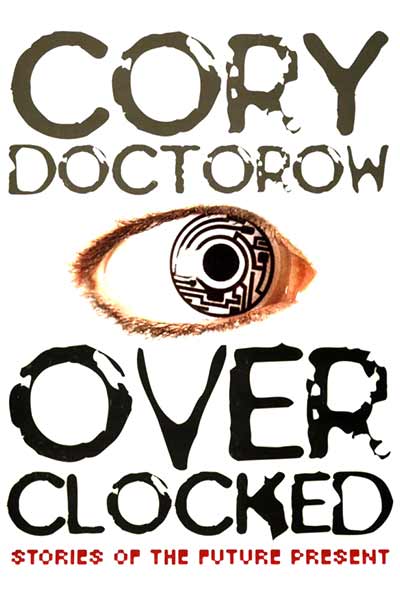
Here’s the seventh and final installment of the podcast of my story Human Readable:
Well, I’ve just had my second flight cancellation from London-Boston in 24 hours, and my new flight doesn’t land until 5PM. As many of you know, I’m scheduled to be speaking at MIT’s Bartos Theater at 5PM, which means I’m going to be late. Someone’s picking me up at the airport and I’m going to sit as far forward on the plane as I can, so with any luck I won’t be too late. Luckily, we’ve got a great big block of time booked for my talk — 5PM-7PM with a subsequent reception until 9PM, so with any luck you’ll be able to entertain yourselves for a bit until I get there. Just cross your fingers and hope for short lines at the Department of Homeland Security checkpoint.
Here’s installment six of the podcast of my story Human Readable:
The Clarion Foundation is the charitable organization that oversees the legendary Clarion science fiction writers’ workshop, and it’s seeking your help in the form of donated banner-space on your site.
I’m on the Board of the Foundation, a new nonprofit, and we’ve just produced our first-ever marketing campaign with the generous volunteer assistance of Grad Conn, my friend and old business-partner. The campaign consists (modestly) of the badges you see below, and a landing-page with some information on signing up to the workshop, which runs for six weeks every summer — it’s going to be in East Lansing, Michigan again this year.
We’re looking for websites that are willing to help us run the campaign by donating some space to host one of these badges (they’re in two standard sizes, 150×150 and 150×58) in a prominent place between now and the application deadline on April 1. Even if you can only run it for part of the time, or in rotation, we’d appreciate your help.
Clarion has trained hordes of talented writers, from Bruce Sterling to Octavia Butler, from Kelly Link to Nalo Hopkinson. I’m a graduate and had the good fortune to teach the program last year as well. Attending Clarion is a life-changing experience for many, a watershed moment that helps writers understand what is needed if they are to succeed, and that gives them the tools to achieve success.
Help us out if you can: inline one of the images below and link it to http://www.theclarionfoundation.org/ads/landing/. You’ll be helping to guide the careers of the writers who’ll be entertaining you in a year or two.
Thanks!


A couple days ago, I posted about my schedule in Boston — talks at MIT, Harvard, Olin College and Boskone, the northeastern regional science fiction convention. The organizers of Boskone have just alerted me to another event I’m scheduled to do there:
I’ll be hosting a “Kaffeeklatsch” at the con on Sunday, 19 March, from 10AM-11AM. These are small, informal coffee-and-cake roundtables where we just talk about whatever’s on your mind. The signup for the Kaffeeklatsch will be at the con, and space is limited, so if you’re interested, be sure to put your name down as early as possible.
On Tuesday night, I gave a talk about DVB-CPCM, Europe’s version of the Broadcast Flag, a plan to make sure that digital TVs don’t do anything to disrupt the entertainment industry’s business-model. The talk was part of the Open Rights Group’s second meeting and it also included a great talk by Phil Booth of the No2ID campaign.
Improbulus, a digital rights activist, recorded both speeches and uploaded them to the Internet Archive. The recording of my talk cuts just a few words off the beginning and end, but nothing major. Hope you enjoy it!
Here’s installment five of the podcast of my story Human Readable:
I’m going to be in Boston next week for a gig as an MIT artist-in-residence, a bunch of meetings, some public talks and Boskone, the northeastern regional science fiction convention, where I’m going to be a special guest. I hope to see you there! Here are the public events I’ll be at:
Monday, February 13, 2006, 5PM
Down and Out at MIT: An Evening with Cory Doctorow
MIT Bartos Theater (E15), 20 Ames Street, Cambridge, Massachusetts 02139
Sponsored by MIT Comparative Media Studies, MIT Office of the Arts
Wednesday, February 15, 2006, 6PM
Set Top Cop:
Hollywood’s Secret War on Your Living Room
Harvard Emerson Hall, Rm 105
Sponsored by Harvard Berkman Center for Internet and Society, Harvard Computer Society, Harvard FreeCulture
Thursday, February 16, Noon
0WNED — How Hollywood Plans on Making the Future Subservient to the Past
Olin Auditorium, Olin College, Needham, MA
Friday, February 17, 2006, 7PM
Trends in SF Publishing: Technology
Panel at Boskone with James Patrick Kelly, Clayton L. McNally, Steve Miller and Don Sakers
Saturday, February 18, 2006, 10AM
Special guest talk at Boskone
Saturday, February 18, 2006, 1PM
Reading at Boskone
Saturday, February 18, 2006, 4PM
Technology Today!
Panel at Boskone with Tobias Buckell, Ernest Lilley, Edie Stern and Alicia Kestrel Verlager
Saturday, February 18, 2006, 5PM
Blogs, Boing Boing, and Beyond
Panel at Boskone with Kathryn Cramer, Daniel P. Dern, MaryAnn Johanson, Teresa Nielsen Hayden
Sunday, February 19, 2006, 10AM
Kaffeeklatsch
Sunday, February 19, 2006, 11AM
Booksigning at Boskone
Sunday, February 19, 2006, Noon
Intellectual Property: Public Domain Issues
Panel at Boskone with Deb Geisler and Patrick Nielsen Hayden
Sunday, February 19, 2006, 2PM
Cyborgs: After Man, and Beyond
Panel at Boskone with Robert I. Katz, Karl Schroeder, Charles Stross and Alicia Kestrel Verlager
The Locus Awards ballot is online, where science fiction fans can vote on their favorite works of 2005. I’m proud to report that I’m eligible in three categories: Best Fantasy Novel (Someone Comes to Town, Someone Leaves Town), Best Novella (Human Readable) and Best Novelette (I, Robot).
The ballot is drawn from the Locus Recommended Reading List, which is an excellent way to familiarize yourself with the best work published in the field this year.
Here’s installment four of the podcast of my story Human Readable: