/ / News

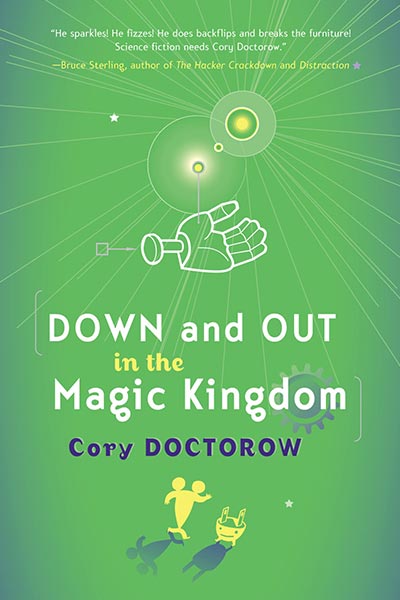
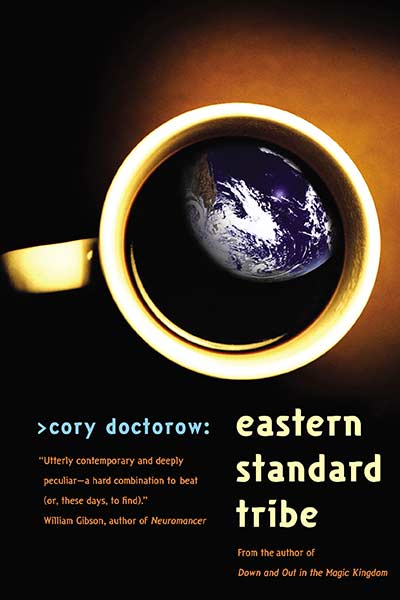
Aki Kyozoku, a fan of my novel Down and Out in the Magic Kingdom, has converted the entire text of the book to a poster that depicts the type and graphics from the book’s cover. By shading the type and inserting spaces in it, Aki was able to use the type itself as pixels in a giant bitmap that you can print on your favorite large-format printer and stick on your wall. Man, that’s cool!

628K PDF Link


/ / News

Michael Ayers, the Toshiba lawyer who negotiates their DRM deals, will give a free public talk at the University of Southern California next Tuesday at 7PM. Michael started out as an engineer and switched to law. He was there when the anti-copying standards were set for DVDs, DVD audio, digital TV, Secure Digital cards, and he is the president of the DTLA consortium, which licenses out the DTCP control-ware from Hitachi, Intel, Matsushita, Sony, and Toshiba.

Michael is the chair of the “Business Group” for AACS, the technology that controls users of Blu-Ray and DVD-HD.

Your home and life are increasingly full of devices that seek to control, rather than enable you, and Michael is part of the negotiations for how those devices will function. As the representative of a technology company, he usually bats for the user, but we’re still getting devices with more and more restrictions.

Michael has generously agreed to speak to my class and then give a public lecture, and I’m really grateful to him for it. He’s always been candid, reasonable and level-headed in the DRM negotiations I worked with him at, and even when we’ve come down on opposite sides of the debate, I’ve been impressed with his honesty and flexibility.

When: September 19, 7PM-9PM
University of Southern California, Annenberg School, 3502 Watt Way
Room 207

/ / News


Holly Phillips and I will co-edit Tesseracts Eleven, the next volume of the award-winning anthology series for Canadian science fiction and fantasy, founded by Judith Merril. We’re open to public submissions from Canadians and Canadian residents, in either French or English, at lengths up to 7,500 words. The deadline is December 31, 2006.

Send your manuscripts to the address below, and follow them up with an electronic submission to tess11@edgewebsite.com. When formatting your electronic manuscript, adhere to the excellent formatting guidelines set out for submissions to Strange Horizons.

Tesseracts Eleven
Attention: Series Editors
c/o Tesseracts Eleven Submissions,
P.O. Box 1714,
Calgary, Alberta, T2P 2L7
Canada


/ / News

My latest column for Locus Magazine is out: How Copyright Broke. In this essay, I explore the fallacy that the public should treat the books and other media they buy as “limited licenses” and not as their property, and why telling your readers that they don’t own the books they buy will never succeed:

When it comes to retail customers for information goods — readers, listeners, watchers — this whole license abstraction falls flat. No one wants to believe that the book he’s brought home is only partly his, and subject to the terms of a license set out on the flyleaf. You’d be a flaming jackass if you showed up at a con and insisted that your book may not be read aloud, nor photocopied in part and marked up for a writers’ workshop, nor made the subject of a piece of fan-fiction.

At the office, you might get a sweet deal on a coffee machine on the promise that you’ll use a certain brand of coffee, and even sign off on a deal to let the coffee company check in on this from time to time. But no one does this at home. We instinctively and rightly recoil from the idea that our personal, private dealings in our homes should be subject to oversight from some company from whom we’ve bought something. We bought it. It’s ours. Even when we rent things, like cars, we recoil from the idea that Hertz might track our movements, or stick a camera in the steering wheel.

When the Internet and the PC made it possible to sell a lot of purely digital “goods” — software, music, movies and books delivered as pure digits over the wire, without a physical good changing hands, the copyright lawyers groped about for a way to take account of this. It’s in the nature of a computer that it copies what you put on it. A computer is said to be working, and of high quality, in direct proportion to the degree to which it swiftly and accurately copies the information that it is presented with.

/ / News

I had an op-ed in Monday’s Daily Trojan, the campus paper at USC, about the ominous anti-P2P message that USC’s administration sent to the student body:

“Copyright infringement occurs whenever someone makes a copy of any copyrighted work – songs, videos, software, cartoons, photographs, stories, novels – without purchasing that copy from the copyright owner or obtaining permission some other way.”

This is simply untrue – if it’s true, we should lock the library doors and arrest any professor who turns up with handouts or anyone who forwards an e-mail. Copyright infringement occurs when you make an unlawful copy of a copyrighted work. But oftentimes when you copy in the course of scholarship, you make a copy in accordance with the law.

Link

See also:
USC’s bizarre, non-legal copyright policy
Universities put Hollywood ahead of students