/ / News

Charlie Stross and I are doing a benefit talk for the Open Rights Group on May 1 in London, entitled “Resisting the all-seeing eye.” Hope to see you there — Stross is a ball, and ORG is a damned worthy cause, especially in this era of ubiquitous surveillance.


From technologies like PGP and Tor to the arguments that will convince people – friends and family as well as media and politicians – to watch out for their digital rights, this event is your anti-surveillance 101.

Cory Doctorow – science fiction novelist, blogger and technology activist – and Charlie Stross – science fiction writer and former programmer and pharmacist – will share how and why to control your data. The event will be moderated by Ian Brown – academic, activist and Blogzilla.

The entry price is either joining Open Rights Group – by handing door staff a completed form (link to PDF) – or making a one-off £10 donation on the door. Please register for tickets here. Drinks will be available, as is The Three Kings – a local pub – to continue the debate.

What: Doctorow and Stross: Resisting the all-seeing eye
When: 1830, Friday 1 May 2009
Where: Crypt on the Green, St James Church, Clerkenwell, Clerkenwell Close, London, EC1R 0EA – Map

Event – Doctorow and Stross: Resisting the all-seeing eye

/ / Little Brother, News

The Libertarian Futurist Society has released its slate of nominees for this year’s Prometheus Awards, the award for the best “pro-freedom” science fiction of the year. I’m proud to say that my novel Little Brother made the cut, as did five other standout books, including a couple personal favorites: Half a Crown by Jo Walton and Saturn’s Children by Charlie Stross.

* Matter, by Iain Banks (Orbit Books) – Part of Banks’ series of far-future space operas about the Culture, a utopia which reflects Banks’ interest in anarchism through its avoidance of the use of force except when necessary for protection and defense. The novel focuses on an agent in Special Circumstances, the Culture’s special forces unit, who returns to her home planet, a “shellworld” with multiple layers of habitation, after her father has been killed in a coup.

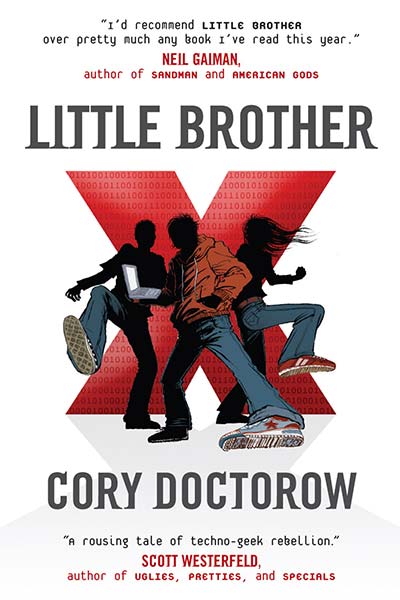
* Little Brother, by Cory Doctorow (TOR Books) – A cautionary tale about a high-school student and his friends who are rounded up in the hysteria following a terrorist attack, the novel focuses on how people find the courage to respond to oppression.

* The January Dancer, by Michael Flynn (TOR Books) -The classic space opera, set in an interstellar civilization created by a wide-ranging human diaspora, revolves around how discovery of a an alien relic sends agents of a multisystem federation on a quest that exposes them to political and economic institutions of many different cultures and requires them to deal with threats to freedom, from piracy to political corruption.

* Saturn’s Children, by Charles Stross (Ace Books) -A robot’s adventures after all the humans in a society have died raises complex issues of ethics, duty, family and struggle in this Heinlenesque novel.

* Opening Atlantis, by Harry Turtledove (Penguin/Roc Books) – Set in a world where medieval Europeans discover an island continent in the Atlantic Ocean, this first novel in a new atternate-history series explores the politics of colonization and the struggle for self-determination while offering parallels and contrasts with development of the Americas.

* Half a Crown, by Jo Walton (TOR Books) -The sequel to Walton’s Prometheus Award-winning Ha’penny concludes her alternative-history trilogy, set two decades after Britain reached accommodation with Hitler’s Germany in the 1940s, with a chilling portrait of people all too willing to trade freedom for security.

2009 PROMETHEUS AWARDS FINALISTS ANNOUNCED

/ / News

The Libertarian Futurist Society has released its slate of nominees for this year’s Prometheus Awards, the award for the best “pro-freedom” science fiction of the year. I’m proud to say that my novel Little Brother made the cut, as did five other standout books, including a couple personal favorites: Half a Crown by Jo Walton and Saturn’s Children by Charlie Stross.

* Matter, by Iain Banks (Orbit Books) – Part of Banks’ series of far-future space operas about the Culture, a utopia which reflects Banks’ interest in anarchism through its avoidance of the use of force except when necessary for protection and defense. The novel focuses on an agent in Special Circumstances, the Culture’s special forces unit, who returns to her home planet, a “shellworld” with multiple layers of habitation, after her father has been killed in a coup.

* Little Brother, by Cory Doctorow (TOR Books) – A cautionary tale about a high-school student and his friends who are rounded up in the hysteria following a terrorist attack, the novel focuses on how people find the courage to respond to oppression.

* The January Dancer, by Michael Flynn (TOR Books) -The classic space opera, set in an interstellar civilization created by a wide-ranging human diaspora, revolves around how discovery of a an alien relic sends agents of a multisystem federation on a quest that exposes them to political and economic institutions of many different cultures and requires them to deal with threats to freedom, from piracy to political corruption.

* Saturn’s Children, by Charles Stross (Ace Books) -A robot’s adventures after all the humans in a society have died raises complex issues of ethics, duty, family and struggle in this Heinlenesque novel.

* Opening Atlantis, by Harry Turtledove (Penguin/Roc Books) – Set in a world where medieval Europeans discover an island continent in the Atlantic Ocean, this first novel in a new atternate-history series explores the politics of colonization and the struggle for self-determination while offering parallels and contrasts with development of the Americas.

* Half a Crown, by Jo Walton (TOR Books) -The sequel to Walton’s Prometheus Award-winning Ha’penny concludes her alternative-history trilogy, set two decades after Britain reached accommodation with Hitler’s Germany in the 1940s, with a chilling portrait of people all too willing to trade freedom for security.

2009 PROMETHEUS AWARDS FINALISTS ANNOUNCED

/ / Little Brother, News

Hot damn! The 2009 Hugo Awards ballot is live and it’s a doozy, and not just because I’m on it twice (Best Novel: Little Brother and Best Novella: True Names, with Ben Rosenbaum). No, it’s better than that — the entire ballot is just killer, especially my competition in the Best Novel category (hell, three quarters of the authors were invited to my wedding, and I’d have been delighted to have the remaining one in attendance). A million thanks to all of you who nominated both works!

I can’t wait to see who wins (and no matter who wins, I can’t wait for the annual Hugo Losers party, which is bound to be a hell of a thing and a half). I’m going to the WorldCon for the awards, of course — my tux is hanging in its dry-cleaning bag awaiting its annual airing.

And hey, look at that, Patrick Nielsen Hayden, who edited Little Brother, is also up for Best Editor!

Best Novel
* Anathem by Neal Stephenson (Morrow; Atlantic UK)
* The Graveyard Book by Neil Gaiman (HarperCollins; Bloomsbury UK)
* Little Brother by Cory Doctorow (Tor Teen; HarperVoyager UK) — Free download
* Saturn’s Children by Charles Stross (Ace; Orbit UK)
* Zoe’s Tale by John Scalzi (Tor)

Best Novella
* “The Erdmann Nexus” by Nancy Kress (Asimov’s Oct/Nov 2008)
* “The Political Prisoner” by Charles Coleman Finlay (F&SF Aug 2008) – Read Online
* “The Tear” by Ian McDonald (Galactic Empires)
* “True Names” by Benjamin Rosenbaum & Cory Doctorow (Fast Forward 2) — Free download
* “Truth” by Robert Reed (Asimov’s Oct/Nov 2008)

Best Novelette
* “Alastair Baffle’s Emporium of Wonders” by Mike Resnick (Asimov’s Jan 2008) — Read Online
* “The Gambler” by Paolo Bacigalupi (Fast Forward 2) — Read Online
* “Pride and Prometheus” by John Kessel (F&SF Jan 2008)
* “The Ray-Gun: A Love Story” by James Alan Gardner (Asimov’s Feb 2008) — Read Online
* “Shoggoths in Bloom” by Elizabeth Bear (Asimov’s Mar 2008) — Read Online

Best Short Story

* “26 Monkeys, Also the Abyss” by Kij Johnson (Asimov’s Jul 2008) — Read Online
* “Article of Faith” by Mike Resnick (Baen’s Universe Oct 2008)
* “Evil Robot Monkey” by Mary Robinette Kowal (The Solaris Book of New Science Fiction, Volume Two)
* “Exhalation” by Ted Chiang (Eclipse Two)
* “From Babel’s Fall’n Glory We Fled” by Michael Swanwick (Asimov’s Feb 2008)

Another thing about this ballot — it’s the copyfightingest ballots in my memory, filled with writers and editors who advocate for sharing, fanfic, and looser copyrights.

Hugos 2009

/ / News

Hot damn! The 2009 Hugo Awards ballot is live and it’s a doozy, and not just because I’m on it twice (Best Novel: Little Brother and Best Novella: True Names, with Ben Rosenbaum). No, it’s better than that — the entire ballot is just killer, especially my competition in the Best Novel category (hell, three quarters of the authors were invited to my wedding, and I’d have been delighted to have the remaining one in attendance). A million thanks to all of you who nominated both works!

I can’t wait to see who wins (and no matter who wins, I can’t wait for the annual Hugo Losers party, which is bound to be a hell of a thing and a half). I’m going to the WorldCon for the awards, of course — my tux is hanging in its dry-cleaning bag awaiting its annual airing.

And hey, look at that, Patrick Nielsen Hayden, who edited Little Brother, is also up for Best Editor!

Best Novel
* Anathem by Neal Stephenson (Morrow; Atlantic UK)
* The Graveyard Book by Neil Gaiman (HarperCollins; Bloomsbury UK)
* Little Brother by Cory Doctorow (Tor Teen; HarperVoyager UK) — Free download
* Saturn’s Children by Charles Stross (Ace; Orbit UK)
* Zoe’s Tale by John Scalzi (Tor)

Best Novella
* “The Erdmann Nexus” by Nancy Kress (Asimov’s Oct/Nov 2008)
* “The Political Prisoner” by Charles Coleman Finlay (F&SF Aug 2008) – Read Online
* “The Tear” by Ian McDonald (Galactic Empires)
* “True Names” by Benjamin Rosenbaum & Cory Doctorow (Fast Forward 2) — Free download
* “Truth” by Robert Reed (Asimov’s Oct/Nov 2008)

Best Novelette
* “Alastair Baffle’s Emporium of Wonders” by Mike Resnick (Asimov’s Jan 2008) — Read Online
* “The Gambler” by Paolo Bacigalupi (Fast Forward 2) — Read Online
* “Pride and Prometheus” by John Kessel (F&SF Jan 2008)
* “The Ray-Gun: A Love Story” by James Alan Gardner (Asimov’s Feb 2008) — Read Online
* “Shoggoths in Bloom” by Elizabeth Bear (Asimov’s Mar 2008) — Read Online

Best Short Story

* “26 Monkeys, Also the Abyss” by Kij Johnson (Asimov’s Jul 2008) — Read Online
* “Article of Faith” by Mike Resnick (Baen’s Universe Oct 2008)
* “Evil Robot Monkey” by Mary Robinette Kowal (The Solaris Book of New Science Fiction, Volume Two)
* “Exhalation” by Ted Chiang (Eclipse Two)
* “From Babel’s Fall’n Glory We Fled” by Michael Swanwick (Asimov’s Feb 2008)

Another thing about this ballot — it’s the copyfightingest ballots in my memory, filled with writers and editors who advocate for sharing, fanfic, and looser copyrights.

Hugos 2009

/ / News

I’m thrilled to announce that I’m doing a benefit reading for the Electronic Frontier Foundation in San Francisco on March 23, 2009 — a week this Monday — along with Rudy Rucker, Annalee Newitz and Charlie Jane Anders. Hope to see you there:


Join EFF on Monday, March 23rd, for a fundraising event featuring award-winning writer Cory Doctorow. Cory will be reading from his novel, “Little Brother,” a story of high-tech teenage rebellion set in the familiar world of San Francisco. As he currently calls the UK home, this is a rare opportunity to to hear Cory read from his work in person. He will be joined by fellow writers Rudy Rucker, Annalee Newitz and Charlie Jane Anders reading from their latest works.

7pm on Monday March 23, at the 111 Minna Gallery in San Francisco.

Admission is $25. No one turned away for lack of funds. Must be 21 or older to attend.

Geek Reading with Cory Doctorow, Rudy Rucker, Annalee Newitz and Charlie Jane Anders

/ / News

I’ve just had a quick article on the wars between corporate IT and tech enthusiast employees published in the Harvard Business Review. I’ve been on both sides of that barricade, and while I understand the plight of IT, I think that it’s against everyone’s interest to give them to power to lock employees out of figuring out better ways of using their PCs and the Internet to get the job done.

The dirty secret of corporate IT is that its primary mission is to serve yesterday’s technology needs, even if that means strangling tomorrow’s technology solutions. The myth of corporate IT is that it alone possesses the wisdom to decide which technologies will allow the workers on the front line to work better, faster and smarter — albeit with the occasional lackluster requirements-gathering process, if you’re lucky.

The fact is that the most dreadful violators of corporate policy — the ones getting that critical file to a supplier using Gmail because the corporate mail won’t allow the attachment, the ones using IM to contact a vacationing colleague to find out how to handle a sticky situation, the incorrigible Twitterer who wants to sign up all his colleagues as followers through the work day — are also the most enthusiastic users of technology, the ones most apt to come up with the next out-of-left-field efficiency for the firm.

There has to be a way to bring those people inside the church, rather than going to war against them. I suspect the answer is in modern virtualization tools, which allow users to have a “clean” OS and environment that they use for in-compliance processing and work, and a “wild” sandbox where anything goes, each on separate network segments. Earning this setup would require demonstrating skill and desire to imagine new ways of getting the job done, and its use would be subject to regular, brief reports on lessons learned, techniques tried, failures and successes.

The High Priests of IT — And the Heretics