/ / Podcast


Edgar Allen Poe wrote “The Masque of the Red Death” in 1842. It’s about a plutocrat who throws a masked ball in his walled abbey during a plague with the intention of cheating death.

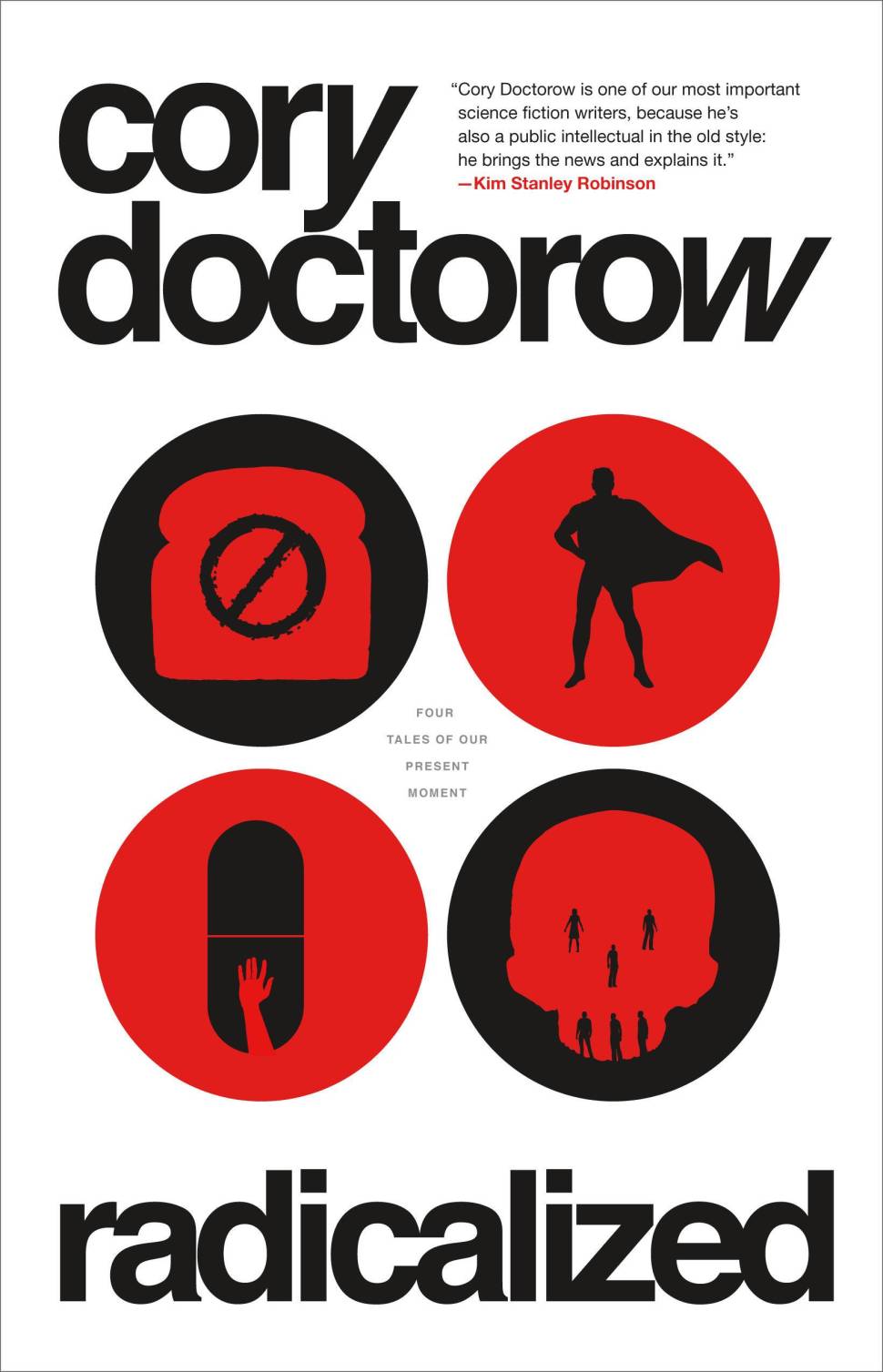
My novella “The Masque of the Red Death” is a tribute to Poe; it’s from my book Radicalized. It’s the story of a plute who brings his pals to his luxury bunker during civlizational collapse in the expectation of emerging once others have rebuilt.

Naturally, they assume that when they do emerge, once their social inferiors have rebooted civilization, that their incredible finance-brains, their assault rifles, and their USBs full of BtC will allow them to command a harem and live a perpetual Frazetta-painting future.

And naturally – for anyone who’s read Poe – it doesn’t work out for them. They discover that humanity has a shared microbial destiny and that you can’t shoot germs. That every catastrophe must be answered with solidarity, not selfishness, if it is to be survived.

Like my story When Sysadmins Ruled the Earth, the Masque of the Red Death has been on a lot of people’s minds lately, especially since this Guardian story of plutes fleeing to their New Zealand luxury bunkers was published. Hundreds of you have sent me this.

I got the message. Yesterday, I asked my agent to see if Macmillan Audio would let me publish the audiobook of my Masque of the Red Death for free. They said yes, and asked me to remind you that the audiobook of Radicalized (which includes Masque) is available for your delictation.

I hope you’ll check out the whole book. Radicalized was named one of the @WSJ’s best books of 2019, and it’s a finalist for Canada Reads, the national book prize. It’s currently on every Canadian national bestseller list.

There’s one hitch, though: Audible won’t sell it to you. They don’t sell ANY of my work, because I don’t allow DRM on it, because I believe that you should not have to lock my audiobooks to Amazon’s platform in order to enjoy them.

Instead, you can buy the audio from sellers like libro.fm, Downpour.com, and Google Play. Or you can get it direct from me. No DRM, no license agreement. Just “you bought it, you own it.”

And here’s the free Macmillan Audio edition of Masque of the Red Death, read with spine-chilling menace by the incredible Stefan Rudnicki, with a special intro from me, freshly mastered by John Taylor Williams. I hope it gives you some comfort.

/ / Podcast

Last night I sat down for an interview and lively Q&A at the Kelowna Public Library with the CBC’s Sarah Penton as part of the Canada Reads national book prize, for which my book Radicalized is a finalist. Courtney Dickson was kind enough to send me raw audio from the board and to give me permission to post it and include it in my podcast feed. It was a genuinely wonderful night, with great and thoughtful questions, and I’m really glad that I get to share it with you! (MP3)

/ / Articles

My latest Locus column explores what copyright expert Rebecca Giblin calls “The New Copyright Bargain” – a copyright system designed around enriching authors above all, rather rather than treating authors’ incomes as an incidental output of enriching entertainment or tech corporations. The column is called “A Lever Without a Fulcrum is Just a Stick.” Copyright is billed as giving creators leverage over the corporations we contract with, but levers need fulcrums.

https://locusmag.com/2020/03/cory-doctorow-a-lever-without-a-fulcrum-is-just-a-stick/

In an increasingly concentrated marketplace, any exclusive rights that are given to creators are simply appropriated by corporations as a non-negotiable condition of the standard contract. Think of how samples could originally be used without permission (in the Paul’s Boutique/It Takes a Nation of Millions era), enriching old R&B artists who’d been burned by one-sided contracts.

(Image from Kembrew Macleod’s “Creative License” https://www.dukeupress.edu/creative-license)

Those artists experienced a temporary enrichment when paying for samples became the norm, but today, all contracts simply require signing away your sampling rights. The fight to require licenses for samples merely gave the labels yet another right to demand of their artists. Which means that anyone hoping to sample must sign to a label and pay for a license either to that label or one of the other three. Giving new rights to artists in a monopolized market is like giving your bullied kid more lunch money. It doesn’t buy the kid lunch, it just gives the bullies the opportunity to take more money from your kid.

After the “Blurred Lines” suit, labels have begun to fret about being sued over artists’ copying the “vibe” of another artist. It’s easy to feel smug about copyright maximalists being hoist on their own petards. But the end-game is easy to see: just make selling your “vibe” rights a condition of signing a record deal, and you transfer ownership of whole genres to the Big 4 labels.

What would a copyright look like that protected artists, rather than practicing the Magic Underpants Gnome method of:

  1. Enrich entertainment corporations;

  2. ?????

  3. Artists get more money

Any new bargain in copyright centered on artists needs to take account of the concentration in tech and entertainment, and create rights for artists that aren’t just creator’s monopolies to be scooped up through non-negotiable contracts. Measures like reversion (which lets artists in the USA claim back rights they signed away 35 years ago), blanket licenses (designed to pay artists regardless of whether they’re “rightsholders”), and restoring unionization rights are the key to paying artists.

Merely expanding the “author’s monopoly” does no good in a world of industrial monopolies: it just gives those monopolists more ammo to use in the fight to shift revenues onto their own balance sheets, at the expense of working creators.

/ / Podcast

A couple of weeks ago, I posted Part I of my interview with the Firewalls Don’t Stop Dragons podcast, a podcast that covers computer security in a way that is accessible to nontechnical people. Carey Parker has posted part II (MP3) of the interview, where we dig into Right to Repair, Adversarial Interoperability, and monopoly control and trustbusting. It’s a great interview — hope you enjoy hearing it as much as I enjoyed participating in it!

/ / News

Today’s links

  1. How “Authoritarian Blindness” kept Xi from dealing with coronavirus: Zeynep Tufekci in outstanding form.
  2. The Snowden Archive: every publicly available Snowden doc, collected and annotated.
  3. Key computer vision researcher quits: facial recognition is a moral quagmire.
  4. My interview on adversarial interoperability: you can’t shop your way out of late-stage capitalism.
  5. 81 Fortune 100 companies demand binding arbitration: monopoly and its justice system.
  6. I’m coming to Kelowna! Canada Reads is bringing me to the BC interior, March 5.
  7. A flat earther commits suicide by conspiracy theory: conspiracies are comorbid with corruption.
  8. This day in history: 2019, 2015, 2010, 2005
  9. Colophon: Recent publications, current writing projects, upcoming appearances, current reading


How “Authoritarian Blindness” kept Xi from dealing with coronavirus (permalink)

Xi Jinping’s refashioning of the Chinese internet to ratchet up surveillance and censorship made it all but impossible for the Chinese state to use the internet to detect and contain Corona Virus, writes Zeynep Tufekci in The Atlantic. Tufekci talks about “authoritarian blindness,” where people too scared to tell the autocrat the hard truths makes it impossible for the autocrat to set policy that reflects reality.

https://www.theatlantic.com/technology/archive/2020/02/coronavirus-and-blindness-authoritarianism/606922/

(Cue Mao telling China to “eat 5 meals a day” because his apparats were too scared to warn him of impending famine, then selling off the nation’s food reserves for foreign currency because he thought it was surplus. Food production collapsed.)

Before Xi, a certain amount of online dissidence was tolerated because it helped root out dangerously corrupt local leaders before they could do real damage. It’s always hard to make autocracies sustainable because corruption and looting leaves them hollow and brittle.

When Xi took power in 2012, he restored “one man rule” and began a series of maneuvers, including purges, to consolidate power for himself. The rise and rise of China’s mobile internet made this far more effective than at any time in history.

“Authoritarian blindness” kicked off the Hong Kong protests because the state so badly misjudged the cause and severity of the grievances there. The same thing happened in Wuhan when doctors and netizens faced retaliation for describing early virus outbreaks.

The reality-debt built up by official denial always results in reality bankruptcy, eventually – so finally, the reports of the virus were so widespread and alarming they could no longer be suppressed. But by then, the virus had proliferated. This is an important point: “the killer digital app for authoritarianism isn’t listening in on people through increased surveillance, but listening to them as they express their honest opinions, especially complaints.”

That’s how you stabilize the unstable: by using digital authoritarianism to fine tune the minimum viable amount of good governance to diffuse public anger. It’s how you maximize your looting without getting strung up by your ankles.


The Snowden Archive (permalink)

The Snowden Surveillance Archive collects “all documents leaked by former NSA contractor Edward Snowden that have subsequently been published by news media.”

https://snowdenarchive.cjfe.org/greenstone/cgi-bin/library.cgi

It’s indexed and searchable, created by Canadian Journalists for Free Expression and the Politics of Surveillance Project at the Faculty of Information at the University of Toronto. (Canada is a “Five Eyes” country that partners with the NSA on global mass surveillance)

There’s a “Portable Archive” version – a tarball with all the docs so you can create your own mirror:

https://snowdenarchive.cjfe.org/greenstone/collect/snowden1/portablearchive.html

They provide instructions for turning this into a kiosk they call a “Snowden Archive-in-a-Box.” Costs about CAD120.00


Key computer vision researcher quits (permalink)

Joseph Redmon is the creator of YOLO (You Only Look Once), a key Computer Vision technology. He’s just announced his resignation from computer vision work, citing ethical concerns with Facial Recognition.

https://twitter.com/pjreddie/status/1230523827446091776

His thread is really important, calling out the gap between what ML researchers SAY they want to do about ethics and how they actually deal with ethical issues: “basically all facial recognition work would not get published if we took Broader Impacts sections seriously.”

“There is almost no upside and enormous downside risk.” That’s some serious Oppenheimer stuff right there. The kicker? “For most of grad school I bought in to the myth that science is apolitical and research is objectively moral and good no matter what the subject is.”


My interview on adversarial interoperability (permalink)

The Firewalls Don’t Stop Dragons podcast (which offers information security advice and analysis for non-technical people) just posted part 2 of our interview on Adversarial Interoperability, Right To Repair, and technological fairness.

http://podcast.firewallsdontstopdragons.com/2020/02/24/adversarial-interoperability-part-2/

Part one went live last week:

https://twitter.com/doctorow/status/1229842619380858885

In this one, I try to explain how John Deere’s war on farm-based repairs is connected to Apple’s war on independent repair, and how consumer choices can’t solve either problem — but collective action can!

It’ll take a movement, not individual action. Thankfully, such a movement exists. EFF’s Electronic Frontier Alliance, a network of groups nationwide working on local issues with national coordination. It’s the antidote to individual powerlessness.

https://www.eff.org/electronic-frontier-alliance/allies


81 Fortune 100 companies demand binding arbitration (permalink)

Binding arbitration was originally created as a way for giant corporations to resolve their disputes with each other without decades-long court battles costing tens of millions of dollars. SCOTUS ratified the principal in 1925: firms of similar size and power could use binding arbitration as an alternative to litigation.

http://www.onthecommons.org/magazine/we-now-have-a-justice-system-just-for-corporations

In the century since, corporations have eroded the idea of arbitration as something reserved for co-equals and have turned it into a condition of employment and of being a customer.

In an era of both monopoly and monoposony, it can be hard to find a single employer OR vendor who will conduct business with you unless you first surrender the rights your elected lawmakers decided that you are entitled to.

Today, the largest corporations in the world require you to “agree” to binding arbitration before you can conduct business with them: your monopolistic ISP or cable operator probably does.

As do Walmart, Uber, and Amazon (and not coincidentally, all three have crowded out all the competitors you might choose to take your business to if this strikes you as unfair).

In 2019, SCOTUS ratified the practice.

https://www.cnn.com/2020/02/13/business/binding-arbitration-consumers/index.html

81 out of the Fortune 100 non-negotiably require binding arbitration if you want to conduct business with them. “Arbitration is often confidential and the outcome doesn’t enter the public record” – if you get screwed you won’t know if it’s a one-off or a pattern.

This is especially pernicious in the realm of US health care. There is ONE pain specialist in all of Southern California that my insurer covers who doesn’t require binding arbitration. When I took my daughter to the ER with a broken bone, they threatened not to treat her unless we signed an arbitration waiver – and that ER is now owned by a PE firm that bought every medical practice in a 10mi radius and now they all do it.

We are literally replacing public courts with private corporate justice, where the “judge” is paid by the company that maimed you, or ripped you off, or killed you.


I’m coming to Kelowna! (permalink)

I’ve never been to Kelwona, BC or anywhere in BC apart from Victoria and Vancouver, so I am SO TOTALLY EXCITED to be appearing in Kelowna for Canada Reads on Mar 5. Please come and say hello! (it’s free!)

https://www.eventbrite.ca/e/cbc-radio-presents-in-conversation-with-cory-doctorow-tickets-96154415445

The event is a collaboration between the Kelowna Public Library and CBC Books, and I’m being emceed and interviewed by Sarah Penton. It’s going to be recorded for airing later as well (I’ll be sure to fold it into my podcast, which you can get here: http://craphound.com/podcast/)


A flat earther commits suicide by conspiracy theory (permalink)

A(nother) flat-earther has tried to prove that the Earth is disc-shaped by launching a homemade rocket. This one (“Mad” Mike Hughes) killed himself by pancaking into the desert.

https://www.nbcnews.com/news/us-news/daredevil-mad-mike-hughes-dies-homemade-rocket-launch-filmed-tv-n1141286

This is awful. Jokes about “Darwin Awards” don’t change that.

When you scratch a conspiracist, you generally find two things:

  1. Someone who knows chapter-&-verse about real conspiracies (e.g. “If you think antivax is so outlandish, let me tell you about the Sackler family”)
  2. Someone who has been traumatized by conspiracies (belief that the levees were dynamited during Katrina to drown Black neighborhoods are often embraced by people whose family were flooded out in 58 when the levees in Tupelo were dynamited to drown Black neighborhoods).

A belief that the aerospace industry engages in coverups and conspiracies is not, in and of itself, irrational. Aerospace is the land of conspiracies and coverups. Look at the Boeing 737 Max!

Conspiracies are an epiphenomenon of market concentration. “Two may keep a secret if one of them is dead”: the ability to conspire is a collective action problem, wherein linear increases in the number of conspirators yield geometric increases in the likelihood of defections. When an industry is reduced to 3-5 giants, the likelihood is that every top exec at each company worked as a top exec at one or more of the others (to say nothing of the likelihood of intercompany friendships, marriages, etc). Moreover, an industry that concentrated will almost certainly be regulated by its own former execs, as they are likely the only ones qualified to understand its workings.

Many of us were appalled by the sight of the nation’s tech leaders gathered around a table at Trump Tower after the inauguration.

But we should have been even more alarmed by the realization that all the leaders of the tech industry fit around a single table.

We are living in both a golden age of conspiratorial thinking and of actual conspiracies. The conspiracy theories don’t necessarily refer to the actual conspiracies, but “conspiracy” is a plausible idea with a lot of explanatory power in 2020.

We spend a lot of time wondering about how we can fix the false beliefs that people have, but some of our focus needs to be on reducing the plausibility of conspiracy itself. Make industries more competitive and diverse, make regulators more accountable.

Put out the fires, sure, but clear away the brush so that they don’t keep reigniting.

I strongly recommend Anna Merlan’s REPUBLIC OF LIES for more.
https://boingboing.net/2019/09/21/from-opioids-to-antivax.html


This day in history (permalink)

#15yrsago: Labour MP Brian Sedgemore excoriates his own government’s terror laws in the speech of his lifetime: https://web.archive.org/web/20050227035611/http://www.publications.parliament.uk/pa/cm200405/cmhansrd/cm050223/debtext/50223-21.htm

#10yrsago: How ducks, Nazis and themeparks gave America its color TV transition: https://www.theguardian.com/technology/2010/feb/23/digital-switchover-bbc-spectrum

#5yrsago: Alex Stamos, then CSO of Yahoo, publicly calls out then-NSA Director Adm. Mike Rogers on crypto backdoors: https://arstechnica.com/tech-policy/2015/02/yahoo-exec-goes-mano-a-mano-with-nsa-director-over-crypo-backdoors/

#5yrsago: A chronology of the Canadian Conservative Party’s war on science under PM Stephen Harper: https://scienceblogs.com/confessions/2013/05/20/the-canadian-war-on-science-a-long-unexaggerated-devastating-chronological-indictment

#5yrsago: Citizenfour, Laura Poitras’s movie about Edward Snowden, wins the Academy Award for best documentary: https://www.aclu.org/press-releases/edward-snowden-congratulates-laura-poitras-winning-best-documentary-oscar-citizenfour

#1yrago: Every AOC staffer will earn a living wage: https://www.rollcall.com/2019/02/22/alexandria-ocasio-cortezs-call-for-a-living-wage-starts-in-her-office/

#1yrago: Richard Sackler’s “verbal gymnastics” in defending his family’s role in killing 200,000 Americans with opiods: https://arstechnica.com/science/2019/02/sackler-behind-oxycontin-fraud-offered-twisted-mind-boggling-defense/

#1yrago: German neo-Nazis use Qanon memes to signal-boost their messages: https://www.thedailybeast.com/how-fringe-groups-are-using-qanon-to-amplify-their-wild-messages

#1yrago: French courts fine UBS €3.7b for helping French plutes dodge their taxes: https://www.thelocal.fr/20190220/breaking-french-court-hits-swiss-bank-ubs-with-37-billion-fine-in-french-tax-fraud-case

#1yrago: Apple to close down its east Texas stores to avoid having any nexus with America’s worst patent court: https://www.macrumors.com/2019/02/22/apple-closing-stores-in-eastern-district-texas/

#1yrago: Small business cancels its unusably slow Frontier internet service, Frontier sticks them with a $4,300 cancellation fee: https://arstechnica.com/information-technology/2019/02/frontier-demands-4300-cancellation-fee-despite-horribly-slow-internet/

#1yrago: Fast food millionaire complains that social media makes kids feel so entitled that they are no longer willing to work for free: https://amp.news.com.au/finance/work/careers/muffin-break-boss-fury-over-youth-who-wont-work-unpaid/news-story/57607ea9a1bbe52ba7746cff031306f2

#1yrago: Apps built with Facebook’s SDK shovel incredible quantities of incredibly sensitive data into Facebook’s gaping maw: https://www.cnbc.com/2019/02/22/facebook-receives-personal-health-data-from-apps-wsj.html

#1yrago: Super-high end prop horror-movie eyeballs, including kits to make your own: https://fourthsealstudios.com/

#1yrago: EU advances its catastrophic Copyright Directive without fixing any of its most dangerous flaws: https://arstechnica.com/tech-policy/2019/02/european-governments-approve-controversial-new-copyright-law/


Colophon (permalink)

Today’s top sources: Four Short Links (https://www.oreilly.com/feed/four-short-links), Slashdot (https://slashdot.org), Naked Capitalism (https://nakedcapitalism.com/”).

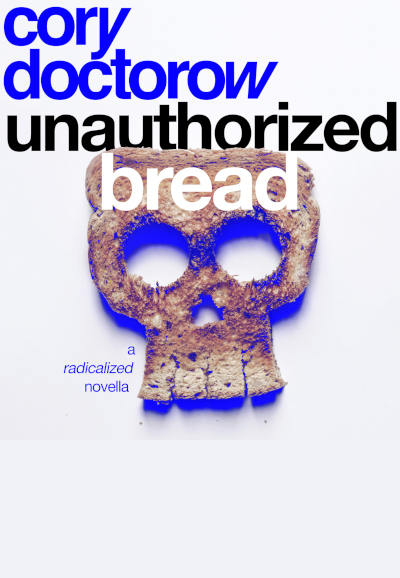
Hugo nominators! My story “Unauthorized Bread” is eligible in the Novella category and you can read it free on Ars Technica: https://arstechnica.com/gaming/2020/01/unauthorized-bread-a-near-future-tale-of-refugees-and-sinister-iot-appliances/

Upcoming appearances:

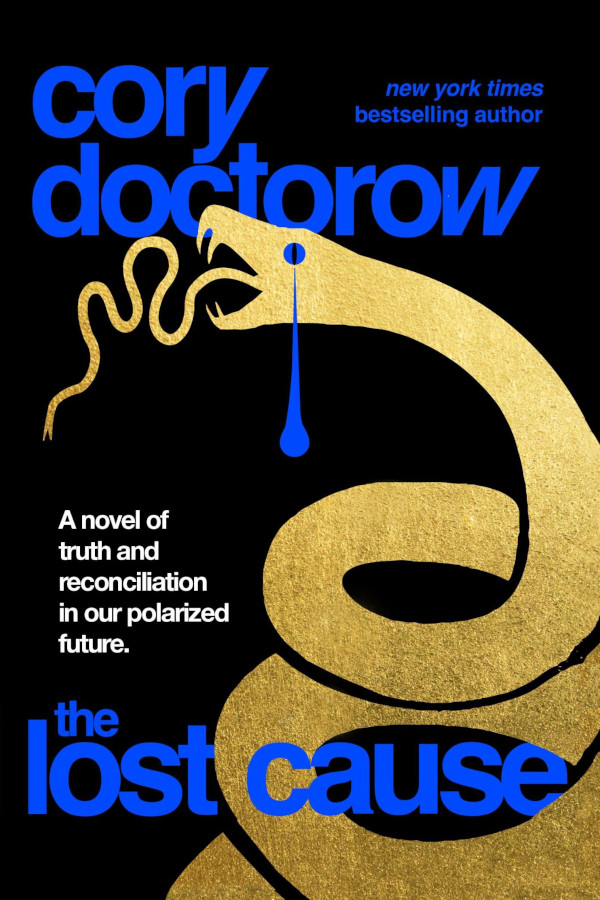
Currently writing: I just finished a short story, “The Canadian Miracle,” for MIT Tech Review. It’s a story set in the world of my next novel, “The Lost Cause,” a post-GND novel about truth and reconciliation. I’m getting geared up to start work on the novel now, though the timing is going to depend on another pending commission (I’ve been solicited by an NGO) to write a short story set in the world’s prehistory.

Currently reading: I finished Andrea Bernstein’s “American Oligarchs” this week; it’s a magnificent history of the Kushner and Trump families, showing how they cheated, stole and lied their way into power. I’m getting really into Anna Weiner’s memoir about tech, “Uncanny Valley.” I just loaded Matt Stoller’s “Goliath” onto my underwater MP3 player and I’m listening to it as I swim laps.

Latest podcast: Persuasion, Adaptation, and the Arms Race for Your Attention: https://craphound.com/podcast/2020/02/10/persuasion-adaptation-and-the-arms-race-for-your-attention/

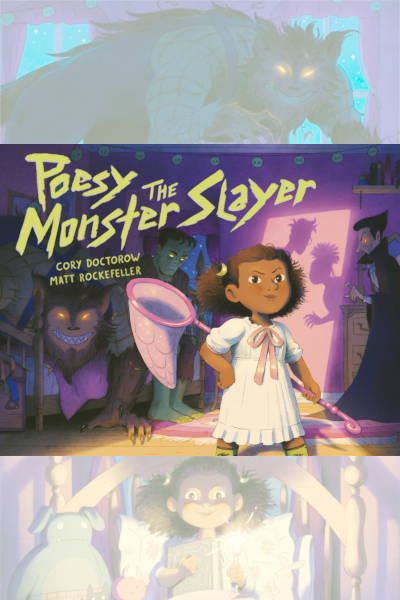
Upcoming books: “Poesy the Monster Slayer” (Jul 2020), a picture book about monsters, bedtime, gender, and kicking ass. Pre-order here: https://us.macmillan.com/books/9781626723627?utm_source=socialmedia&utm_medium=socialpost&utm_term=na-poesycorypreorder&utm_content=na-preorder-buynow&utm_campaign=9781626723627

(we’re having a launch for it in Burbank on July 11 at Dark Delicacies and you can get me AND Poesy to sign it and Dark Del will ship it to the monster kids in your life in time for the release date).

“Attack Surface”: The third Little Brother book, Oct 20, 2020.

“Little Brother/Homeland”: A reissue omnibus edition with a very special, s00per s33kr1t intro.