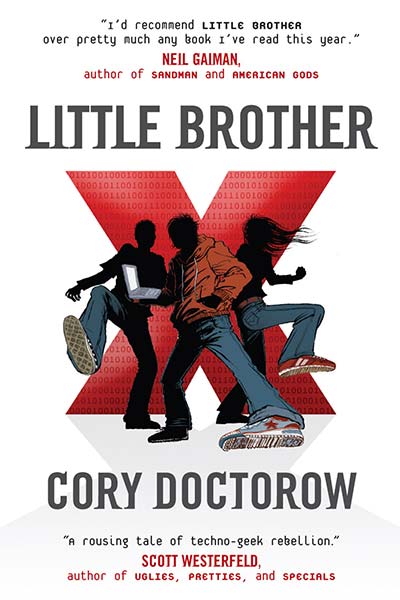
@Halvais, a fan of my novel Little Brother, has set up a wiki-style site with the full text of the book for group annotation with links and commentary. Sweet!
@Halvais, a fan of my novel Little Brother, has set up a wiki-style site with the full text of the book for group annotation with links and commentary. Sweet!
@Halvais, a fan of my novel Little Brother, has set up a wiki-style site with the full text of the book for group annotation with links and commentary. Sweet!
Here’s some more pieces of that interview I did with the At Your Library folks on media literacy, activism and libraries.

The Robot Comics folks have been industriously converting my Creative Commons licensed IDW graphic novel, Cory Doctorow’s Futuristic Tales of the Here and Now (which collects six of my short stories adapted to comics form by an array of talented writers and editors) to a multiplicity of mobile phone platforms.
This is all under the auspices of the CC license and all the resulting comics are free — there’s stuff for Android, the Nintendo DSi, and the iPhone/iPod Touch (Apple finally caved and decided that the panel depicting an orc in a video-game being decapitated didn’t disqualify the comic of Anda’s Game from being included as a freebie in the iPhone store).
Cory Doctorow’s Futuristic Tales of the Here and Now reaches 60,000 downloads
Previously:
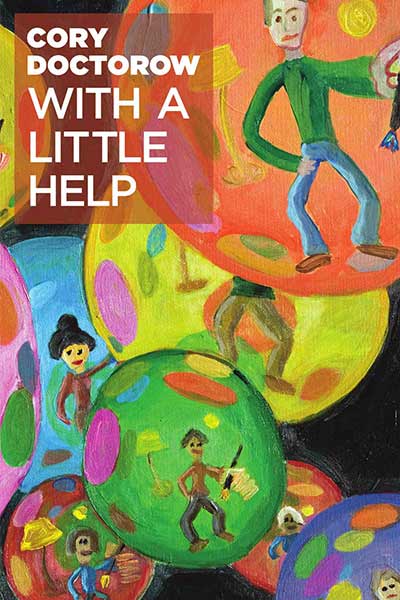
Here’s a transcript of an interview I did with Mur Lafferty at WorldCon on my WITH A LITTLE HELP project/stunt and various other writing things I’m up to:
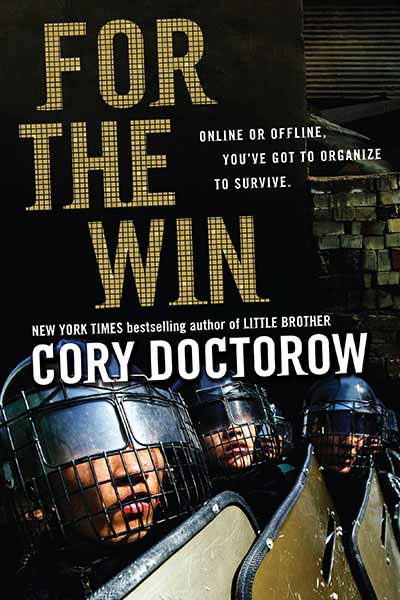
CD: For the Win’s almost done. It’ll be, I think they’re saying May 2010? Or March, one or the other. A month that starts with an “m” and is in the spring of 2010, provided I can turn it in on time, which is like the end of this month, I’m a little late with it. They’ve given me a little extension. It’s coming along pretty well and it’s nearly done, I’m just writing the climax now. And I’m pretty excited with how it’s turned out.
ML: And that’s YA like Little Brother?
CD: Young adult novel, like Little Brother. It’s a book, as you know, about union organizers who use video games to evade the restrictions on labor organizing in the developing world and special economic zones, and who organize gamers, gold-farmers, who then go on to unionize factory girls and so on. And it uses this conceit to explain some macroeconomic, cognitive economic, and behavioral economic ideas, in the same way that Little Brother used its conceit to explain cryptography, security, statistics, and risk.
Here’s an interview I conducted with the At Your Library folks on the role of libraries in activism, media literacy, and Creative Commons.
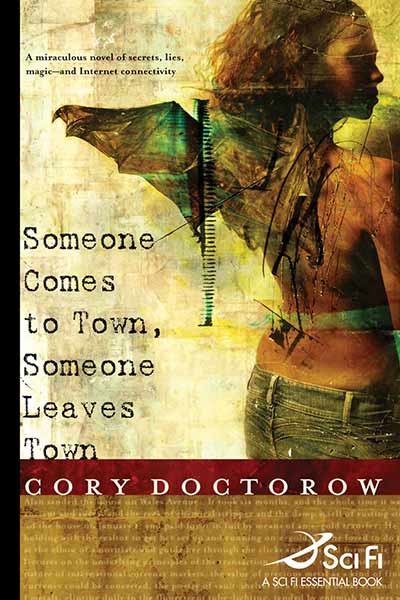
Here’s part thirty-two of my reading of my 2005 novel, Someone Comes to Town, Someone Leaves Town. Thanks to John Williams for mastering!
Mastering by John Taylor Williams: wryneckstudio@gmail.com
John Taylor Williams is a full-time self-employed audio engineer, producer, composer, and sound designer. In his free time, he makes beer, jewelry, odd musical instruments and furniture. He likes to meditate, to read and to cook.
My latest Guardian column, “Why free ebooks should be part of the plot for writers,” talks about how free ebook releases benefit well-known and obscure writers alike.
Releasing a book as a free download isn’t newsworthy in and of itself. It was, once upon a time, especially when that book had the backing of a major publisher. Publishers are often characterised as being conservative about the net, so it was surprising when it happened. These days, many writers have convinced their publishers to dip their toes in the water on this, and it’s simply not notable when it happens again.
Which is not to say that free downloads have no role when it comes to promotion, publicity and marketing. Their main effect is to magnify any good feeling your book has generated, by making it simple for people who love the book to get it under the nose of their social circle.
In Canada, the US and the UK, kids will be going back to school in a short while, so now’s a good time to remind you of the donation program for my books. Here’s how it works: teachers, librarians (and others, like people who work in family shelters, halfway houses, prisons, etc) indicate that they’d like copies of my books for their classes or collections. Then, people like you order copies and have them sent straight to the teachers. I pay someone who checks out each donation solicitation to make sure that it’s legit.
I do this in lieu of cash donations, because this has so many beneficial side effects: it registers as a sale, which means my publisher is happy; it supports booksellers (you can donate a copy from any bookseller that has a mail-order business), who are firmly on the side of the angels; it gets me a royalty and keeps my rapidly growing toddler in shoes and sailor suits; and, of course, it gets books into the hands of teachers, librarians, care-givers, case workers, and the kids, clients, and patrons they serve. It’s a win all the way around (and yes, I’m thinking of ways to automate and expand this program to include other authors, possibly through a charity that can issue tax-receipts to donors, which would be just so kick-ass).

We’ve given hundreds of books to schools, libraries and other worthy institutions this way. For years, readers have asked me if they can donate cash to me because they’ve downloaded my books and don’t need the physical objects. I’m really happy with this solution, even though to date it has made a small loss (it’s not cheap to pay someone a fair wage to hand-write all the web-pages, and vet all the solicitation).