The Yeti Stomper blog has a short interview with me today as part of their “Keeping an Eye On” series.
Here’s a video of Neil Gaiman reading my short story “The Right Book” at the World Science Fiction Convention last week; Neil did the reading for an ambitious short story collection publishing experiment I’m working on; we recorded audio too. The story was written for the 150th anniversary of Britain’s The Bookseller magazine — the brief was to imagine the next 150 years of bookselling. Neil did a wicked reading.
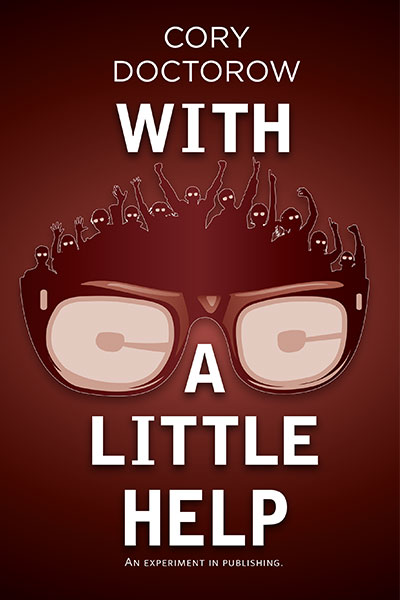
Here’s a short presentation I gave last week at the Minibar event in London, discussing my plans for a new open publishing experiment — a short story collection called WITH A LITTLE HELP.
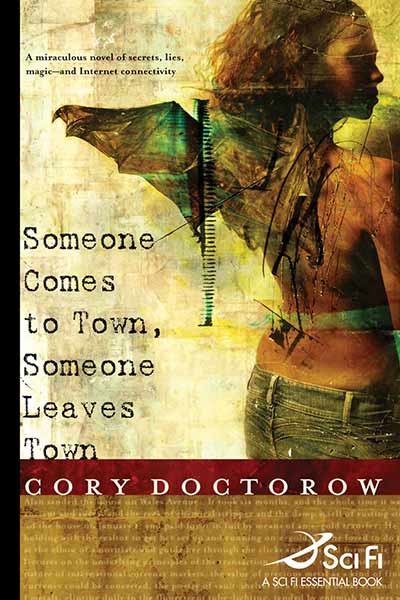
Here’s part thirty-one of my reading of my 2005 novel, Someone Comes to Town, Someone Leaves Town. Thanks to John Williams for mastering!
Mastering by John Taylor Williams: wryneckstudio@gmail.com
John Taylor Williams is a full-time self-employed audio engineer, producer, composer, and sound designer. In his free time, he makes beer, jewelry, odd musical instruments and furniture. He likes to meditate, to read and to cook.
David Wallace Jackson wrote a script that randomly changes the names of the characters in my 2005 Tor Books novel Someone Comes to Town, Someone Leaves Town — a book in which the characters’ names fluctuate, with only their first initials remaining constant. It’s an absolutely delightful idea!
David Wallace Jackson wrote a script that randomly changes the names of the characters in my 2005 Tor Books novel Someone Comes to Town, Someone Leaves Town — a book in which the characters’ names fluctuate, with only their first initials remaining constant. It’s an absolutely delightful idea!
The good folks at the StarShipSofa podcast have once again converted one of my columns to podcast form: Cheap Facts and the Plausible Premise (which appears in the latest Locus) also appears in this week’s podcast, #95, starting around the 9 minute mark. Nice stuff!
Here’s my Guardian review of Chris Anderson’s excellent new book, Free: The Future of a Radical Price. As with The Long Tail, Free gave me lots to think about: it does a tremendous job of enumerating the economic and business opportunities derived from the net’s capacity to deliver so much for free. However, I think that, as with The Long Tail, Free stops short of considering one of the most important aspects of the net: the extent to which purely non-economic, non-commercial activity is filling in niches that were formerly reserved for commercial undertakings, or were altogether invisible.
There’s plenty in our world that lives outside of the marketplace: it’s a rare family that uses spot-auctions to determine the dinner menu or where to go for holidays. Who gets which chair and desk at your office is more likely to be determined on the lines of “from each according to his ability, to each according to his need” than on the basis of the infallible wisdom of the marketplace. The internally socialistic, externally capitalistic character of most of our institutions tells us that there’s something to the idea that markets may not be the solution to all our problems.And here’s where Free starts to trip up. Though Anderson celebrates the best of non-commercial and anti-commercial net-culture, from amateur creativity to Freecycle, he also goes through a series of tortured (and ultimately less than convincing) exercises to put a dollar value on this activity, to explain the monetary worth of Wikipedia, for example.
And there is certainly some portion of this “free” activity that was created in a bid to join the non-free economy: would-be Hollywood auteurs who hope to be discovered on YouTube, for example. There’s also plenty of blended free and non-free activity
But for the sizeable fraction of this material – and it is sizeable – that was created with no expectation of joining the monetary economy, with no expectation of winning some future benefit for its author, that was created for joy, or love, or compulsion, or conversation, it is just wrong to say that the “price” of the material is “free”.

Chris Anderson’s Free adds much to The Long Tail, but falls short
Here’s part thirty of my reading of my 2005 novel, Someone Comes to Town, Someone Leaves Town. Thanks to John Williams for mastering!
Mastering by John Taylor Williams: wryneckstudio@gmail.com
John Taylor Williams is a full-time self-employed audio engineer, producer, composer, and sound designer. In his free time, he makes beer, jewelry, odd musical instruments and furniture. He likes to meditate, to read and to cook.